Giving AI Agents Their Own Inbox: The Promise and Peril of BlinkInbox
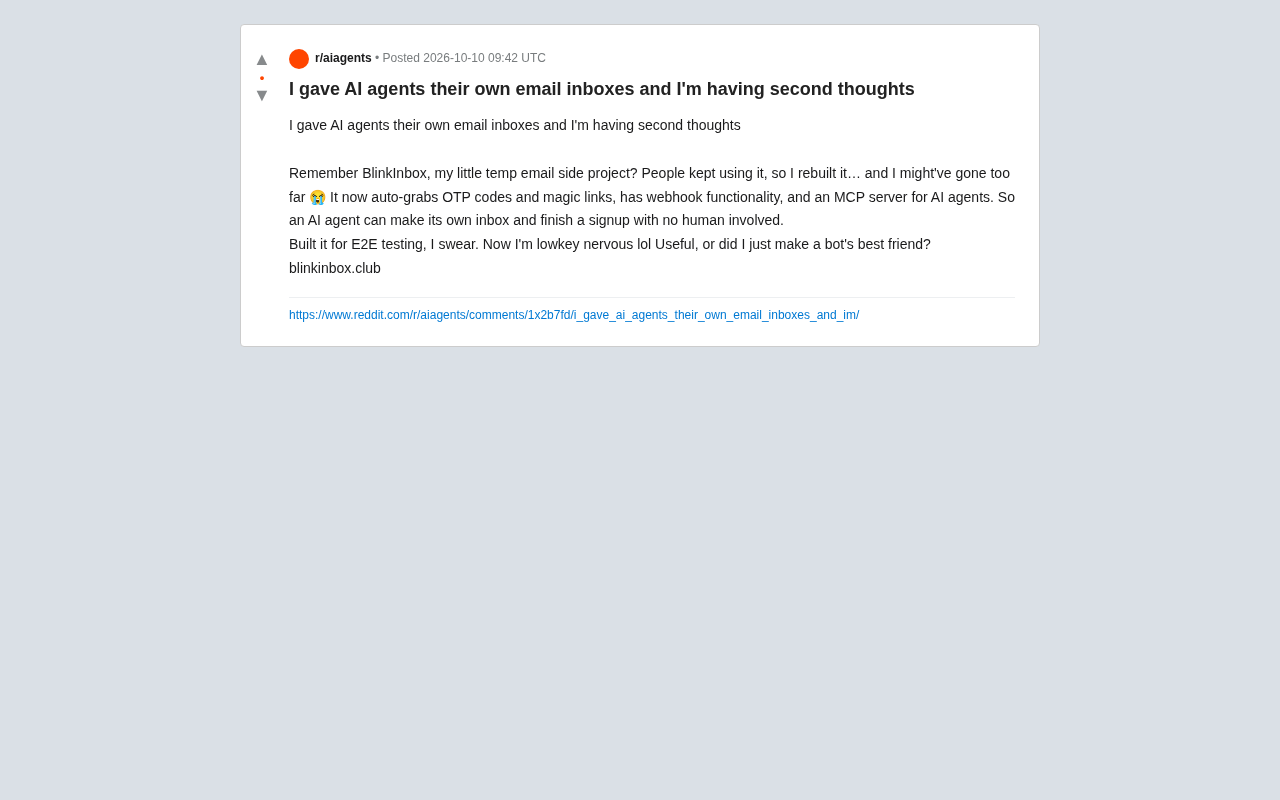
BlinkInbox evolved from a temp email tool into AI agent infrastructure for automated verification — raising both testing utility and abuse concerns.
BlinkInbox started as a simple disposable email service but was rebuilt to automatically extract OTP codes and magic links, support webhook callbacks, and offer an MCP server for AI agents. The result: agents can create inboxes, receive verification codes, and complete full registration flows with zero human involvement. While the stated use case is E2E testing automation, the same capabilities are readily available for bulk account farming, bypassing bot detection, and large-scale fraud. Even the author admits he's "lowkey nervous." The case illustrates a broader tension in the AI agent era: standards like MCP make it trivially easy to combine tools into powerful automation pipelines, while ethical guardrails and platform defenses struggle to keep pace.
From Hobby Project to Something Much Bigger
Some of the most useful tools in the developer community start as throwaway side projects. BlinkInbox began as exactly that — a simple temp email service for generating disposable email addresses. But when the author noticed users kept coming back, he decided to rebuild it from scratch and expand the feature set significantly. The result may have gone further than he anticipated.
In his own words on Reddit, the rebuilt BlinkInbox is no longer just a "catch verification codes" inbox. It now automatically extracts OTP codes and magic link login URLs, supports webhook callbacks, and offers a MCP server (Model Context Protocol) interface designed for AI agents.
This represents a meaningful capability leap: an AI agent can now create its own inbox, receive its own verification codes, and complete an entire registration flow — entirely without human involvement.
What Problem Does This Actually Solve?
To understand the value here, it helps to break down what each component does.
Automatic OTP and Magic Link Extraction
Nearly every modern registration flow requires email verification — either a one-time passcode (OTP) or a magic link you click to log in. For automated testing, this step has always been the biggest bottleneck: getting a machine to "read an email, extract the code, and fill it back into the form" is notoriously painful. BlinkInbox automates this entire step, effectively unlocking the hardest-to-automate part of any registration flow.
OTPs (One-Time Passwords) are typically 4–8 digit codes sent to a user's email or phone during registration or login. They expire quickly — usually within 1–10 minutes — and are single-use. Magic links take a different approach: the platform sends a URL containing a unique token to the user's inbox, and clicking it completes authentication without a password. Both methods share a core assumption: that a human can see the email and act on it manually. Traditional automation frameworks like Selenium and Playwright can simulate browser interactions, but reading external email and extracting dynamic codes has always been a wall — one usually worked around with dedicated test email accounts or mock mail servers. BlinkInbox solves this at the root by parsing real emails into structured data and exposing them via API.
Webhook and MCP Server
Webhooks let the inbox push notifications to your system the moment a new email arrives, enabling real-time programmatic responses. The MCP server taps into a rapidly growing standard for agent-to-tool communication, allowing AI agents to invoke external services in a standardized way. Together, these give an AI agent the ability to own and operate a real email inbox.
The author is explicit that this was built for end-to-end (E2E) testing. In E2E test scenarios, test scripts genuinely need to simulate a full user journey — registration, verification, login — and a mail service that handles verification emails automatically can significantly reduce the time spent writing and maintaining those tests.
MCP (Model Context Protocol) is an open standard proposed by Anthropic in late 2024, designed to unify how AI models interface with external tools and data sources. Before MCP, each AI application typically needed custom adapters for every tool it used — expensive to build and hard to reuse. MCP functions a bit like USB for the hardware world: once a tool provides a compliant MCP server, any compatible AI agent framework (Claude, various agent SDKs, etc.) can use it out of the box. This is why more and more developers are adding MCP server support to their services — it's an instant on-ramp into the entire agent ecosystem. For BlinkInbox, offering an MCP server means any MCP-compatible AI agent can use it directly, with zero additional integration work.
The Author's Own Second Thoughts
What makes this Reddit post genuinely interesting isn't the feature list — it's the author's visible ambivalence. He half-jokes: "Built it for E2E testing, I swear. Now I'm lowkey nervous lol," before posing the question that lingers: "Is this a useful tool, or did I just build a bot's best friend?"
That hesitation isn't performative. When a tool enables an AI agent to register for any service with zero human involvement, it is, by design, a double-edged sword.
The Real-World Abuse Risks
- Bulk account creation and freebie farming: Auto-generated inboxes combined with automated verification is ideal infrastructure for churning through free tiers, trial credits, and promotional offers.
- Bypassing bot detection: Email verification is one of the mechanisms platforms use to filter out automated actors. Tools like this erode that line of defense.
- Fake accounts and fraud: Unattended registration at scale is a natural fit for manufacturing large volumes of fraudulent accounts.
In other words, the capabilities designed for legitimate testing are equally available to bad actors who want to use them for exactly the wrong reasons — which is the root of the author's "second thoughts."
The Ethical Gray Zone of Automation Tools
BlinkInbox's situation is, in many ways, a microcosm of where the AI agent ecosystem stands right now. As standards like MCP make it increasingly easy for agents to reach out and interact with real-world services, the frontier of "what an agent can do" is expanding rapidly — while the rules governing "what an agent should be allowed to do" lag far behind.
Temp email services have always occupied neutral ground — they protect user privacy, reduce spam exposure, and have also long been used to sidestep single-use registration limits. The real variable is the degree of automation. When a human still has to manually copy a verification code, that step acts as a natural rate bottleneck. Once that step is delegated to an agent, the threshold for large-scale abuse drops significantly.
For tool authors, a few mitigation directions are worth considering:
- Apply rate limits and usage quotas to MCP / API calls
- Require API keys and maintain auditable usage logs
- Emit signals that target platforms can identify and block (e.g., a consistent, recognizable email domain)
- Explicitly prohibit fraudulent use in the terms of service
From an architectural standpoint, temp email services undermining identity verification defenses isn't a new problem — scripted temp email abuse long predated the rise of AI agents. What changes the risk profile is the "emergent combination" effect that protocols like MCP enable: when a disposable inbox tool, a browser automation tool, and a proxy IP tool each expose an MCP server, an AI agent can chain them together into a complete automated abuse pipeline without writing a single line of glue code. This "tools as services, agent as orchestrator" architecture dramatically lowers the bar for building capabilities that once required specialist knowledge to assemble. Platform-side defenses — CAPTCHAs, device fingerprinting, behavioral analysis — are facing a new wave of pressure, and defenders are, as usual, playing catch-up.
A Closing Thought
The BlinkInbox story is a reminder that in the age of AI agents, a feature added almost as an afterthought can instantly redefine what a tool fundamentally is. It's both the instrument E2E testing engineers have been waiting for and a potential seedbed for automated abuse at scale.
The author's question — "useful tool, or a bot's best friend?" — has no clean answer. But it cuts to a tension that developers across the ecosystem are increasingly confronting: the speed at which we can release technical capabilities is outpacing our ability to reason through their societal implications. This isn't a problem unique to one temp email project. It's a question every tool that empowers AI agents needs to take seriously.
Related articles

The Other Side of the Agricultural Revolution: How Disease Helped Farmers Defeat Hunter-Gatherers
Historian Kyle Harper explains how agricultural societies defeated hunter-gatherers: not only through population growth from superior energy extraction per unit of land, but also through pathogens bred by settled life that caused extra mortality during expansion—a dual replacement mechanism.

Why Is AI-Generated Language So Hard to Understand?
Why is AI-generated language fluent yet hard to understand? Based on a Hacker News discussion, this article analyzes the cognitive load of AI text from three angles—imbalanced semantic density, lack of common ground, and side effects of alignment training—and offers practical advice for getting along with AI language.

Progressive Disclosure Makes Agents 2.3x Faster: A New Approach to Context Engineering
A Hacker News discussion proposes using progressive disclosure to optimize AI agent context, achieving a 2.3x speedup. This article analyzes the three performance costs of context bloat and introduces practical approaches such as layered tool catalogs, on-demand retrieval, and history compression, along with implementation considerations.