Glasswing's Seven-Month Study: Why Open Source Maintainers Are Disappointed
Glasswing's Seven-Month Study: Why Ope…
Glasswing ran seven months but produced little, exposing the burden and goal mismatch external research places on open source maintainers.
Using a Hacker News discussion as a lead, this article analyzes why the Glasswing study disappointed open source maintainers. The seven-month project engaged maintainers extensively but was criticized for conclusions lacking novelty and practical value, creating a "heavy burden, light output" mismatch. The article argues maintainers contribute unpaid time, so sustained research requests drain scarce energy, while they expect actionable improvements rather than academic descriptions. It recommends maintainer-centered design, shorter cycles, upfront expectation alignment, actionable findings, and transparent feedback loops.
Introduction
In the open source ecosystem, it's not uncommon for external research teams to survey project maintainers. But a study called Glasswing, after running for seven months, left the maintainers who participated feeling disappointed. According to discussions on Hacker News, the study was criticized as "Overwhelming maintainers with Underwhelming findings"—meaning it placed a huge burden on maintainers while producing only disappointing conclusions. Drawing on this lead, this article analyzes how external research affects open source maintainers, and why seemingly well-intentioned studies can backfire.
Background: The Origins and Process of the Glasswing Study
According to the Hacker News post title and community discussion, the Glasswing project lasted seven months, during which it engaged extensively with open source maintainers. Although the original material did not disclose the specific research methods, the phrase "Overwhelming maintainers" suggests that maintainers invested considerable time and energy in participating.
Open source maintainers typically manage projects unpaid in their spare time, so any additional surveys, interviews, or data collection cut into their already scarce energy. A seven-month cycle means the burden was not a one-time event but a sustained interruption.
The scarcity of maintainer time can be understood through the nature of unpaid labor. The vast majority of open source maintainers are not employed by their projects but rather invest time outside their day jobs. According to multiple community surveys (such as GitHub's Open Source Survey), maintainers often spend more than 10 hours per week on project management, code review, and issue responses, with no direct financial return. This "volunteer investment" model means that any external request—whether a survey, an interview, or a data export—competes for the same time budget as core work like code maintenance and community support. When a research cycle stretches to seven months, maintainers must repeatedly switch context and re-explain project background, and the cumulative cost of this fragmented interference far exceeds that of a single long interview.
Maintainers' Disappointment: Input Disproportionate to Output
The core reason maintainers felt disappointed is that the research output failed to match their investment. The phrase "Underwhelming findings" in the post title points directly to conclusions that lacked novelty or practical value. Maintainers expected external research to deliver actionable insights—for example, how to improve project governance, attract contributors, or cope with security pressures.
When research results merely restate the obvious or remain at the level of abstract academic discussion, maintainers naturally feel their time was wasted. This disappointment is also reflected in the Hacker News comment section—although the number of comments was small (6), the post title itself conveyed a strong negative signal.
Actionable insight in the context of open source research refers to findings that can be directly translated into maintainer decisions or actions—for example, "adding a contribution guide to the project README can increase first-contribution conversion by X%" or "adopting a certain type of automation tool can reduce maintenance burden by Y%." By contrast, descriptive conclusions such as "maintainers generally feel exhausted"—while true—offer no incremental value because maintainers are already living that reality. Academic research tends to be oriented toward theoretical contribution, while maintainers judge by practical utility; the two have a systematic divergence in their definitions of "valuable." Glasswing was called "Underwhelming" likely precisely because its output stayed at the descriptive level and failed to cross the threshold from "known" to "usable."
Lessons for the Open Source Community
Research Design Should Be Maintainer-Centered
The Glasswing case reminds research teams that when designing projects involving the open source community, they should factor in maintainers' time costs. Reducing unnecessary interactions, shortening research cycles, and clearly stating upfront the practical value the research will deliver are all ways to ease the burden.
Conclusions Should Be Actionable
Maintainers are often motivated to participate in research by the hope of improving their projects. If research conclusions cannot be translated into concrete action recommendations or tools, then even the most rigorous methods will struggle to win community acceptance. Research teams should align expectations with maintainers at the start of the project to avoid a final output that is disconnected from needs.
Transparent Communication and a Feedback Loop
During a seven-month research cycle, maintainers may not have been clear about the research progress and final use. Establishing regular communication mechanisms so maintainers understand how the research is being used, and providing feedback channels afterward, can help reduce disappointment.
A feedback loop in participatory research refers to a complete cycle of "inform—participate—give back" between the research team and participants. Research lacking a loop is common in academic settings: researchers collect data and publish papers, while participants never learn the conclusions, let alone benefit from them. In open source communities, this one-way extraction is especially sensitive because maintainers have long faced all kinds of "take-only" surveys. Concrete ways to build a loop include: signing a brief value commitment at the start of the study (such as promising a public summary or a tool prototype), regularly sharing progress during the research, publishing conclusions in language maintainers can understand at the end, and clearly stating which recommendations can be directly implemented. A loop is not only an ethical requirement but also affects future participation rates—maintainers who have been let down are more likely to decline the next request.
Community Reaction and Discussion
Although the Hacker News discussion had a limited number of comments, the title itself struck a chord. The open source maintainer community has long faced "research fatigue"—various academic projects, corporate surveys, and community polls keep appearing, but few give anything back to the projects themselves. This sentiment may be reflected in the comments, though the specific content was not provided.
From a broader perspective, the Glasswing incident reflects a tension between the open source community and external researchers: researchers need data to produce results, while maintainers need practical help. If this misalignment of goals is not reconciled, similar disappointments will recur.
Conclusion
The Glasswing study ran for seven months but failed to bring valuable findings to open source maintainers—instead adding to their burden. This case serves as a warning to any team attempting to study the open source ecosystem: respecting maintainers' time and ensuring research output has practical significance is the foundation for building a healthy relationship with the community. For maintainers, learning to filter and decline low-value research requests is also an essential skill for protecting their own energy.
One-line Summary
Glasswing ran for seven months but produced limited output, revealing the burden and goal misalignment that external research places on open source maintainers.
Paragraph Summary
Drawing on the Hacker News discussion, this article analyzes why the Glasswing study left open source maintainers disappointed. The study lasted seven months and involved extensive interaction with maintainers, but its conclusions were criticized as lacking novelty and practical value, creating a mismatch of "heavy burden, light output." The article points out that most open source maintainers contribute unpaid in their spare time, and sustained research requests cut into their scarce energy; meanwhile, maintainers expect actionable improvement recommendations, not academic descriptive conclusions. On this basis, the article proposes that external research should be maintainer-centered, shorten cycles, align expectations upfront, ensure conclusions are actionable, and establish transparent communication and feedback loops to reconcile the tension between researchers' and the community's goals.
Related articles
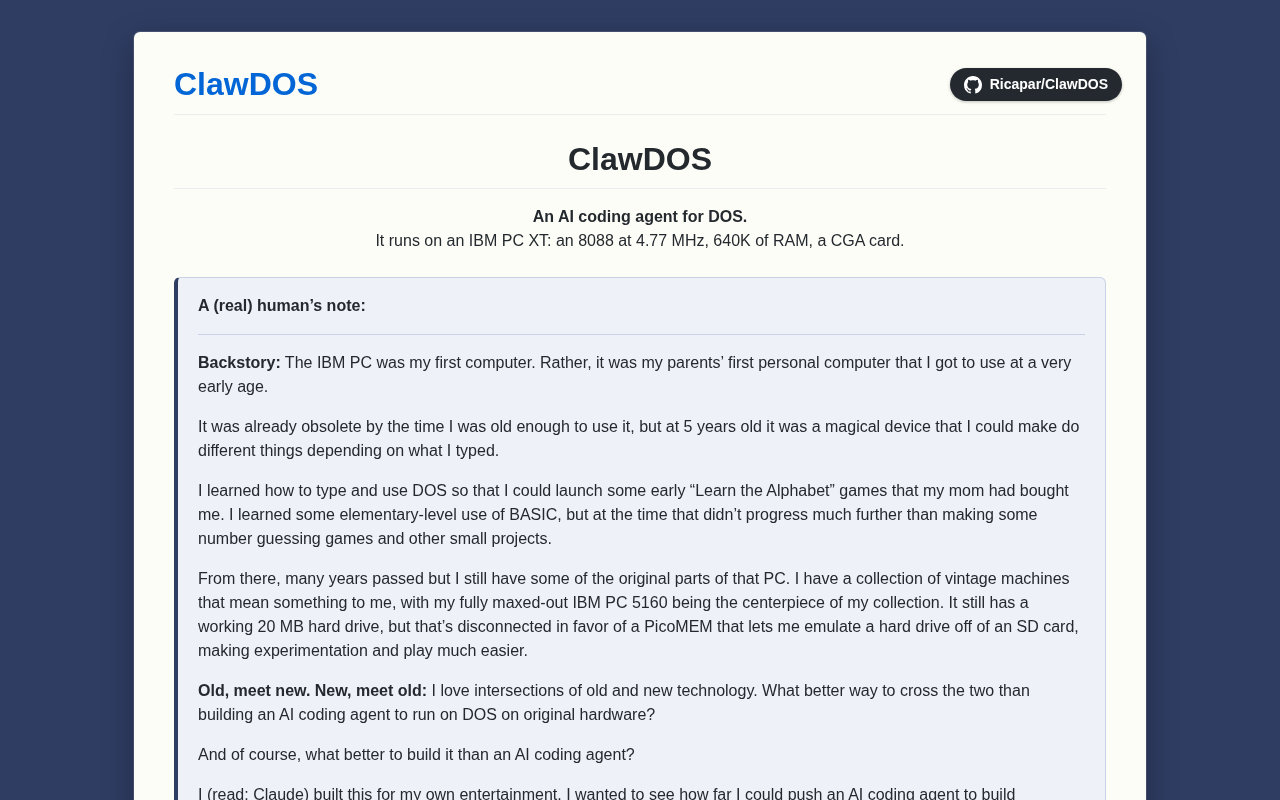
ClawDOS: Bringing AI Coding Capabilities to DOS
ClawDOS is an AI coding agent project for DOS, exploring the possibility of bringing AI coding assistance into resource-constrained retro computing environments. This article analyzes its positioning, use cases, and community response.

Baseten Releases Bison-1 and Groundhog-1, Topping the Decision Model Leaderboard
Baseten releases open-weight decision models bison-1 and groundhog-1 built on Gemma 4; bison-1 scores 76 on the AA Decision Index v2.1 to top the leaderboard. Both support 128k context and image input—here we analyze their capability combination, benchmark significance, and selection advice for developers.

Cline CLI v3.0.75 Released: Yolo Mode Now Default for One-Shot Runs
Cline CLI v3.0.75: one-shot runs now default to yolo mode, --timeout and Ctrl+C can interrupt the first round, read_files is no longer truncated to 8k chars, plus reasoning parameter fixes and 94 new providers.