GLM-4 Open Source Strikes Back: The AI War Expands to Memory and Space Computing

China's GLM open-source AI, HBM memory scarcity, and space data centers redefine the AI industry's new battlefronts.
China's Zhipu AI has released a GLM open-source model that rivals GPT-5.5 and Claude on software benchmarks at just 15% of the cost, reportedly trained on Huawei Ascend chips. Meanwhile, HBM memory shortages are driving AI inflation into consumer electronics, PD disaggregation is extending GPU service life to a decade, and space data centers are emerging as a thermodynamically and economically serious alternative to ground-based infrastructure.
While we were still debating parameter counts and benchmark scores, the competitive dimensions of the AI industry have quietly expanded — from the cost-performance rise of Chinese open-source models, to a global scramble for HBM memory, to the seemingly audacious idea of moving data centers into orbit. This revolution is reshaping the entire fabric of human industry.
China's Open-Source AI Strikes Back: Stronger, Cheaper, Faster
Zhipu AI, founded in 2019 and spun out of the Knowledge Engineering Lab at Tsinghua University's Computer Science department, is one of China's most prominent large model companies. Its GLM series has been continuously iterated since 2022, placing it in direct competition with Western open-source models like Meta's LLaMA and Mistral. The release of Zhipu's latest flagship open-source model has sparked genuine anxiety in Silicon Valley. The model features an enormous parameter count, a million-token context window (roughly 750,000 English words — meaning it can process an entire book or complete codebase in one pass), and is fully open source.
The "open weights" model means anyone can download the model parameters and deploy them locally, without paying for API access — a fundamental departure from the commercial logic of closed-source models like GPT-4 and Claude.
In evaluations by Artificial Analysis (the Federated Intelligence Analysis Index), it topped the charts among all open-weight models. More critically, on software engineering benchmarks, it trails top closed-source models like GPT-5.5 and Claude by less than one percentage point — while costing just 15% of what GPT-5.5 charges.

What's really unsettling Silicon Valley is a pointed observation: Chinese models are "six months behind on model capability, 24 months behind on compute, but only a few months behind overall." "We're going to lose if this keeps up" — that sentence captures the core anxiety in American tech circles. Closed-source models are constrained by government approval processes, while China's open-source models are available to the world with no barriers.
The Silent Breakthrough in Domestic Chips
One signal worth noting: these models are reportedly trained on Huawei's Ascend 910D chips. Ascend is Huawei's self-developed AI training chip series, built on its in-house DaVinci architecture. US export controls have cut China off from high-end GPUs like the H100, H200, and B200 — which has paradoxically accelerated domestic compute R&D. The 910D is reportedly a further spec improvement, targeting parity with the NVIDIA H100. Ascend chips still lag NVIDIA in software ecosystem maturity (CANN framework vs. CUDA), but the gap is narrowing. The trend is clear — Chinese vendors are substituting domestic compute for NVIDIA, and they can already train models approaching the frontier.
This playbook mirrors what happened with solar panels, EVs, and lithium batteries: leverage domestic compute to push high-performance models at rock-bottom prices globally. Comparable quality, dramatically lower cost. That's the most penetrating logic in industrial competition.
HBM Memory: The Most Dangerous Supply Bottleneck in AI
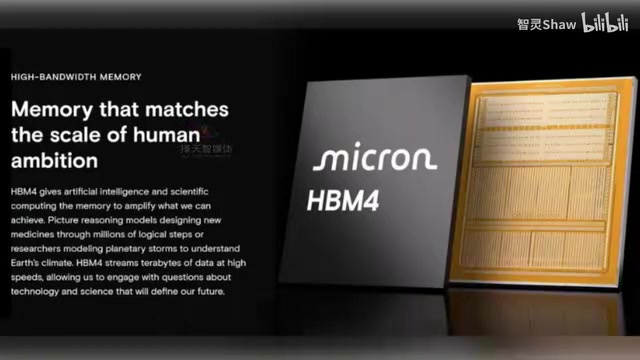
The AI industry is facing a severe chokepoint — HBM (High Bandwidth Memory) is in critically short supply. HBM is a packaging technology that vertically stacks multiple layers of DRAM chips using Through-Silicon Via (TSV) technology, then tightly integrates them with the GPU on the same package via a silicon interposer. Compared to conventional GDDR6 VRAM, HBM delivers 4–9x the bandwidth — HBM3e can reach 1.2 TB/s per stack — but costs orders of magnitude more.
During large language model inference, every single token generation requires reading the entire model weights from memory, making memory bandwidth a hard bottleneck on inference speed. This is the "Memory Wall" problem manifesting acutely in the AI era. The ultra-fast memory stacked alongside the GPU means memory capacity and bandwidth directly determine performance ceilings.
Only three companies in the world have HBM mass-production capability: Micron, SK Hynix, and Samsung. Their oligopoly exists because of the extreme barriers to HBM manufacturing: yield control and TSV precision requirements far exceed those of standard DRAM. Micron's latest earnings showed revenue quadrupling year-over-year, from $9 billion to $42 billion, beating expectations by 16%; its next-quarter guidance of $50 billion far exceeded the market's $43 billion forecast. This year's HBM capacity has been entirely sold out, sending the stock sharply higher.
"AI Inflation" Is Spreading to Consumer Electronics
Some analysts predict memory chips will account for 30–40% of cloud providers' capital expenditure — meaning hundreds of billions of dollars flowing directly into the memory industry. But the impact extends beyond capital markets. The memory shortage has spilled over into consumer electronics.
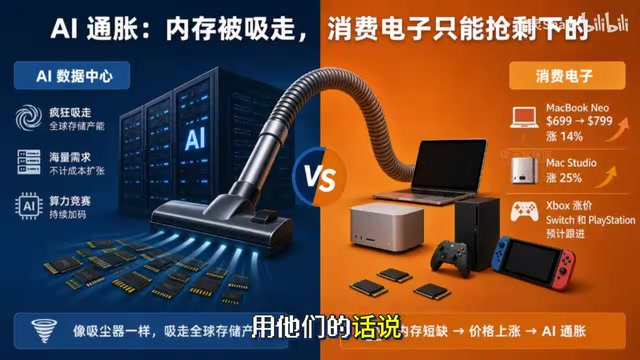
Apple has announced significant price hikes: MacBook prices increased from $699 to $799 (a 14% jump), Mac Studio prices rose 25%, and Xbox prices followed suit. The root cause: AI data centers are vacuuming up global memory production capacity, leaving consumer electronics to fight over whatever's left. This is what's being called "AI inflation."
Space Data Centers: A Long-Term Bet on Compute Economics
Building a large AI data center on the ground requires roughly $35 billion in chip costs, plus $25 billion for power, cooling, and civil construction — totaling approximately $60 billion. The latter involves enormous human labor and will only keep rising over time.
But what if you deployed those same chips in orbit? The concept of space data centers is no longer science fiction — startups like Lumen Orbit and Starcloud are already in the engineering validation phase. Chip costs remain the same ($35 billion), but once Starship achieves full reusability, the cost per kilogram to orbit could fall from today's roughly $2,000 to under $100, bringing launch costs down to around $5 billion — for a total of just $40 billion.
More importantly, two fundamental advantages of the space environment rest on solid thermodynamic ground: orbital solar intensity is approximately 1,361 W/m² with no atmospheric attenuation, far superior to ground conditions, making solar power essentially free; in the vacuum of space, radiative heat dissipation is highly efficient, allowing servers to cool passively through radiative cooling panels with no cooling water or air conditioning required. The average PUE (Power Usage Effectiveness) of current ground-based data centers is around 1.5 — meaning 1.5 kWh consumed for every 1 kWh of actual computation — while theoretical PUE in space approaches 1.0. This means the two largest operational costs effectively drop to near zero.
Launch costs keep falling; ground infrastructure costs keep rising — these two curves will eventually cross. Space data centers may sound fantastical, but behind the idea lies a serious economic calculation.
PD Disaggregation: Extending GPU Service Life to a Decade
A key architectural trend is emerging in AI inference — PD disaggregation (Prefill-Decode separation), first proposed in academia and later deployed in production by companies like ByteDance and Microsoft. The core idea is to split inference into two distinct phases:
- Prefill: Understanding the input content — a parallel, compute-intensive task (similar to matrix multiplication) with high arithmetic intensity, heavily dependent on memory capacity
- Decode: Generating the response token by token — a strictly serial autoregressive process that produces only one token per step, with extremely low arithmetic intensity, heavily dependent on memory bandwidth

The decode phase can be handed off to inference chips specifically optimized for extremely low arithmetic intensity — such as Groq (LPU, Language Processing Unit) or Cerebras (WSE, Wafer Scale Engine) — while the prefill phase can be handled by older H100s and A100s. The deeper significance of this heterogeneous deployment strategy is that "older" GPUs like the H100 and A100 can focus on Prefill without being retired, meaning the actual service life of a GPU could extend from two or three years to seven to twelve years. This dramatically lengthens the depreciation schedule for hundreds of billions of dollars in hardware assets, fundamentally improving the financial model for AI infrastructure investment and making it far easier to finance.
The Biggest IPO in History: Sailing Into Uncharted Waters
The planned IPOs of OpenAI and Anthropic are expected to be the largest in tech history. The combined potential market cap of the two companies is approximately $4 trillion, but the actual float will be small — around 5%, or $150–$200 billion. That scale is entirely digestible for capital markets.
The real challenge lies in the valuation logic. Both companies are in a phase of "rapid revenue growth but significant losses," rendering traditional P/E valuation methods completely useless. Markets will have to rely on revenue multiples (P/S) or more forward-looking "potential market share" narratives. OpenAI also carries unique corporate governance complexity — its "Capped Profit" structure and non-profit parent company architecture are undergoing restructuring; Anthropic has Google and Amazon as strategic shareholders, making its post-IPO equity structure equally complex. The closest historical comparisons are Google's 2004 IPO and Facebook's 2012 IPO, but both were a fraction of the scale being discussed here. When these stocks migrate from private to public markets, where will the pricing anchor be? As one widely circulated description puts it: "We are sailing into waters for which there are no charts."
Conclusion: The Race Is Far From Over
The United States still holds the strongest chip design capabilities, the most mature capital markets, and the grand engineering vision exemplified by SpaceX. But China is also moving fast — the cost advantages of open-source models and the quiet breakthrough of domestic compute are continuously reshaping the competitive landscape.
From GPUs to HBM, from PD disaggregation architectures to space data centers, the frontlines of the AI revolution have expanded far beyond algorithms alone. This race is nowhere near its final chapter.
Related articles

Apple HomeView Hands-On Review: Is the $300 Smart Home Hub Worth It?
Apple HomeView hands-on: a $300 smart home hub with facial recognition for quick account switching, but no App Store or voice recognition. Is the wall-mounted version worth it? Should you buy the first generation?

Meta Muse Wonder Launch: What It Means for Meta's Return to the Frontier AI Race
Meta releases Muse Wonder and WonderFull, benchmarks reach the frontier, community feedback is polarized. An in-depth look at Meta's return to the frontier AI race, its personal agent strategy, and Zuckerberg's different path.

Apple Home Smart Home Lineup Leaked: LG and Schneider Team Up, UWB Door Lock on Board
Apple Home ecosystem gains new LG and Schneider devices: UWB smart lock with proximity unlock, 2.5K dual-camera doorbell, privacy indoor camera, and AirPods-like seamless pairing.