GLM-5.3 Released: How Post-Training Scaling Is Reshaping AI Coding Capabilities

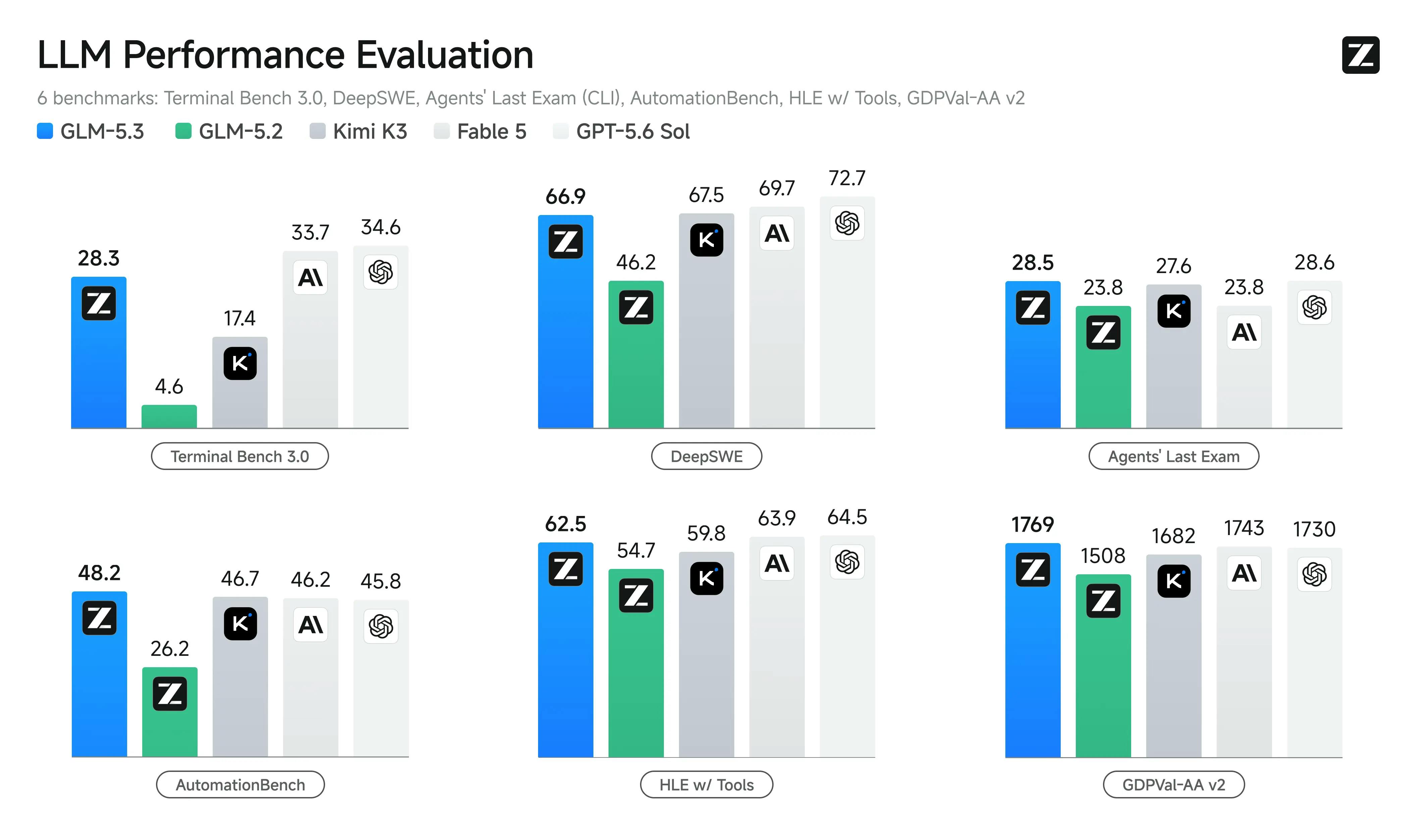
GLM-5.3 achieves open-source SOTA in agentic coding through massive post-training scaling on the same base model.
Z.ai's GLM-5.3 demonstrates that massive post-training scaling can deliver breakthrough coding capabilities without changing the base model. The model claims open-source SOTA on agentic coding tasks and shows emergent abilities in vulnerability discovery and cyber defense. This validates post-training as a cost-effective alternative to expensive pre-training scaling, offering data-sensitive enterprises a viable local deployment option approaching closed-source performance.
GLM-5.3: A Leap in Coding Ability on the Same Foundation Model
Z.ai recently released its next-generation large language model, GLM-5.3, focused on improving performance for complex, long-horizon programming tasks. Unlike the conventional approach of swapping out or scaling up the pre-training foundation to boost performance, GLM-5.3's core highlight is that it achieves a dramatic leap in coding ability through massive post-training scaling on top of the same base model.
According to its Product Hunt listing, GLM-5.3 has reached open-source SOTA (state-of-the-art) performance on agentic coding tasks and has demonstrated emergent capabilities in vulnerability discovery and cyber defense scenarios. The product currently sits at #5 on Product Hunt's daily leaderboard with 93 upvotes, categorized under Open Source, Artificial Intelligence, and Developer Tools.
Post-Training Scaling: A Technical Approach Under Fresh Scrutiny
Over the past two years, the industry's focus on improving model capabilities has been gradually shifting from simply stacking pre-training data and parameter scale toward fine-grained refinement during the post-training phase. GLM-5.3's naming and positioning perfectly reflect this trend—it explicitly emphasizes that the upgrade was achieved "on the same foundation model."
Why Post-Training Scaling Deserves Attention
Post-training scaling means that specific task performance can be significantly improved without the prohibitively expensive process of re-doing pre-training. For scenarios like programming—where objectives are well-defined and can be optimized through reinforcement learning and high-quality feedback signals—post-training often delivers immediate, tangible results.
To understand the technical implications of post-training scaling, it helps to contrast it with the pre-training phase. Pre-training typically involves unsupervised learning on trillions of tokens of text data, with compute costs easily reaching tens of millions of dollars. The post-training phase, on the other hand, encompasses supervised fine-tuning (SFT), reinforcement learning from human feedback (RLHF), and the more recently emerged reinforcement learning from code execution feedback—for example, using unit test pass rates as reward signals to guide the model toward generating more correct code. OpenAI's o1 series first validated the effectiveness of investing more compute during inference time and post-training, while Meta's Llama series and DeepSeekAd have also adopted large-scale reinforcement learning during post-training to enhance math and coding abilities. From an economic perspective, post-training compute costs are typically 1/10 to 1/100 of pre-training costs, yet the improvements on specific tasks can be remarkably significant—this is the fundamental reason this approach is being re-evaluated.
The underlying logic is this: the base model already possesses broad knowledge and reasoning potential, and the role of post-training is to "align" that potential to specific tasks—especially agentic coding tasks that require multi-step planning, tool use, and long-context maintenance.
This also explains why GLM-5.3 can achieve breakthroughs on "long-horizon programming tasks." Long-horizon tasks refer to complex work that requires spanning multiple steps, continuously maintaining state, and dynamically adjusting strategies based on intermediate results—such as autonomously completing the development, debugging, and integration of a feature module. These tasks pose multiple technical challenges for AI systems: first, context management—a complete feature module development might involve modifications across dozens of files and thousands of lines of code, requiring the model to maintain consistency across extremely long context windows; second, error propagation—small errors in early steps get amplified in subsequent steps, requiring the model to possess backtracking and correction abilities; third, planning capability—the model needs to decompose macro-level goals into executable sub-task sequences and dynamically adjust plans during execution. When training these capabilities within a reinforcement learning framework, the core challenge is reward sparsity: final feedback is only available after the entire task is completed, with intermediate steps lacking clear reward signals. Common industry solutions include Process Reward Models and Monte Carlo Tree Search (MCTS). These tasks are precisely where traditional models fall short, and they represent the key focus areas for post-training reinforcement.
Emergent Capabilities in Agentic Coding and Security
GLM-5.3's two major capability labels deserve separate discussion: open-source SOTA in agentic coding, and emergent capabilities in vulnerability discovery and cyber defense.
Agentic Coding: A New Benchmark for the Open-Source Camp
Claiming "open-source SOTA" is a weighty positioning statement. It means that among publicly available models, GLM-5.3 holds a leading position in code generation, code comprehension, and autonomously completing tasks as a coding agent.
It's important to understand that agentic coding is one of the most significant paradigm shifts in the AI programming domain during 2024-2025. Unlike traditional code completion (such as GitHub Copilot's early form), agentic coding requires the model to possess autonomous planning, environment interaction, and error recovery capabilities. A typical agentic coding workflow includes: understanding user requirements → decomposing tasks → writing code → executing code → observing results → fixing errors → iterative optimization. The mainstream benchmarks for evaluating these capabilities include SWE-bench (which requires models to autonomously fix issues in real GitHub repositories), SWE-bench Verified, and HumanEval. Currently, the closed-source representatives in this field include Anthropic's Claude Code and OpenAI's Codex CLI, while the open-source camp's previous SOTA was typically held by DeepSeek-Coder and Qwen-Coder series.
For developers and enterprises, open-source SOTA means providing a high-performance option that doesn't depend on closed-source APIs and can be self-deployed and customized—this is particularly important for data-sensitive teams. In the AI programming tools space, a significant capability gap has long existed between open-source and closed-source models. The closed-source camp has dominated benchmark leaderboards thanks to more abundant compute resources and more refined safety alignment. The core value of open-source models manifests across three dimensions: data sovereignty (enterprises can deploy locally, avoiding code leakage risks), customization flexibility (can be fine-tuned for specific codebases), and cost controllability (no per-API-call charges). For industries with extremely high data security requirements—such as finance, defense, and healthcare—open-source models are virtually the only acceptable solution. If GLM-5.3 has indeed achieved open-source SOTA level, it means developers in these industries have, for the first time, a localized option approaching the coding capabilities of closed-source models.
Emergent Capabilities in Security
Even more intriguing is the emergent capability GLM-5.3 has demonstrated in vulnerability discovery and cyber defense. "Emergent" here means these capabilities were not specifically trained objectives, but rather naturally surfaced as byproducts once the model's capability scale crossed a certain threshold.
Emergent capabilities are one of the most controversial concepts in large language model research. The concept was first systematically articulated by Jason Wei et al. at Google Research in 2022, referring to capabilities that don't exist in smaller models but suddenly appear when model scale exceeds a certain critical point. Notably, follow-up research from Stanford in 2023 challenged the definition of emergence, arguing that so-called "emergence" might merely be an artifact of evaluation metric selection—if continuous evaluation metrics are used instead of binary correct/incorrect judgments, capability improvements often show smooth curves rather than sudden jumps. In the context of GLM-5.3, the "emergent capabilities" in security more likely mean that after extensive training on programming tasks, the model's depth of code understanding reached a level sufficient to identify security vulnerability patterns, rather than a truly discontinuous jump. Regardless of the underlying mechanism, this phenomenon itself still holds significant practical value.
This phenomenon is inherently research-worthy: when a model becomes sufficiently powerful in programming, it appears to naturally acquire the ability to understand code vulnerabilities and identify security risks. This opens new possibilities for AI applications in cybersecurity—from automated code auditing to proactive vulnerability mining to assisting in building defense systems.
Of course, the double-edged nature of these capabilities warrants vigilance: the same abilities, if misused, could also become tools for attackers.
Practical Implications for Developers and the Industry
From a practical standpoint, GLM-5.3's release adds a strong open-source competitor to the AI-assisted programming ecosystem. At a time when closed-source models dominate coding capability leaderboards, an open-source SOTA model focused on long-horizon programming tasks can lower the barrier for enterprises and individual developers to access high-quality AI coding capabilities.
From a technical trend perspective, GLM-5.3 once again validates the effectiveness of post-training scaling as an independent technical approach. It signals to the industry that, against the backdrop of ever-increasing pre-training costs, deepening post-training, alignment, and reinforcement learning may be a more cost-effective path to capability improvement.
One additional note: publicly available information about GLM-5.3 remains relatively limited, and its claimed SOTA performance and emergent capabilities still await further verification through third-party benchmarks and real-world usage. For developers following AI programming tools, it's worth staying tuned and reserving comprehensive judgment until more evaluation data and practical user feedback become available.
Conclusion
GLM-5.3 represents a new approach to enhancing large model capabilities: rather than chasing ever-larger foundations, it unlocks latent potential through massive post-training on an existing base. Its open-source leadership in agentic coding, combined with emergent capabilities in security, both demonstrates the direction of technical progress and raises new questions about capability boundaries and safety governance. For the broader open-source AI programming ecosystem, this is undoubtedly a significant milestone worth continued observation.
Related articles

GPT-Next Leak, Gemini 4 Argon Imminent: AI News Roundup
GPT-Next leak suggests extreme efficiency; OpenAI's 28-day shipping pledge boosts speed 50%; Gemini 4 Argon nears release; Anthropic subscription value report sparks debate.

GPT-Next Leaked, Gemini 4 Argon Speeds Up, Fable 5.5 May Launch Today
OpenAI's GPT-Next model leaks, expected to be extremely low-cost and possibly part of the 28-day release plan; Gemini 4 Argon internal testing accelerates, NanoBanana 2.1 is live; Semi Analysis tests show Claude Max's equivalent API value is about 5 times that of ChatGPT Pro; Fable 5.5 may launch today.

Gemini 4 Argon Launches Globally: Key Highlights from the AI Daily Brief
Google opens Gemini 4 Argon globally across Pro and Ultra subscriptions and the API, and demonstrates robot control. This article rounds up open-source models, Agent infrastructure, cost transparency, and safety governance updates.