GLM-5.4 Released: Loop Transformer Architecture Boosts Intelligence Without Extra Parameters — So Why Is It So Slow in Practice?
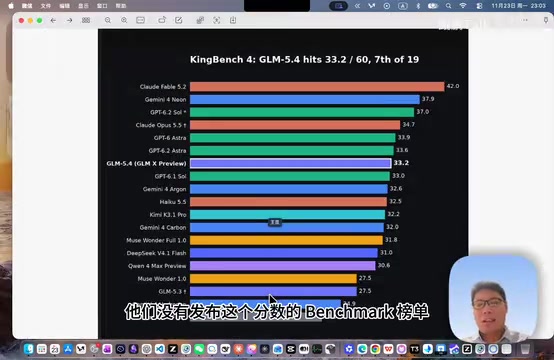
Zhipu GLM-5.4 uses Loop Transformer to boost capability without adding parameters, but speed and credibility controversies remain.
Zhipu AI released the non-open-source GLM-5.4 model, whose biggest highlight is the Loop Transformer architecture — multiple rounds of looped computation during inference improve output quality without increasing parameter count. Third-party evaluations show it surpasses GPT-6.1 and Gemlet 4 but lags behind top models such as Fable 5.2, and the leaderboard is unofficial and of questionable credibility. Users report limited perceived capability gains and slow speed with severe queuing as the biggest complaints; the official team acknowledges the model easily enters a repeated-thinking state. The article also criticizes official demos for lacking reproducibility and suggests open-sourcing prompts and agent configurations. On the positive side, the quota has been increased 1.5x, and Loop Transformer has been adopted by both a Chinese and a U.S. company; if further validated, it could drive industry adoption.
Zhipu AI recently officially released the GLM-5.4 model. Although it has not yet been open-sourced, it quickly became a hot topic in the community thanks to its brand-new Loop Transformer architecture and substantial gains in measured capability. However, it also brought complaints about excessively slow inference, severe server queuing, and even controversy sparked by overseas bloggers accusing it of "plagiarism." How good is this model really? And does Loop Transformer represent a new technical direction?
The First Loop Transformer Flagship Model: Boosting Intelligence Without Adding Parameters
The biggest technical highlight of GLM-5.4 is its adoption of the Loop Transformer architecture. Simply put, this architecture lets the model perform multiple rounds of looped computation during inference, thereby significantly improving output quality without increasing the number of model parameters. According to Bilibili creator Kunpeng Talk, Zhipu upgraded GLM-5 with Loop Transformer: the model weights did not get larger, but the capability improvement is very obvious.
A detail worth noting: almost at the same time, a small U.S. model called Inlink also adopted a similar Loop Transformer architecture. Two companies independently choosing the same technical route somewhat validates the feasibility of this approach. Although the concept of Loop Transformer was proposed as early as 2018, actually implementing it in large-model training and achieving results is still regarded as an engineering innovation.
Dynamic Looping: Adjusting Computation Based on Task Complexity
Unlike Inlink, which explicitly stated that it "ran two rounds, three passes in total," Zhipu did not disclose the specific number of loop rounds for GLM-5.4. The creator speculates that GLM-5.4 may adopt a dynamic looping mechanism — dynamically deciding the number of loop layers based on task complexity, thereby balancing capability and speed. In theory, this design can avoid excessive computation on simple tasks, but actual performance remains to be verified.
Loop Transformer's core idea is to have the model repeatedly call the same set of Transformer layers during inference, rather than passing each token through a single forward pass as in a standard Transformer. This approach originates from early work such as the Universal Transformer proposed in 2018. Its intuition is that extra computation steps give the model more "thinking time," allowing it to iteratively refine representations in latent space. Compared with scaling by increasing parameter count, Loop Transformer only increases inference-time computation (FLOPs) without increasing memory usage or weight size, making it especially attractive for memory-constrained local deployment scenarios. The cost is that inference latency grows linearly with the number of loops, which is the architectural reason behind the complaints about GLM-5.4's speed.
Dynamic looping mechanism (also called adaptive computation) means the model decides the number of loops or computation depth based on input difficulty — fewer loops for simple tasks and more loops for complex ones. This idea has been explored in early work such as ACT (Adaptive Computation Time) and PonderNet. The core difficulty lies in how to train the model to learn "when to stop" — usually by introducing a learnable stopping gate or imposing a penalty on computation, otherwise the model tends to loop endlessly. The article mentions that GLM-5.4 "easily enters a state of deep thinking or repeated thinking," which is exactly the typical behavior of such mechanisms when effective stopping constraints are lacking: the model cannot accurately judge when it has obtained enough information, leading to wasted compute and increased latency.
Third-Party Evaluation Shines, but Official Leaderboard Is Missing
This time Zhipu did not release an official benchmark leaderboard; instead, third-party users published evaluation results. According to evaluation data circulating in the community, GLM-5.4 surpasses GPT-6.1 and Gemlet 4 on multiple tasks, but still lags somewhat behind top overseas models such as Fable 5.2, Gemlet 4Nero, GPT-6.1, and GPT-6.2. On multimodal recognition tasks, GLM-5.4 also trails GPT-6.2, but shows significant improvement over the previous generation, especially in the multimodal domain.
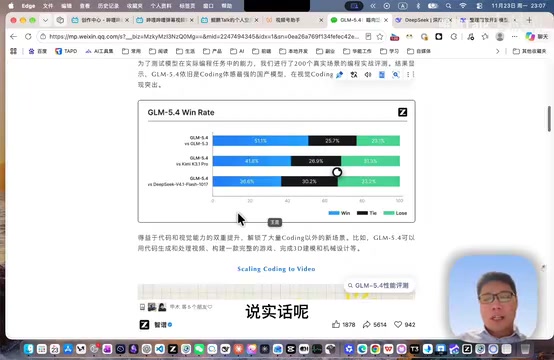
However, the credibility of this third-party leaderboard is questionable — it is neither official data nor released by an authoritative evaluation organization. Interestingly, the same leaderboard shows GLM-5.4 slightly weaker than MiniMax M30 E-Flash, while the latter's actual reputation in the community is not particularly strong. This also reminds us to remain cautious about unofficial leaderboards.
Open Before Benchmarking: Zhipu Wised Up
Zhipu's choice this time to open the model for use first and fill in the leaderboard later was described by the creator as "smart." Previously, models such as Kimi sparked controversy due to excessive marketing or KOL mishaps. Zhipu clearly learned its lesson and adopted DeepSeekAd's strategy of "just drop the model and let users speak." This pragmatic attitude seems rare in today's浮躁 release environment.
Hands-On Experience: Capability Gains Not Strongly Felt, Speed Is the Biggest Complaint
Despite the architectural innovation and impressive evaluation data, user feedback from hands-on testing presents a different picture. The creator admitted that after testing it himself, he was "not particularly amazed," similar to the situation with several recent domestic models (such as Kimi K3.1 and Qwen 38 Max): leaderboard scores improved noticeably, but users' perceived improvement was limited.
The more prominent problem is speed. A large number of users reported request errors or queuing. The creator believes this may be due to insufficient compute capacity or server overload caused by excessive user enthusiasm. In addition, Zhipu officially acknowledged that the model easily enters a "deep thinking" or repeated-thinking state, wasting time and compute and noticeably slowing output speed.
Trust Crisis for Demo Demonstrations: Reproducibility Is the Real Test
After GLM-5.4's release, the official team showcased some demos of generated videos and 3D modeling. The creator sharply criticized this: demos alone cannot prove model capability, because there is no way to rule out repeated sampling, additional agent frameworks, or prompt engineering.
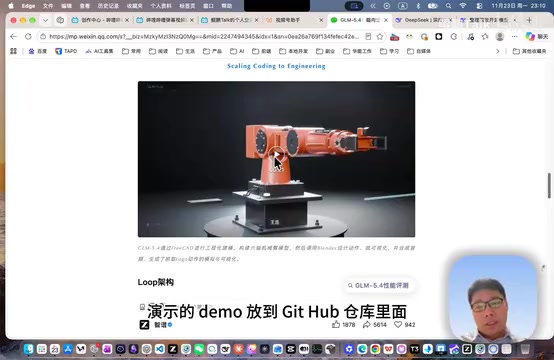
He suggested that the official team fully open-source the demo prompts, agent configurations, and generation process to a GitHub repository so the community can reproduce them. If the model cannot output stably, that itself reflects insufficient capability. This view hits on a common problem in current large-model marketing — demos look glossy but lack verifiability.
Model distillation (Knowledge Distillation) refers to training a weaker model (student) on the outputs of a stronger model (teacher), so that the student model imitates the teacher's answer distribution. In the LLM context, controversy often focuses on whether the teacher's chain-of-thought (Chain-of-Thought) data was used — if the teacher API is encrypted or hides the reasoning process, distillation can only learn the final answers, not the reasoning ability. Overseas bloggers accused GLM-5.4 of "distilling Claude Opus 5.5" while also claiming that Claude encrypted its reasoning chain, causing domestic models' capabilities not to improve. These two statements are logically contradictory: if the reasoning chain were truly encrypted and inaccessible, the path to distilling reasoning ability would not exist, and the accusation itself would lose its technical basis.
Increased Quota and Open Ecosystem: Real Benefits for Users
Although speed is not ideal, Zhipu increased the GLM-5.4 quota by 1.5x this time, equivalent to giving 50% more tokens on top of the original amount. For users who have already purchased a membership, stronger model capability and more tokens amount to a real benefit. The model is currently fully available in Coding Plan, but as of publication, it is only accessible within Zcode; entry points such as ZcodeTray, Workbody, and Coder have not yet gone live.
Controversy and Outlook: Is Loop Transformer the Future?
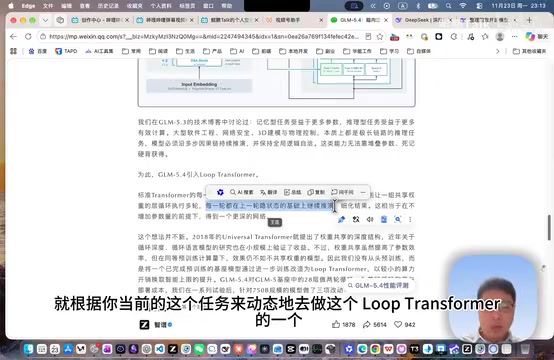
Some overseas bloggers accused GLM-5.4 of "distilling" Claude Opus 5.5, but also claimed that Claude encrypted its reasoning chain, causing domestic models' capabilities not to improve — a logical contradiction. The creator considers such accusations "ridiculous." Setting aside the controversy, the fact that the Loop Transformer architecture has been adopted by both a Chinese and a U.S. company shows that it has gained recognition from some R&D engineers. If it is subsequently validated by more models, this architecture could improve performance without increasing weights, which would be especially beneficial for users deploying small models locally.
The creator also called for a rational view of the gap: current models can already solve 80%-90% of problems, and the remaining hard problems may not be solved even by switching to a stronger model. The trend of Chinese models catching up with the most advanced U.S. level remains unchanged, but it will take time.
One-line Summary
Zhipu GLM-5.4 achieves gains without adding parameters via the Loop Transformer architecture, but controversy over speed and credibility persists.
Paragraph Summary
Zhipu AI released the non-open-source GLM-5.4 model. Its biggest highlight is the Loop Transformer architecture — through multiple rounds of looped computation during inference, it improves output quality without increasing parameter count. Third-party evaluations show it surpasses GPT-6.1 and Gemlet 4 but lags behind top models such as Fable 5.2, and the leaderboard is unofficial and of questionable credibility. User feedback from hands-on testing shows limited perceived capability improvement, while slow speed and severe queuing have become the biggest complaints; the official team acknowledges the model easily enters a repeated-thinking state. The article also criticizes the official demos for lacking reproducibility and suggests open-sourcing prompts and agent configurations. On the positive side, the quota has been increased 1.5x, and Loop Transformer has been adopted by both a Chinese and a U.S. company; if further validated, it could drive the industry to follow suit.
Related articles
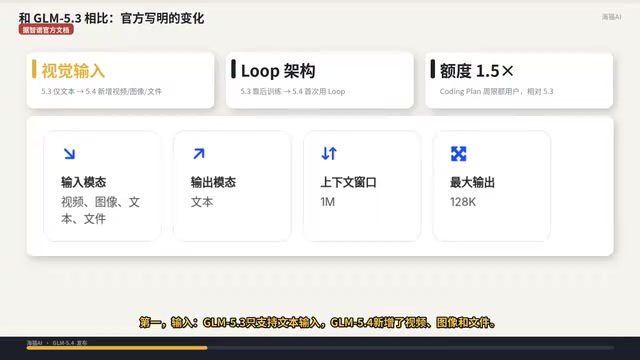
Zhipu GLM-5.4 Released: Loop Transformer Runs 28 Layers Twice
Zhipu releases GLM-5.4, the first Loop Transformer flagship: 28 layers run twice for 2-3T-equivalent intelligence, plus video and image input. API and open weights not yet released.

GLM-5.4 Coding Test 4.6x Slower? Unpacking the Loop Transformer Architecture
GLM-5.4 coding test took 431 minutes vs. competitor's 109, 4.6x more steps. We analyze its Loop Transformer architecture, KingBench4 score of 55.3, Max tier's 1.04M token cost, and tier selection advice.

Zhipu GLM-5.4 Quietly Released: A Debut for Loop Transformer Architecture
Zhipu GLM-5.4 quietly lands in coding plans: first Loop Transformer flagship with 750B params, 1M token context, AIM math up from 19.2 to 30.4, and native vision for coding from screenshots.