GLM-5.4 Hands-On: Loop Transformer Gives Coding a Big Boost, But It's Not Frontier Yet
GLM-5.4 uses a loop transformer to deepen reasoning; coding beats 5.3 but still trails frontier models.
Z.ai published no benchmark scores for GLM-5.4. Its core tech is a loop transformer—running the GLM-5 base's 28 layers twice to deepen reasoning without adding parameters, at the cost of longer inference (one developer hit the 5-hour limit). It's a clear upgrade over 5.3, fixing 28 of 105 planted bugs vs. 19, but far behind Gemini 4 Neon's 63. The claim of matching 2-3 trillion parameter models was only tested at 30B and needs caution. Z.ai plans open weights.
After GLM-5.4 launched, Z.ai didn't publish any benchmark scores. One developer using the model through OpenCode shared a first-hand account: it worked so hard it triggered the 5-hour usage limit. That detail alone says something—the model is willing to "think a few more rounds" on coding tasks instead of wrapping up hastily.
Core Mechanism: A Loop Transformer That Runs 28 Layers Twice
The key technology Z.ai disclosed is a loop transformer. Specifically: it runs the 28 layers of the GLM-5 base twice, letting the model "think deeper" without increasing parameter count. Z.ai claims this design can match models with 2-3 trillion parameters, but that comparison was tested on a 30-billion-parameter model—it's the vendor's own claim and should be treated with caution.
The clever part of this approach is that it bypasses parameter bloat. Traditionally, boosting model capability often means stacking more parameters, whereas a loop transformer reuses existing layers to achieve a deeper reasoning path. The cost is longer inference time—which also explains why users hit the 5-hour limit.
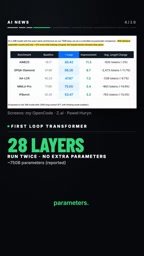
A Recurrent Transformer is a class of architecture design in which the same set of network layers is invoked multiple times, unlike a standard Transformer where each layer executes only once in the forward pass. Its idea traces back to explorations of decoupling "depth" from "parameters": the model's effective computational depth is determined by how many times layers are reused, while parameter count is still determined by the number of physical layers. Such designs require more forward computations at inference, significantly increasing latency and compute consumption, but they can improve performance on complex reasoning when parameters are constrained. Similar ideas in academia include the recurrent depth mechanism of the Universal Transformer, and recent research on "test-time compute scaling," which emphasizes investing more compute at inference to obtain higher-quality outputs. GLM-5.4 running 28 layers twice is essentially doubling effective depth—an engineering implementation within this lineage.
The "trillion-parameter model" comparison mentioned in the article touches on a common point of confusion in LLM capability evaluation: parameter count is not equivalent to effective capability. Activated parameter count, training data scale, training compute (usually measured in FLOPs), and the compute budget at inference all affect final performance. Mixture-of-Experts (MoE) architectures are a typical example—total parameter count can be large, but only a small fraction is activated per forward pass. So it's theoretically not impossible for a small-parameter model to match a large-parameter model by increasing inference compute, but the conclusion depends heavily on whether the test tasks, evaluation methods, and compute budgets are aligned. Z.ai didn't publish benchmark scores, and the comparison was only done at the 30-billion-parameter scale—meaning the claim lacks reproducible independent verification, and readers should treat it as a vendor assertion rather than established fact.
Real-World Experience: A Qualitative Improvement Over 5.3
According to this developer's experience, GLM-5.4's progress over 5.3 is clear. The problem with 5.3 was that it "cut off after doing a bit of work," whereas 5.4 loops, rethinks, and keeps improving its fix. This characteristic is especially suited to repetitive tasks—the model doesn't stop after the first attempt but iterates repeatedly until the result converges.

Another piece of evidence comes from Pavel Hurin's early bug-hunting test: out of 105 planted bugs, GLM-5.4 fixed 28, while 5.3 fixed only 19. That's an improvement of nearly 50%, showing the loop mechanism does produce real results in complex debugging scenarios.
The Gap With Competitors: A Step Behind Gemini 4 Neon
In the same bug-hunting test, Gemini 4 Neon fixed 63, far exceeding GLM-5.4's 28. This comparison is brutal but also honestly defines GLM-5.4's position: it's a solid iteration, but not a breakthrough frontier model.

The developer's assessment was restrained: "A real improvement, but not stunning, and not frontier yet." This judgment is worth considering—it affirms GLM-5.4's practical value while avoiding over-trusting vendor claims. After all, Z.ai hasn't published benchmark scores, and the claim that the loop transformer matches trillion-parameter models was only verified on small-scale models; the actual capability boundary still needs more independent testing to confirm.
The bug-hunting test cited in the article falls under "automated program repair" evaluation: known bugs are planted into a codebase, the model is asked to locate them and generate fix patches, and success is judged by whether tests pass. This type of evaluation is closer to real debugging scenarios than pure code generation, because it requires the model to understand cross-file context, reproduce failure causes, and produce a runnable minimal change. But its limitations are also obvious: the type distribution of planted bugs, the language and scale of the codebase, and the criteria for judging a "fix" can all significantly affect scores, and numbers obtained by different vendors under different settings should not be directly compared across the board. The sample size of 105 bugs is also on the small side—fluctuation in a single case could produce several percentage points of difference—so the 28 vs. 63 gap should be understood as a directional signal rather than a precise capability scale.
A Variable Worth Watching: Open Weights
Z.ai plans to open the weights of GLM-5.4. For developers who need local deployment or fine-tuning, this may be more appealing news than benchmark scores. If the loop transformer architecture can be fully explored by the open-source community, it might spawn more practical approaches for improving reasoning depth under limited parameters.
In the short term, GLM-5.4 suits coding scenarios where users are willing to trade longer inference time for more stable output—especially repetitive debugging work that requires the model to repeatedly refine fixes. If what you're after is the strongest current coding capability, Gemini 4 Neon remains the safer choice.
Open weights means the parameter files of a trained model are publicly released, allowing others to download, run locally, and fine-tune, but typically without disclosing the training data and full training process—so it differs from fully open-source models. For developers, the practical value of open weights shows in several ways: data doesn't leave the local environment, meeting compliance and privacy requirements; fine-tuning can be done for specific codebases or domains; and there's no dependence on a vendor API's rate limits and pricing. For architectures like the loop transformer, open weights matter even more—the community can empirically measure the curve of how layer reuse count affects latency and quality, and explore strategies for adjusting loop depth under limited VRAM, experiments that are nearly impossible on closed-source APIs.
One-line Summary
GLM-5.4 uses a loop transformer to deepen reasoning; coding ability improves markedly over 5.3 but still lags behind frontier models.
Paragraph Summary
After GLM-5.4 launched, Z.ai published no benchmark scores. Its core technology is a loop transformer—running the 28 layers of the GLM-5 base twice to deepen the reasoning path without increasing parameter count, at the cost of longer inference time, with one developer even triggering the 5-hour usage limit. Hands-on testing shows a qualitative improvement over 5.3: it iterates on fixes rather than wrapping up hastily, fixing 28 of 105 planted bugs versus 19 for 5.3, but far behind Gemini 4 Neon's 63. The vendor claims parity with 2-3 trillion parameter models, but that comparison was only verified on a 30-billion-parameter model and should be treated with caution. Z.ai plans to open the weights, which may be more appealing to local-deployment and fine-tuning developers than scores.
Related articles
China's New GLM Model Adopts Loop Transformer: Will ChatGPT Follow Suit?
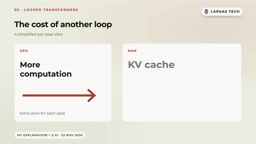
Zhipu's GLM adopts the Loop Transformer architecture, iterating multiple times to improve output quality as the first model to publicly confirm this design. This article explains the principles, KV cache cost, and surrounding developments in Google AI search and coding agent benchmarks.
GLM-5.4 Is 5x Cheaper Than Claude — But at What Cost?
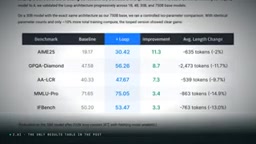
GLM-5.4 offers near-Claude coding ability at $18/month, about one-fifth the cost, but lacks flagship benchmarks and max effort can exhaust quotas on a single 7-hour task. This article combines the official paper and three independent reviews to explain the recurrent Transformer architecture and offer practical advice.
GLM-5.4 Open-Source Coding Model Tested: The Strongest, But It Takes 7 Hours
Z.AI releases GLM-5.4 coding model with Loop Transformer architecture, called the strongest open-source coding model by independent review, but it takes over 7 hours and ~15x tokens on the same benchmark. Here's the architecture, test scores, pricing, and competitive landscape.