GLM-5.4 Loop Transformer Explained: Separating Mechanism from Evidence

Zhipu GLM-5.4 uses shared-layer looping for two rounds to achieve equivalent depth; officially claimed to approach 2-3 trillion parameters, but independent evidence is still lacking.
Zhipu released GLM-5.4, centered on the Loop Transformer architecture: the same set of already-trained layers runs an extra round, keeping parameters unchanged while equivalently deepening the network. Officially, its intelligence level approaches 2 to 3 trillion parameter models. The article breaks down mechanism and evidence based on official materials: three engineering changes (gated progressive updates, hybrid KV cache, reuse of first-round sparse attention indices) keep the memory and cost of the extra round controllable; the experiment whose conditions are actually written out is the 30B model with the same architecture as 750B, where about 10% more training compute brings clear improvement, but this is a conditional conclusion. GLM Coding Plan users can already use it; the API awaits security assessment and weights await security hardening before open source, with no dates given. Officially, 1 million context, maximum output 128,000, and speed up to 200 tokens per second off-peak. The author's conclusion: what can be confirmed now is the technical route itself; the 2 to 3 trillion parameter class is an official statement, and an independent scorecard still awaits the model card and open weights.
Release Information and Availability
Zhipu has released GLM-5.4, whose core selling point is an architectural change called Loop Transformer: the same set of already-trained layers is run for an additional round, and the company claims its intelligence level approaches that of 2 to 3 trillion parameter models. How much verifiable evidence is behind this claim? Based on official materials, this article sorts out the mechanism and the evidence separately.
Release Information and Availability Scope
According to a review by Bilibili creator "Why Called QQ," Zhipu's English blog lists a release date of November 23, while Chinese materials say November 22; the two dates should not be merged into a single day. Officially, GLM-5.4 is the first-generation flagship direction of Loop Transformer, codenamed Fan Coding.
All GLM Coding Plan users can currently use it, and it has launched simultaneously on platforms such as Zcode, Tray, and Workbody Coder. Users with weekly quotas get 1.5x the quota of 5.3 when using 5.4; Chinese news also mentions that V2, V3, and team edition users of Coding Plan likewise get 1.5x — these two statements are official parallel statements and should be understood separately.
The API will open only after security assessment, and weights are planned for open source after security hardening, but no dates have been given. As of verification, there is no official 5.4 model card and no public weights.
The product documentation states: input supports video, images, text, and files; output is text; context is 1 million, maximum output 128,000. The documentation also lists capabilities such as thinking mode, streaming output, function calling, context caching, and structured output. These are official capability descriptions; the creator says no hands-on testing was done.
"Intelligence level reaching the 2 to 3 trillion parameter class" is the company's own statement, and there is currently no independent scorecard that can directly prove it.
What Loop Transformer Actually Changes
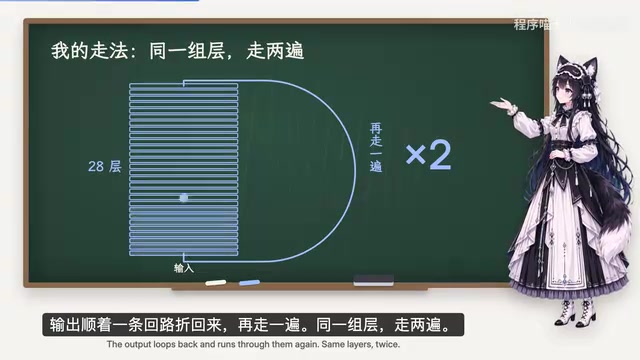
In a standard Transformer, each layer runs only once, and the input passes through each layer's forward computation directly to the output. GLM-5.4 lets a group of weight-sharing layers loop for an additional round; the second round continues inference from the hidden state already updated in the previous round, keeping the same set of parameters, which is equivalent to making the network deeper. Officially, this is described as "obtaining a deeper network without increasing parameter count."
This idea is not new. The 2018 Universal Transformer already proposed a looping mechanism. Officially, it is also acknowledged that under equal training compute, a loop model trained from scratch still cannot catch up with a model that does not share weights, so the choice was to modify an existing base rather than pretrain a new one from scratch. The official claim is to trade a smaller compute overhead for a higher intelligence ceiling.

The numerical boundaries need to be clear: the official statement is for the 750B scale and for running two rounds on 28 layers of the previous-generation base. They did not disclose 5.4's exact total parameters, activated parameters, or number of experts. Earlier official numbers are that the previous-generation base had 744 billion total parameters and 40 billion activated per token — those are public numbers for the previous-generation base and cannot be directly written as 5.4's model card.
Three Changes That Make "One More Round" Work
First, gated progressive updates. If the hidden state were directly overwritten each round, the scale would drift further and further, so each round has an independent per-token gate that writes back into the residual stream proportionally. Officially, the first round uses a smaller gate value to stabilize scale, while the second round opens the gate to write updates more fully and adjusts according to per-token prediction difficulty.
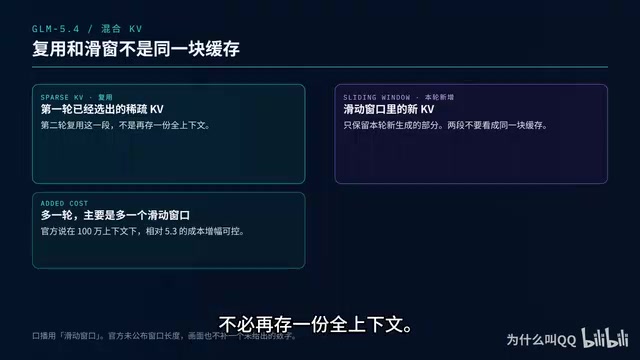
Second, hybrid KV cache. The second round reuses the first round's sparse KV and retains only the newly generated KV of this round in the sliding window; what is reused is the sparse KV already selected in the first round, while what is in the sliding window is the newly generated part of the second round — the two segments cannot be viewed as the same block of cache. In this way, an extra round mainly adds one sliding-window cache, without needing to store another full-context copy. Officially, at 1 million context the cost increase relative to 5.3 is controllable, but the sliding window length was not disclosed.
Third, directly reuse the first round's sparse attention indices. Officially, the effect is almost equivalent, and no additional retrieval overhead is paid.
Universal Transformer is a model architecture proposed by Google in 2018 (paper "Universal Transformers"). Its core idea is to "loop and reuse" Transformer encoder layers along the depth dimension: the same set of layers is executed repeatedly for a fixed or adaptive number of steps, thereby obtaining RNN-like iterative computation capability without increasing parameters. It introduced two key designs — first, weight sharing across layers; second, an optional "Adaptive Computation Time" (ACT) mechanism for each step, allowing different tokens to decide how many loop steps they need. This route can theoretically improve compositional generalization, but later large-scale practice found that under equal training compute, weight-sharing loop models often struggle to catch up with deeper models that have more parameters and do not share weights, so mainstream large models have not widely adopted it. GLM-5.4's approach can be seen as an engineering restart of this old idea: rather than training a loop model from scratch, it modifies an existing base and trades a smaller incremental compute cost for equivalent depth.
Sparse Attention means that when computing attention, the model no longer lets every token interact pairwise with all historical tokens, but selects only a portion of key positions to participate in computation, thereby reducing the O(n²) complexity. Common approaches include sliding window attention (focusing only on the most recent context), block sparse patterns, and sparse index schemes that rely on retrieval or routing to select Top-K relevant tokens. "Reusing the first round's sparse attention indices" in the article means: the second loop no longer redoes the retrieval of "which historical tokens are worth attending to," but directly follows the set of positions already selected in the first round. This saves one index computation overhead, and officially the effect is almost equivalent. But it is important to distinguish: reuse of indices is not the same as reuse of KV cache — the former reuses "whom to select," while the latter reuses "the content selected"; the two are different levels of implementation.
Evidence Grading: What Can Be Matched to Sources
Officially, validation was done on 1B, 4B, 30B, and up to 750B bases, but the experiment whose conditions are actually written out is the 30B model with the same architecture as 750B: same parameter count, overall training compute about 10% more, and the loop shows a clear improvement over the baseline. Before evaluation, it underwent 200,000-token long-text training (SFT) and thinking was enabled. These numbers can only be interpreted under these premises.
Officially, the longer the reasoning chain, the greater the help, especially in math, long context, and code, and it will think with fewer tokens. The Chinese text says average output length drops 10% to 14% on GPQA and MMLU Pro; the English corresponds to GPQA Diamond and MMLU Pro. This set of numbers belongs to the 30B experiment; 5.4 itself has no matching public scorecard.
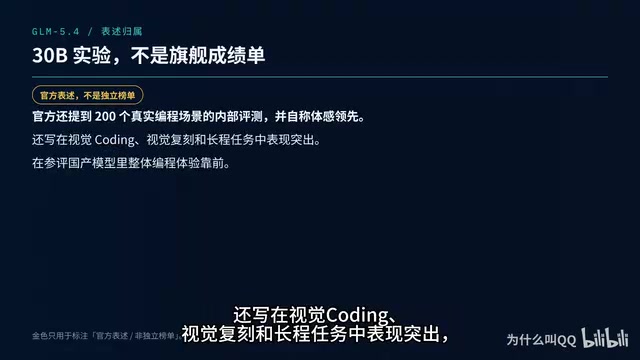
Regarding coding experience, officially there is an internal evaluation of 200 real coding scenarios, claiming a leading feel and outstanding performance in visual coding, visual replication, and long-horizon tasks, with overall coding experience near the front among domestic models. These are official impressions; externally, no corresponding public ranking can be seen.
Officially, the direction is also called Fan Coding — code is not only for writing software, but also for making demo games, 3D design, and mechanical design. Officially cited public cases include creators using 5.4 for 3D interaction and FreeCAD mechanical parts, but these cannot be called reproducible evaluations.
On speed, officially up to 200 tokens per second at off-peak times, and still 70 to 80 at peak; this is not third-party testing. Officially, it is also acknowledged that the model easily enters long thinking states, and the company believes the model will reflect and self-correct during thinking; long thinking can sometimes support better results, but they also list it as an unresolved problem. Open questions also include how to allocate compute according to difficulty, and how benefits change as the number of loop rounds and scale increase further. Officially, they will not choose only one side between deepening layers and making models bigger; the next model will be significantly larger, but no name or date was given.
In the context of model releases, a "Model Card" is a standardized document that usually includes model architecture and parameter scale, training data overview, evaluation results, known limitations, intended use, and ethical risks. It is both a basis for developers choosing models and an entry point for external researchers to review official claims. The article repeatedly emphasizes that "there is still no official 5.4 model card," meaning: before the model card is released, key information such as total parameters, activated parameters, number of experts, and benchmark results exists only in scattered statements, lacking a formal reference standard. Related to this is "open-source weights" — even if the model card is released, if the weights are not public, independent reproduction and third-party evaluation still cannot proceed. Therefore, "waiting for the model card and weights" is not a formal requirement, but a necessary precondition for turning official statements into verifiable evidence.
What Can Be Confirmed Now
Before the API and weights are opened, what can mainly be confirmed is the technical route itself: shared-weight looping, three engineering changes, and the conditional benefits of the 30B control experiment. A complete independent scorecard is not yet available, and the API and weights are not yet open. For developers, what is worth watching in GLM-5.4 is how the idea of "equivalent deepening" is implemented in engineering, not the parameter-level claims at this stage.
Related articles

GLM-5.4 Released: How a 750B Model Achieves Stronger Reasoning
Zhipu AI releases GLM-5.4, a 750B model that boosts reasoning by running the middle 28 layers twice. GPQA Diamond rises from 47.58 to 56.26, with 1M token context and weights to be open-sourced after safety hardening.

Understanding GLM 5.4 in 8 Minutes: How Loop Transformer Makes AI Smarter Without More Parameters
GLM 5.4 didn't grow its parameters yet got smarter. Using the memorizer-vs-reasoner analogy, this article explains how Loop Transformer runs the middle 28 steps twice, how gated progressive update and two other techniques stabilize the second pass, and how generalized Coding uses code to command 3D, mechanical design, and game development — with official comparison data and open questions.
GLM-5.4 Released: An In-Depth Look at Zhipu's First Loop Transformer Flagship Model
Zhipu releases GLM-5.4, its first Loop Transformer flagship. Built on GLM-5 with 28 layers looped twice—no extra params, ~10% more compute, stronger math and long-context reasoning.