Global Time Says Goodbye to Leap Seconds: Infrastructure Risks and a New Era of Timekeeping

BIPM has decided to abolish leap seconds, shifting the global time standard thoroughly from astronomical orientation to atomic orientation.
BIPM voted to abolish the leap second mechanism used since 1972 to avoid infrastructure failure risks similar to Y2K. Leap seconds bridge the deviation between atomic time (TAI) and Earth-rotation-based time (UT1) by occasionally inserting one second into Coordinated Universal Time (UTC), but they have caused outages at platforms such as Reddit, Mozilla, and Twitter. As atomic clock precision improves, the contradiction between the two time standards becomes harder to reconcile. BIPM plans to allow the UTC-UT1 deviation to exceed one minute and complete standard revisions by 2035. Developers will benefit from simpler time-handling logic, but legacy systems still need compatibility attention during the transition.
The End of the Leap Second: A Long-Overdue Time Standardization Reform
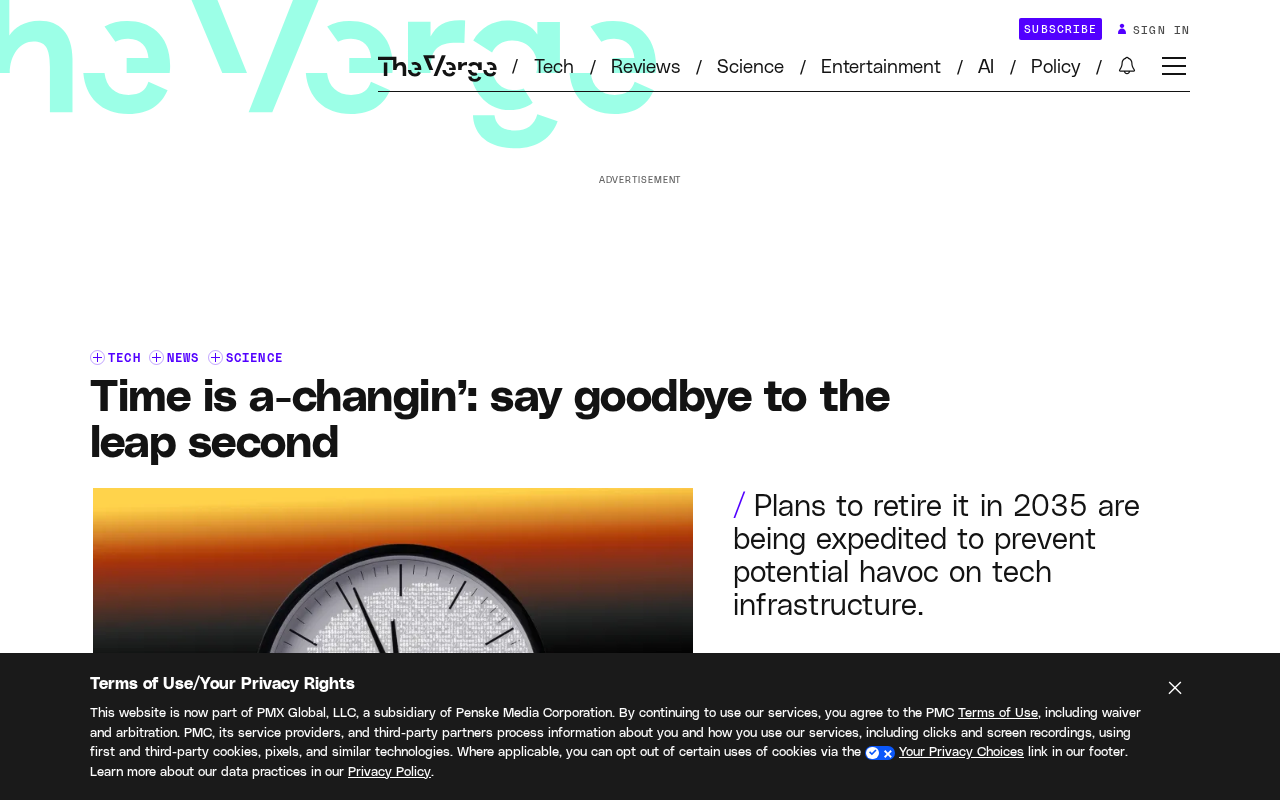
According to the International Bureau of Weights and Measures (BIPM), the global time measurement system is about to undergo a major transformation—the leap second will be officially abolished. This decision aims to avoid infrastructure failure risks similar to the "Y2K" incident, marking the end of the practice of artificially inserting leap seconds that has been in place since 1972.
The leap second is a temporary time adjustment mechanism that occasionally adds or subtracts one second from Coordinated Universal Time (UTC) to keep atomic clock time synchronized with astronomical time generated by Earth's rotation. Since its first introduction in 1972, 27 leap second adjustments have been implemented globally. However, as modern technological systems become increasingly dependent on time precision, the troubles caused by this mechanism are gradually outweighing its value.
Why the Leap Second Became a "Time Bomb" for Technical Systems
The leap second may seem insignificant, but it can trigger a chain reaction. Global computer systems, financial trading networks, satellite navigation, and communication infrastructure all rely on precise and continuous time references. When a leap second is inserted, different systems may handle this extra second in different ways, leading to inconsistent timestamps, log corruption, and even service interruptions.
Several well-known platforms have experienced failures during past leap second adjustments. The 2012 leap second caused brief outages at Reddit, Mozilla, and other websites; the 2015 one affected Twitter and systems at multiple airlines. Although these incidents did not cause catastrophic consequences, they exposed the fragility of the leap second in the modern technological ecosystem. BIPM's vote to abolish the leap second is a direct response to such risks—rather than continuing to patch an outdated mechanism, it is better to eliminate the hazard at its root.
NTP and the Leap Indicator Flag
The Network Time Protocol (NTP) is the most widely used time synchronization protocol on the Internet. It distributes standard time hierarchically to billions of devices worldwide through a tiered server structure. NTP includes a "Leap Indicator" in its packet header to notify clients in advance of an impending leap second adjustment. The problem is that not all systems correctly parse or respond to this flag: some operating systems directly "roll back" one second at the kernel level, some ignore the flag in user space, and some virtualized environments do not pass the information through at all.
This fragmentation in handling is the core reason why leap seconds cause failures. When the same financial transaction is recorded on two servers that handle it differently, timestamps may be duplicated or reversed, breaking transactional consistency. Therefore, the abolition of the leap second is not just a trade-off between astronomical and atomic time, but a fundamental simplification of time semantics in distributed systems.
The Fundamental Contradiction Between Atomic Time and Astronomical Time
The root of the leap second problem lies in the essential difference between two time standards. Atomic time (TAI) is based on the oscillation frequency of cesium atoms and is extremely stable and precise; astronomical time (UT1) depends on Earth's rotation speed and is subject to unpredictable micro-fluctuations caused by tidal friction, core motion, and other factors. As atomic clock precision continues to improve, the deviation between the two time standards becomes increasingly obvious, and the frequency of leap second insertions becomes difficult to predict.
According to BIPM's plan, the allowed deviation between UTC and UT1 will be expanded to one minute or even more in the future, no longer bridged by frequent leap seconds. This means that timekeeping will shift more thoroughly to an atomic time basis, and the influence of Earth's rotation will be gradually marginalized. Fields that rely on astronomical observation (such as celestial navigation and deep space exploration) will need to handle this deviation on their own.
The Relationship Between TAI, UTC, and UT1
Understanding the leap second controversy requires clarifying the hierarchical relationship among three time scales. International Atomic Time (TAI) is a continuous time scale generated by the weighted average of hundreds of atomic clocks worldwide. It has no jumps and is the "ideal time" in the metrological sense. Universal Time (UT1) directly reflects Earth's rotation angle and is tied to astronomical observations and geophysical phenomena, but its "second length" is not uniform.
Coordinated Universal Time (UTC) is a compromise product: its second length is strictly equal to that of TAI, but by inserting leap seconds, its deviation from UT1 is kept within 0.9 seconds at all times. In other words, UTC is essentially a "hybrid time" with TAI as its skeleton and UT1 as its reference. Abolishing the leap second means that UTC will give up real-time tracking of UT1 and gradually evolve into "TAI with a fixed offset." This transition poses no obstacle in metrology, but it shakes the long-standing philosophical foundation that "civil time must be tied to the sun."
Practical Impact on Industry and Developers
The abolition of the leap second is good news for most software developers. In the past, handling leap seconds required introducing complex logic into code: the NTP protocol notifies clients through the "leap indicator," while some systems use "leap smear" technology to spread the extra second over a longer period and digest it gradually. Google was an early practitioner of this approach, but its implementation is not an industry-wide standard.
Once the leap second officially exits, developers can simplify time-handling logic and reduce edge cases caused by time discontinuities. However, during the transition period, attention still needs to be paid to compatibility with legacy systems—existing leap second tables need to be updated, and hardware devices that rely on old standards may require firmware upgrades. Compliance teams at financial institutions also need to adjust time synchronization strategies to ensure that transaction records meet regulatory requirements.
How Leap Smear Works
Leap smear is an engineering technique for bypassing the leap second jump: instead of inserting a full second at a single moment, it "spreads" that second across a longer time window before and after (for example, the 20-hour window used by Google), allowing the system clock to catch up slowly at an extremely small rate deviation. For upper-layer applications, time always remains monotonically increasing, the non-standard timestamp "23:59:60" never appears, and business logic does not need to be modified.
However, the smear approach is not without cost. It requires all nodes within the same trust domain to use a consistent smear window and algorithm; otherwise, millisecond-level deviations will still occur between nodes. In cross-organizational scenarios (such as between financial exchanges and brokerages), such consistency is extremely difficult to guarantee. After the abolition of the leap second, smear technology will gradually exit the stage of history, but the core problem it reveals—how to maintain monotonic and consistent time in distributed systems—will continue to exist in other scenarios (such as clock drift correction).
The Global Game of Time Standardization and Coordination
Behind this decision lies years of international discussion. As early as 2012, the International Telecommunication Union (ITU) considered abolishing the leap second, but the matter was shelved due to disagreements among parties. Those in favor of abolition, represented by the United States and France, believed that the technical cost of leap seconds could no longer be ignored; opponents, including the United Kingdom and China, worried that severing the link between time and Earth's rotation would weaken the continuity of astronomical observation.
BIPM's vote this time reflects that technical pragmatism has gained the upper hand. With the global coverage of digital infrastructure, a coordinated and unified continuous time reference is more urgent than chasing Earth's rotation. This shift also means that time measurement will move thoroughly from "astronomically oriented" to "atomically oriented," with impacts far beyond the technical community—it redefines how humanity understands and measures time itself.
Where the Future Time System Is Heading
The abolition of the leap second is not the end, but the starting point of a new phase in time measurement. BIPM plans to complete the formal revision of relevant standards before 2035, during which new definitions and dissemination specifications for UTC will be formulated. The maturation of next-generation timekeeping technologies such as quantum clocks may further drive innovation in time standards.
For ordinary users, this change is almost imperceptible—the time on phones and computers will still display normally, with only the background synchronization mechanism quietly changing. But for engineers, scientists, and standards makers, the retirement of the leap second reminds us: in the digital world, the definition of time is not only a matter of physics, but also of the feasibility of global collaboration.
One-line Summary
BIPM has decided to abolish the leap second, and the global time standard will shift thoroughly from astronomical orientation to atomic orientation.
Paragraph Summary
BIPM voted to abolish the leap second mechanism used since 1972 to avoid infrastructure failure risks similar to Y2K. Leap seconds bridge the deviation between atomic time (TAI) and time generated by Earth's rotation (UT1) by occasionally inserting one second into Coordinated Universal Time (UTC), but they have caused outages at platforms such as Reddit, Mozilla, and Twitter. As atomic clock precision improves, the contradiction between the two time standards becomes increasingly difficult to reconcile. BIPM plans to allow the deviation between UTC and UT1 to expand to more than one minute and complete standard revisions before 2035. Developers will benefit from simplified time-handling logic, but legacy systems still need attention to compatibility during the transition period.
Related articles

Frontend to AI Agent Development: A Frontline Architect Explains Career Paths and Opportunities
A frontline AI architect explains the industry changes and practical paths for frontend developers transitioning to AI Agent development: why pure frontend jobs are disappearing, why Agent + full-stack has become mainstream in hiring, and three transformation routes—Agent development engineer, FDE, and remote contracting—along with corresponding learning strategies.

How to Choose an AI Agent Development Course: Five Pitfall-Avoidance Guidelines
A mechanical-engineering career changer's two-year pitfall-tested checklist for screening AI Agent development courses: complete delivery pipeline, resume-worthy projects, real development perspective, update frequency, and coaching feedback—with concrete judgment methods and pitfall-avoidance tips.

Coze AI Agent Building for Beginners: A Zero-Code AI Agent Development Guide
Coze, ByteDance's one-stop AI application development platform, supports zero-code drag-and-drop AI agent building. This article outlines Coze's core concepts, three advantages, differences between the domestic and international versions, and the distinction between agents and apps, helping beginners quickly get started with AI Agent development.