Globenomics: A Geography Game and Country Auction Experiment on a 3D Globe

Globenomics blends a 3D globe, 16 geography games, country auctions, and economic data into one gamified learning experience.
Globenomics is an educational game on Product Hunt built around an interactive 3D globe with 16 geography games including speedruns, flag guessing, and duels. Its standout feature is a virtual currency (GlobeMillions) and country auction system where players bid to hold one of 195 countries for 24 hours, earn "Country King" status, and attach promotional links — creating ongoing social competition. Clicking any country also surfaces economic data like GDP, passport strength, and the Big Mac Index, spanning Education, Games, and Data Visualization.
At the intersection of education and gaming, a product called Globenomics has made its debut on Product Hunt. It combines a freely explorable 3D globe, 16 geography mini-games, and an auction system built around 195 countries — an attempt to make geography and economic data playable, competitive, and social through gamification.
A Product That Turns Geography into a Game
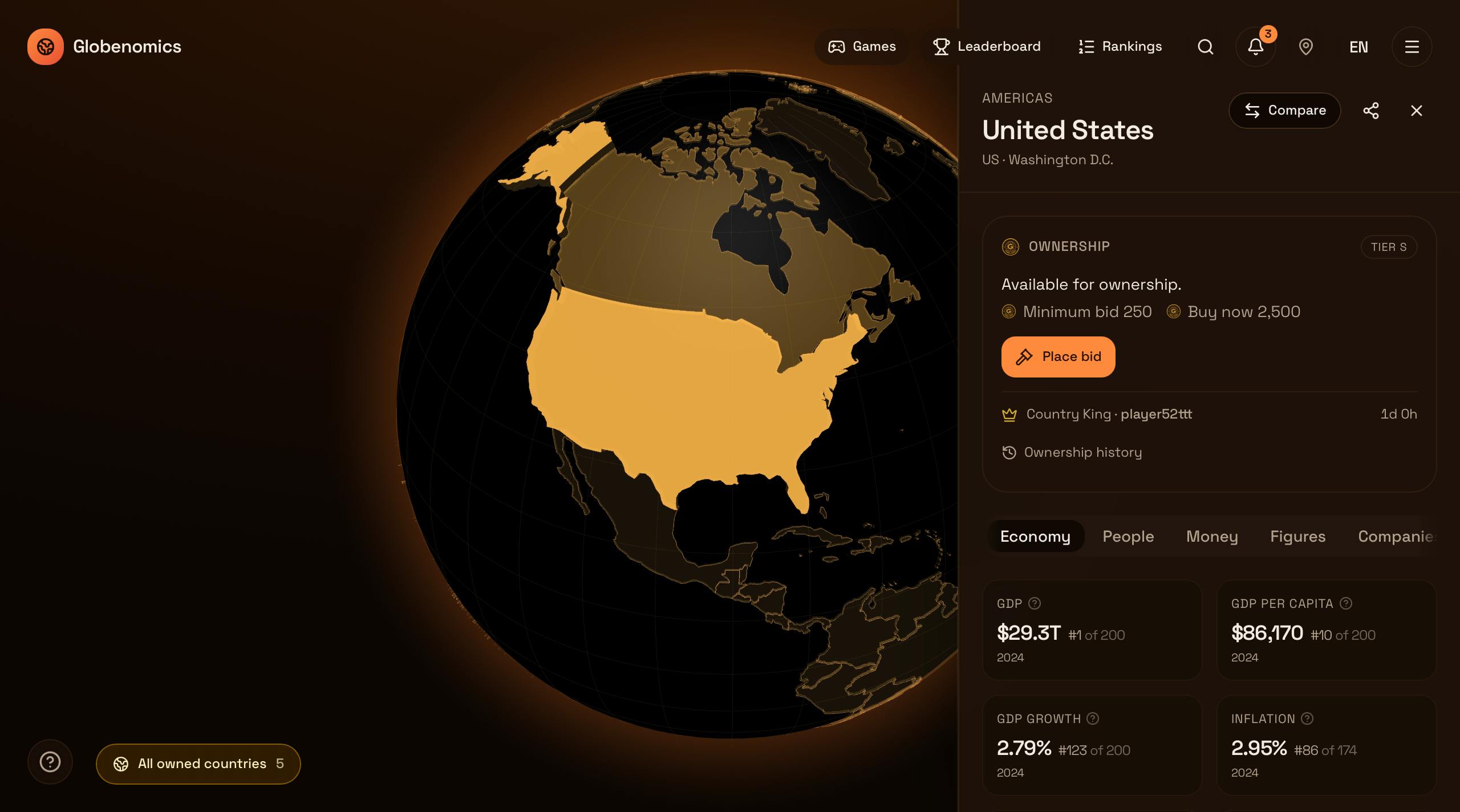
At its core, Globenomics features a fully interactive 3D globe. Users can play 16 geography-themed games on it — from timed speedruns to identify all 195 countries, to matching capitals, guessing flags, and even dueling friends. The concept itself isn't new, but consolidating a dozen different game modes into a single globe interface creates a fairly complete geography knowledge training ground.
For educational use cases, the value of products like this lies in reducing the monotony of memorization. Turning "memorize capitals" into a timed challenge or two-player duel is essentially about using instant feedback and competitive psychology to boost learning motivation. Its target audience includes both geography enthusiasts and casual users looking for a lightweight way to brush up on world knowledge.
Game Currency and Country Auctions: A Layer of Social Strategy
What truly sets Globenomics apart from typical geography quiz apps is its virtual economy system. Playing games earns a currency called GlobeMillions, and all 195 countries are put up for auction.
Players can bid on countries using their accumulated currency. Once won, you "hold" that country for 24 hours: your avatar and name appear on it, and you can attach a message and a promotional link (which goes through moderation before going live). Whoever holds a country the longest earns the title of "Country King."
This mechanism transforms solo geography quizzing into an ongoing social competition. It draws inspiration from earlier internet experiments — "buy a pixel," "claim a territory" — using limited scarce resources (only 195 countries) to fuel competition and a desire for visibility. The inclusion of a moderation step also shows the team is aware of the content risks that come with open promotional links.
This kind of "territorial" social mechanic has a few classic precedents in internet history. The 2005 "Million Dollar Homepage" let users purchase pixel grids to display ads, while Reddit's r/place let users collaboratively paint pixel art and compete for territory — both validated that scarcity plus a desire for display can drive sustained user behavior. Globenomics builds on this by adding time decay (24-hour holding periods) and cumulative rankings (Country King), making the competition continuous rather than one-off, requiring ongoing game time to maintain your "territory." The promotional link feature also hints at a potential future monetization angle: holding a high-traffic country (like the US or China) with an attached external link could carry real value for brands or individuals — which is what distinguishes this mechanic from a purely in-game points system.
Data Visualization: An Economic Portrait of Every Country
Beyond games and auctions, Globenomics also embeds a wealth of economic and social data. Clicking on any country lets you view its GDP and wage levels, number of billionaires, unicorn companies, tax rates, passport strength, and indicators like the Big Mac Index.
This layer gives real substance to the product's "economics" branding. Aggregating data that's typically scattered across various reports into a single visualized globe interface offers an intuitive entry point for users who want to quickly compare economic conditions across countries. It also explains why the product is listed under three categories on Product Hunt — Education, Games, and Data Visualization — simultaneously.
The Big Mac Index is an informal exchange rate assessment tool created by The Economist in 1986. It uses the price of a McDonald's Big Mac across countries as a benchmark to measure purchasing power parity (PPP). Because the Big Mac is highly standardized globally, price differences directly reflect local price levels and currency over/undervaluation, making it one of the most commonly cited "lightweight" economic indicators in popular economics. Passport strength (Passport Index) is typically measured by the number of countries a passport can access visa-free or with visa-on-arrival — a grassroots metric that reflects a country's diplomatic relationships and international standing. By centralizing indicators that would otherwise require consulting multiple separate sources, Globenomics lowers the barrier to cross-country economic comparison. That said, data timeliness and source reliability will be key considerations for ongoing user trust.
Performance and Takeaways
Based on Product Hunt data, Globenomics received 16 upvotes, 2 comments, and ranked 15th on the day. These numbers suggest it's still early-stage with limited traction, though the product concept itself has a degree of novelty.
Its potential lies in the combination of three elements: educational geography games, social country auctions, and aggregated economic data visualization. The risks lie in long-term retention — whether mechanisms like virtual currency and "Country King" can sustain repeat visits, and whether data accuracy and update frequency can be maintained, will directly shape the product's reputation. For practitioners interested in gamified learning and data visualization, Globenomics is a small but worthwhile case study to watch.
Related articles

LLaMA-Factory in Practice: A Complete No-Code Guide to Fine-Tuning Large Models
An introduction to LLaMA-Factory, the open-source fine-tuning tool: its 60.1K-star background, supported models and algorithms, local vs. cloud deployment, and CUDA setup steps.

Zeng Ming's Deep Retrospective: Why OpenAI May Not Be the Ultimate Winner — and Why the Corporate System Will Disappear
Zeng Ming's deep retrospective on the AI endgame: model companies are just infrastructure, OpenAI and Anthropic won't be the final winners; the next battle is the Agent entry point standard; the corporate system will disappear as AI restructures collaboration, and only mission-driven companies can survive the cycle.

OpenHands v1.28.0: OpenCode and PI Added as Built-in Agents, API Keys Requestable In-Conversation
OpenHands ships 5 releases in 21 days: v1.27.0 adds OpenCode and PI as built-in agents, v1.28.0 enables in-chat key requests. ACP integration, credential reuse, model list changes, and upgrade advice.