GM Reinvents OnStar with AI: A 30-Year-Old In-Car Service Gets Its Biggest Upgrade Yet

GM gives its 30-year-old OnStar its biggest AI overhaul ever—direction clear, details unclear.
GM is undertaking one of the largest overhauls in OnStar's 30-year history, centered on artificial intelligence, as first reported by The Verge. OnStar began with safety services like automatic crash notification, roadside assistance, and stolen-vehicle location, and long relied on button-press calls and human agents. The overhaul aims to turn it into an AI-capable in-car intelligence layer that could reshape voice interaction, proactive service, and content distribution, directly affecting subscription monetization. But the report confirms only the direction, leaving model sources, timing, privacy approach, and OTA upgrades for existing owners undisclosed; data compliance and automotive-grade reliability remain key hurdles.
General Motors is undertaking one of the largest overhauls to date of its 30-year-old OnStar in-car service, with artificial intelligence as the core approach. The news was first reported by tech outlet The Verge, marking a significant pivot for a traditional automaker in the smart cockpit and connected-vehicle services space.
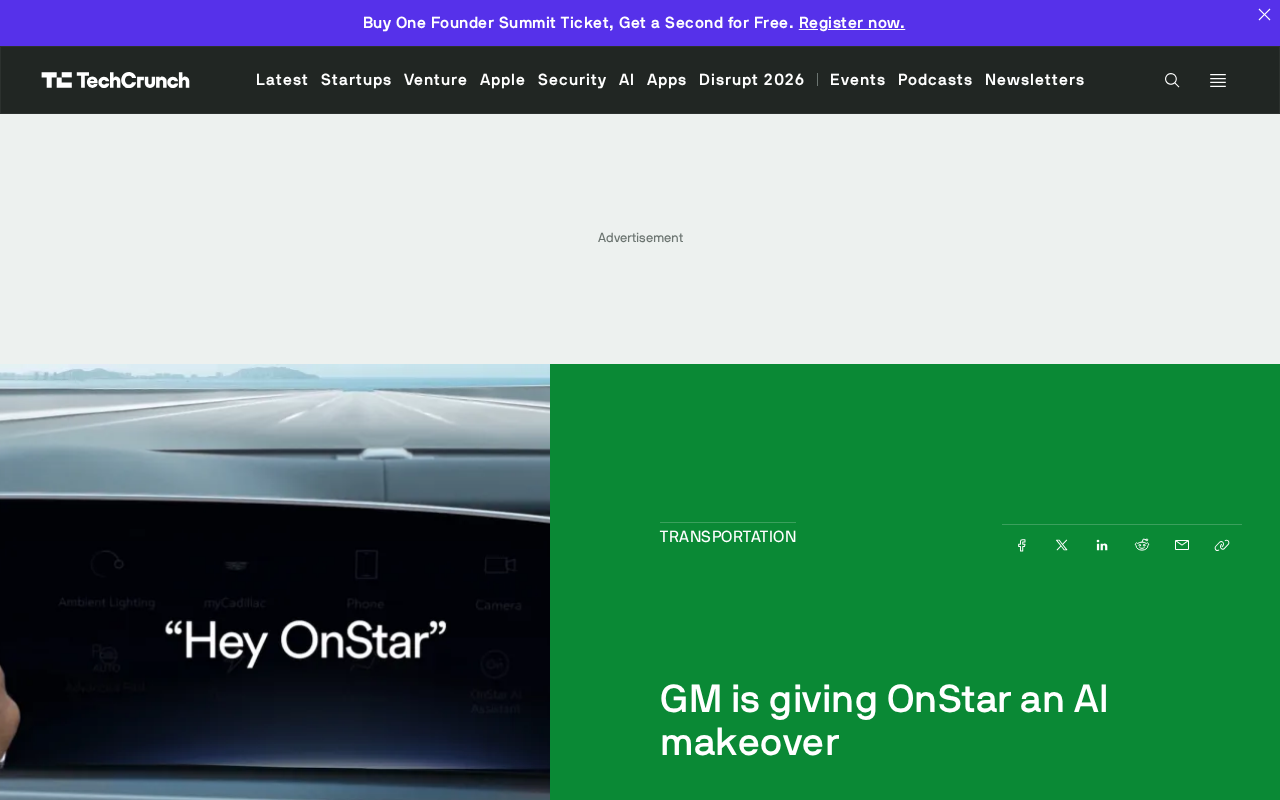
Thirty Years of OnStar: From Emergency Calls to AI Assistant
Launched in the 1990s, OnStar originally centered on safety and emergency response—automatic crash notification, roadside assistance, and stolen-vehicle location made it an early representative of connected-vehicle services. Over three decades, OnStar accumulated a vast user base and vehicle data, but its interaction model long remained stuck at button-press calls and human customer service.
The essence of GM's overhaul is to upgrade OnStar from "a call center on the other end of the phone" into an AI-capable in-car intelligence layer. According to The Verge, this is one of the largest overhauls in the product's history, but the original report did not disclose a specific feature list, rollout timeline, or technology vendors.
Telematics refers to the exchange of information between a vehicle and external networks via onboard communication modules, and OnStar is an early commercialized example of this concept. Its technical foundation typically includes GPS positioning, cellular communication (evolving from 2G to 4G/5G), and crash sensor integration—after detecting airbag deployment, the vehicle can automatically report its location to a call center and establish a voice channel. The value of such services lies in turning a vehicle from an isolated machine into a networked terminal that can be remotely sensed and remotely intervened with, laying the hardware and data foundation for later OTA updates, remote diagnostics, and subscription services. Understanding this context is essential to seeing that OnStar's overhaul is not about building AI from scratch, but about layering intelligence on top of existing communication and data links.
The Industry Logic Behind the AI Overhaul
Competitive pressure on traditional automakers is shifting from powertrains to software experience. Tesla set user expectations with OTA and in-car voice assistants, Chinese emerging brands made smart cockpits a core selling point, and the OnStar experience in GM vehicles has fallen behind in responsiveness and intelligence.
Bringing AI into OnStar means GM may restructure three links: first, voice interaction, replacing layered menus and human transfers with natural language; second, proactive service, using vehicle sensor data to predict failures or safety risks; third, content and service distribution, making the in-car system a sustainably operated entry point. For GM, OnStar is not only a service product but also a business unit that contributes subscription revenue every year—AI-ification directly affects its monetization efficiency.
OTA (Over-the-Air) refers to pushing software updates to vehicles over wireless networks, covering modules such as the infotainment interface, powertrain control, and driver assistance. Tesla was the first automaker to scale this, enabling vehicles to keep receiving feature iterations after sale and thereby changing users' expectations that "a car will grow old." For traditional automakers, OTA is not only a technical capability but also an organizational one—it requires an electrical/electronic architecture that supports vehicle-level flashing, cloud-based version management and rollback mechanisms, and compliance with functional safety and regulatory filing requirements. If OnStar is to bring AI upgrades to existing owners via OTA, OTA is an unavoidable distribution channel—which is why the detail in the original report about "whether existing owners can get the upgrade via OTA" carries weight.
Several Points to View Calmly
It must be noted that currently public information is extremely limited. The Verge's report only confirms the direction of an "AI makeover" and the qualitative description of "one of the largest overhauls in history," without key details such as the source of the models, whether they are developed in-house, the data privacy approach, or whether existing owners can get the upgrade via OTA.
The risks of such an overhaul are equally obvious: in-car AI involves sensitive data such as location and driving behavior, making privacy compliance an unavoidable threshold; automotive-grade systems have far higher reliability requirements than consumer electronics, and the cost of AI misjudgment could be a safety incident; moreover, how the 30-year-old human customer service system can collaborate with AI rather than simply be replaced also tests GM's product design capabilities.
Readers can view this news as a signal—traditional automakers' connected-vehicle services are entering a period of AI reconstruction, but the actual results still await real-world validation after the product launches.
Automotive Grade is a reliability standard relative to consumer-electronics grade, typically requiring components to operate stably across a wide temperature range from -40°C to 125°C, with longer supply cycles and lower failure rates, and to comply with standards such as ISO 26262 functional safety. This means in-car AI cannot simply transplant cloud large models or phone-based solutions: inference latency, offline availability, compute power consumption, and heat dissipation are all constrained by onboard hardware, and any misrecognition can be directly tied to driving safety. Therefore, when traditional automakers introduce AI, they often adopt a layered architecture of "cloud training, lightweight onboard inference" and retain human fallback channels—which also explains why such overhauls typically land more slowly than consumer-grade products.
One-line Summary
GM is giving its 30-year-old OnStar its biggest AI overhaul ever—direction clear, details unclear.
Paragraph Summary
General Motors is undertaking one of the largest overhauls in the history of its 30-year-old OnStar in-car service, with artificial intelligence as the core approach, as first reported by The Verge. OnStar originally established itself with safety services such as automatic crash notification, roadside assistance, and stolen-vehicle location, and long remained in an interaction model of button-press calls and human customer service. This overhaul aims to upgrade it into an AI-capable in-car intelligence layer, potentially restructuring three links—voice interaction, proactive service, and content distribution—and directly affecting the monetization efficiency of this subscription business. However, the report only confirms the direction and qualitative description, without disclosing key information such as model sources, rollout timing, privacy approach, or whether existing owners can upgrade via OTA; data compliance and automotive-grade reliability remain the main thresholds.
Related articles

LLaMA-Factory in Practice: A Complete No-Code Guide to Fine-Tuning Large Models
An introduction to LLaMA-Factory, the open-source fine-tuning tool: its 60.1K-star background, supported models and algorithms, local vs. cloud deployment, and CUDA setup steps.

Zeng Ming's Deep Retrospective: Why OpenAI May Not Be the Ultimate Winner — and Why the Corporate System Will Disappear
Zeng Ming's deep retrospective on the AI endgame: model companies are just infrastructure, OpenAI and Anthropic won't be the final winners; the next battle is the Agent entry point standard; the corporate system will disappear as AI restructures collaboration, and only mission-driven companies can survive the cycle.

OpenHands v1.28.0: OpenCode and PI Added as Built-in Agents, API Keys Requestable In-Conversation
OpenHands ships 5 releases in 21 days: v1.27.0 adds OpenCode and PI as built-in agents, v1.28.0 enables in-chat key requests. ACP integration, credential reuse, model list changes, and upgrade advice.