GMKTec Neo X1 Pro Review: Big Performance in a Tiny Box, but $3,200 Is a Hard Sell

A powerful, compact gaming PC held back by a $3,200 price tag and inflexible configuration options.
The GMKTec Neo X1 Pro packs a 16-core Ryzen 9 9955HX3D and RTX 5070 12GB into a Micro-ATX mini case, delivering near-desktop-flagship CPU performance and smooth 1440p gaming — roughly 73% faster than last-gen mini PCs. Repairability is excellent thanks to all-standard off-the-shelf parts. However, the $3,199 top-spec price, while market-accurate, is undermined by a forced 64GB RAM bundle that no gamer will ever use, pricing out most buyers. The reviewer suggests a barebone model would unlock far broader appeal.
Small form factor PCs have never been easy to build, which is why a polished pre-built option always deserves attention. Jeff from the Craft Computing channel recently reviewed GMKTec's latest mini gaming PC, the Neo X1 Pro — a machine that fits in a carry-on bag yet delivers desktop-class performance. Is it worth buying? The answer is more complicated than you might expect.
$3,200 Price Tag: Justifiable but Painful
Jeff opens the review by addressing the most glaring issue head-on: the price. In a market where RAM, storage, and GPU prices are all elevated, the Neo X1 Pro tops out at $3,199. The irony? That price is actually "about right."
Jeff ran a DIY cost breakdown: an AMD Ryzen 9 9955HX3D paired with a microATX motherboard runs about $760, 64GB of DDR5-5600 starts at $880 (with most kits exceeding $1,000), an RTX 5070 comes in over $800, and a 2TB Gen4 NVMe is around $300. Add a case, 850W SFX PSU, 240mm AIO cooler, cables, fans, assembly labor, warranty, and a Windows 11 Pro license, and building a comparable system yourself would cost roughly $2,950.
In other words, GMKTec's premium isn't outrageous — the problem lies with the hardware market itself. As Jeff repeatedly emphasizes: "I'm not saying $3,200 is a good price for this hardware. I'm saying that's just what the market looks like right now."
A Mobile CPU That Punches Way Above Its Weight
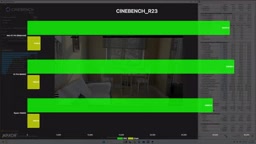
Inside the Neo X1 Pro sits not a desktop processor, but the AMD Ryzen 9 9955HX3D mobile chip. Don't let the "mobile" label fool you — it shares the same 16-core Zen 5 architecture as the desktop flagship 9950X3D.
The CPU offers two power modes in the BIOS. In the default balanced mode, power is capped at 100W, with Cinebench R23 multi-thread scores around 32,300 and single-thread around 2,000. Switching to the 165W performance mode pushes multi-thread up to 39,660 and single-thread to 2,181 — approaching the desktop 9950X3D.
By comparison, the desktop 9950X3D is only about 7% faster in multi-thread workloads, yet the CPU alone costs $680, while the Neo X1 Pro's estimated "CPU + motherboard" combination comes to around $750. From a value standpoint, that's a compelling deal. Jeff admits that while he's always considered 16 cores overkill for a gaming PC, the value proposition of the 9955HX3D is hard to argue with.
The "3D" suffix in AMD Ryzen 9 9955HX3D refers to AMD's 3D V-Cache technology — extra L3 cache stacked vertically on top of the CPU die, expanding total cache from around 32MB on standard models to up to 128MB. The core idea: gaming CPU bottlenecks often aren't about raw compute power, but whether data can be fetched from cache fast enough. The massive L3 cache reduces latency from accessing main memory, improving frame rates and consistency. The 9955HX3D marks the first time this technology has trickled down to mobile HX-series chips for high-performance laptops and small form factor systems — which is why it delivers near-desktop-flagship performance without simply cranking up clock speeds or power draw.
Gaming Benchmarks: 73% Faster Than Last-Gen Mini PCs

Paired with the Yeaston RTX 5070 12GB, the Neo X1 Pro delivers impressive gaming results. Interestingly, Jeff recommends that pure gamers leave the CPU in the lower balanced mode — most games favor single-threaded performance, and the 9955HX3D can still boost to 5.4GHz on a single core even at lower power. The performance mode offers negligible gaming gains while consuming 50% more CPU power.
Jeff compared the Neo X1 Pro directly against the Minisforum G1 Pro (RTX 5060 8GB + Ryzen 8945HX) he reviewed earlier this year. The Neo X1 Pro leads overall 3DMark scores by about 73%, at nearly twice the price.
Real-world gaming results (all at 1440p):
- Cyberpunk 2077: RTX Ultra preset + DLSS Transformer mode — 93 FPS average, 51 FPS 1% low; the G1 Pro managed only 68 FPS at medium settings
- Red Dead Redemption 2: Ultra settings — 86 FPS average, nearly 60 FPS 1% low; the G1 Pro's 1% low nearly dropped below 30
- Helldivers 2: Ultra settings — 131 FPS average, 75 FPS 1% low — its 0.1% low was 5 FPS higher than the RTX 5060's average
- Starfield: 98 FPS average, 54 FPS 1% low
- Borderlands 4: Very High preset — 111 FPS average

Notably, the 8GB RTX 5060 was frequently on the edge of running out of VRAM at 1440p, while the 12GB RTX 5070 never caused concern. Throughout testing, the Neo X1 Pro drew only 375W from the wall in balanced mode while remaining relatively quiet.
DLSS Transformer mode is a major architectural upgrade introduced with DLSS 4. Traditional DLSS used convolutional neural networks (CNN) for super-resolution reconstruction, while Transformer mode switches to a Transformer architecture — the same class of neural network that powers modern large language models. Transformers excel at understanding global context across an image, enabling more accurate detail reconstruction and reducing ghosting and flickering, especially in fast-motion scenes. The mode is more computationally demanding and currently performs best on RTX 50-series GPUs, which is one reason Cyberpunk 2077 was able to hit 93 FPS average at Ultra settings with the RTX 5070.
Excellent Repairability
Small form factor PCs often come with fears of proprietary parts, awkward assembly, or poor repairability. The Neo X1 Pro completely defies those expectations. Remove the side panel and you're looking at a standard Micro-ATX desktop build — a standard desktop RTX 5070, a standard Micro-ATX motherboard, onboard M.2 slots, two expandable SO-DIMM memory slots, and a side-mounted radiator that comes off with just two screws.
Jeff praised the "all off-the-shelf parts" design philosophy, calling it both compact and easy to service and upgrade. This becomes an important setup for his later recommendations.
The Configuration Problem
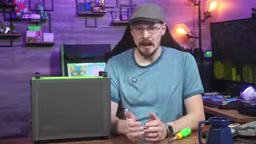
Despite the excellent hardware and "defensible" pricing, Jeff says he can't recommend the Neo X1 Pro to most buyers. The core issue is a rigid set of configuration options.
GMKTec's website only offers two SKUs: an RTX 5060 Ti (likely 8GB) + 32GB DDR5 + 1TB NVMe at $2,199, or the top-spec RTX 5070 + 64GB DDR5 + 2TB NVMe.
The problem: if you want the RTX 5070, you're forced into 64GB of RAM. Jeff is blunt about it: "As a gaming PC, you will never use 64GB of RAM — I don't care what you're playing. Even if you're running three 4K monitors in a flight simulator, you won't touch 64GB." For a pure gaming build, that's wasted budget, artificially inflating what should be a gaming machine to workstation-level pricing.
A Smarter Way to Sell This Thing
Given the machine's excellent repairability, Jeff offers a constructive suggestion: GMKTec should sell the Neo X1 Pro as a barebone system. That means pre-installing the motherboard + CPU combination, 240mm AIO, and 850W PSU, offering a few GPU options (or even a GPU-less variant), then letting users source their own RAM and storage.
He explains that for buyers seeking a compact powerhouse like this, buying 16GB of RAM and dropping it in yourself isn't a barrier at all. This approach would dramatically lower the entry point while preserving the 9955HX3D's appeal to content creators and 3D professionals who actually need 64GB.
A barebone system is a well-established product category in the PC industry. Manufacturers pre-integrate fixed components like the chassis, motherboard, cooling, and power supply, leaving buyers to supply the CPU, RAM, storage, and GPU. This model is especially common in Mini-ITX and ultra-compact PC segments, with notable examples from AOpen, Shuttle, and now GMKTec. The appeal: buyers can configure exactly what they need — a gamer might choose 16GB of RAM while a content creator opts for 64GB — without paying for specs they'll never use. For a machine like the Neo X1 Pro, which uses entirely standard off-the-shelf parts, selling it as a barebone is technically straightforward. It's ultimately a business strategy decision.
Verdict: Great Machine, Wrong Moment
The Neo X1 Pro is an excellent PC — quiet, compact, and seriously powerful. Whether you want a living room Steam box, a LAN party machine you can actually carry, or a capable desktop replacement, it handles all of those roles with ease. It achieves what Jeff considers the hallmark of a great gaming PC: it's "completely invisible to the gaming experience."
But the $3,200 real-world price tag means it's realistically only suited for content creators, 3D professionals, or high-budget buyers who aren't bothered by current RAM prices. That price is a product of the market, not GMKTec's fault — but Jeff still can't give it an enthusiastic thumbs-up.
If GMKTec offered more flexible configurations or a barebone version, this little powerhouse would have a much broader audience. For now, it's a great product born at the wrong time.
Related articles

M&M's Spent Millions Replacing Artificial Blue Dye — Why Is It So Hard?
Mars spent millions trying to replace artificial blue dye in M&M's with spirulina, but thick material clogs pipes and residue risks mold, forcing a full production-line rebuild. Here's the engineering behind the reformulation.

Teammate Wanted for Meta Global AI Developer Hackathon: Computer Vision & Medical AI
A Reddit developer seeks teammates for the Meta Global AI Developer Hackathon, focusing on computer vision and medical AI. This article analyzes the track logic, skills-complementarity needs, and topic selection strategy behind this teaming signal.
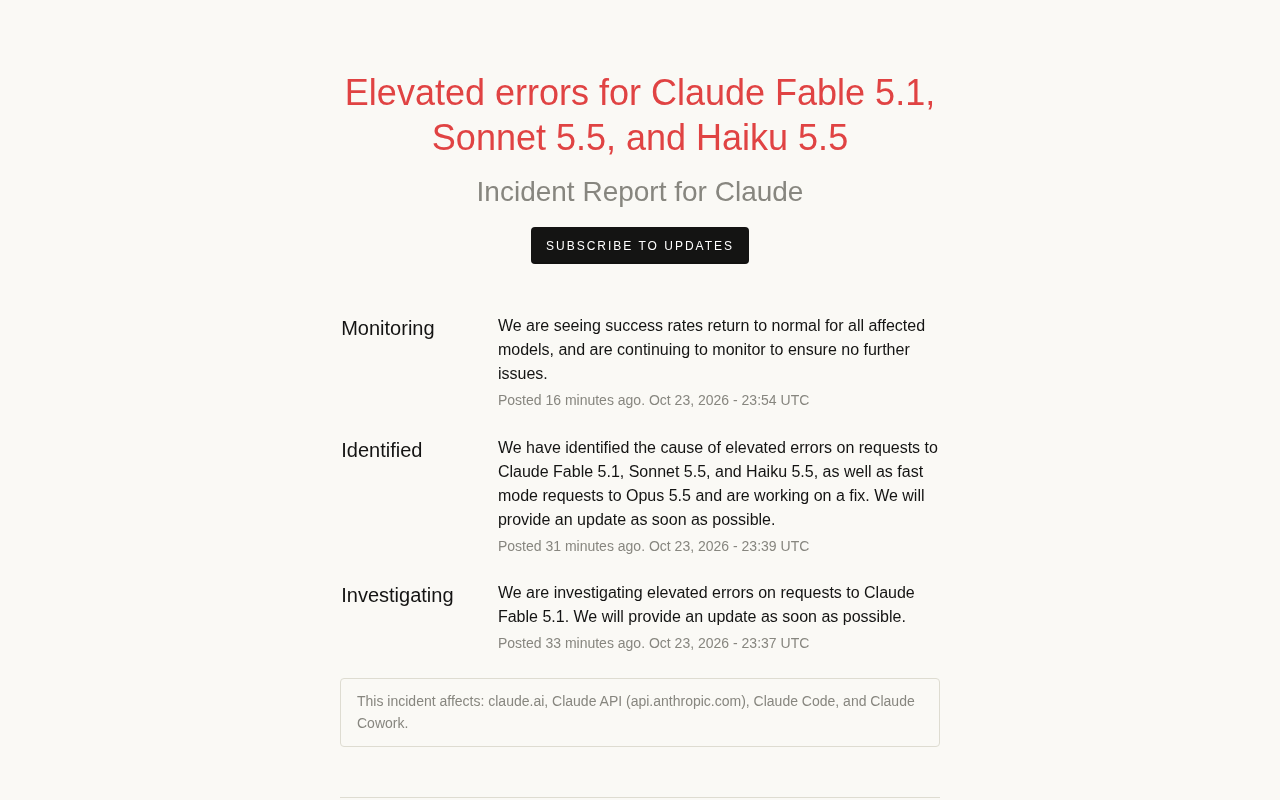
Multiple Claude Models Hit by Errors: A Postmortem of Fable 5.1, Sonnet 5.5, and Haiku 5.5
Claude Fable 5.1, Sonnet 5.5, Haiku 5.5, and Opus 5.5 fast mode saw elevated errors; Anthropic identified and resolved the issue in 17 minutes. This postmortem covers the timeline, the technical reasons for the multi-model cascading failure, and practical lessons for retry and degradation strategies.