Google AI Mode Inflates Product Prices by 21.6%: Causes and Solutions
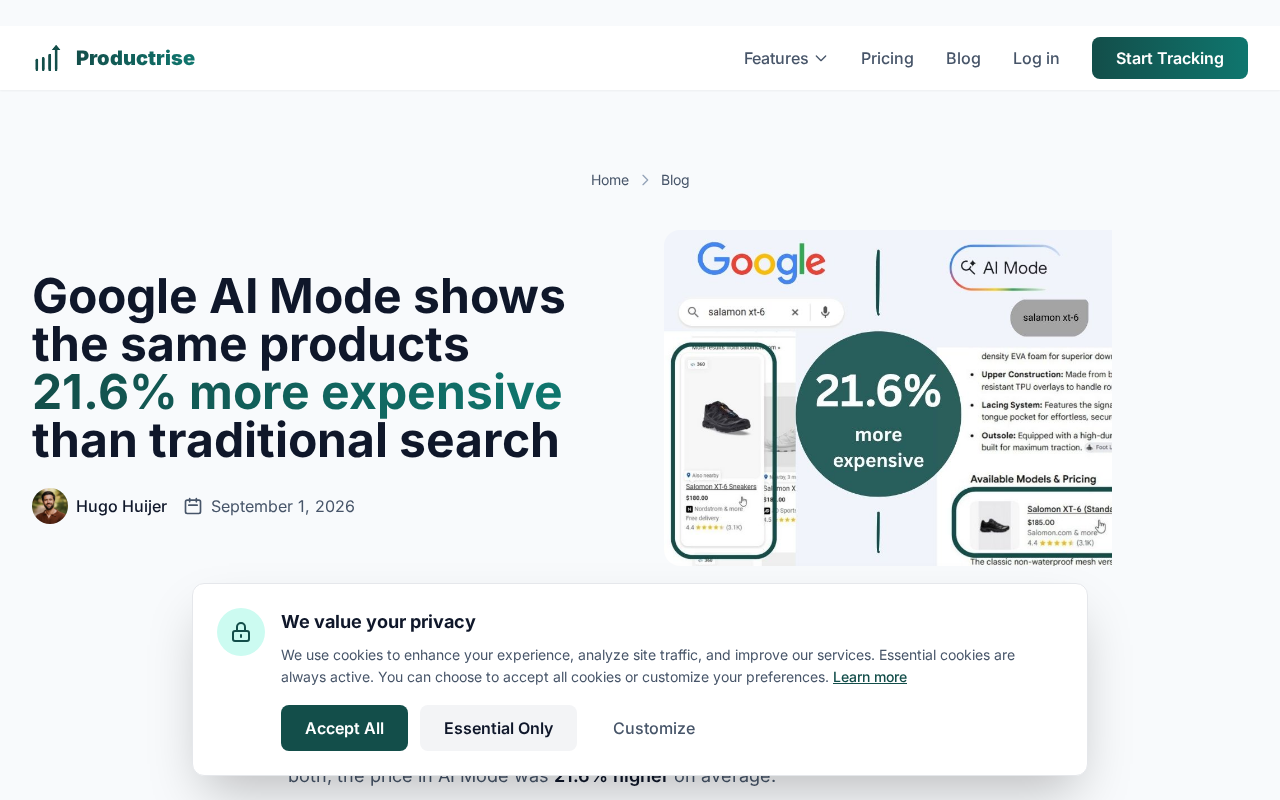
Google AI Mode shows product prices averaging 21.6% higher than traditional search results.
New research reveals that Google AI Mode displays product prices averaging 21.6% higher than traditional search results. The bias stems from AI models favoring well-structured data from premium brands, compressing price comparison opportunities, and operating as opaque black boxes. This article analyzes the technical causes, real-world consumer impact, and proposes countermeasures at the user, platform, and regulatory levels.
The Hidden Cost of AI Search
As Google gradually rolls out AI Overview and AI Mode to mainstream users, an issue that cannot be ignored is surfacing: Are AI-generated search results actually helping users find the best prices? The latest research data offers an alarming answer — Google AI Mode displays product prices that are, on average, 21.6% higher than traditional search results.
This finding is not an isolated anecdote but a conclusion drawn from systematic comparisons of similar products across both search modes. For Google, which handles billions of shopping-related searches daily, the consumer losses and business logic behind this figure warrant a deeper look.
Where Does the AI Search Price Bias Come From?
Misalignment Between AI Recommendation Logic and User Interests
Traditional search relies on algorithms like PageRank to rank results in a relatively transparent manner, where price comparison websites and low-priced products on e-commerce platforms can earn top rankings through relevance. PageRank is the web page ranking algorithm proposed by Google founders Larry Page and Sergey Brin in 1998. Its core idea is to evaluate page importance by analyzing hyperlink relationships between web pages — the more high-quality pages that link to a page, the higher its weight. Building on this, Google gradually introduced text relevance algorithms like TF-IDF and BM25, as well as machine learning models like RankBrain and BERT to understand search intent. Although this system has grown increasingly complex, its underlying logic is relatively explainable: ranking criteria can be traced back to specific signal factors (such as link count, page quality, content relevance, etc.), providing a foundation for regulatory review and fairness assessment.
However, Google AI Mode operates on a fundamentally different mechanism — it uses large language models to understand, summarize, and reorganize content, essentially "translating" and "filtering" information rather than directly presenting raw indexed results. Specifically, AI Mode relies on the Gemini series of large language models (LLMs), which are based on the Transformer architecture and learn language patterns and knowledge representations through pre-training on massive text datasets. When processing a search request, AI Mode doesn't simply retrieve web pages from the index. Instead, it executes a multi-step process: first understanding the user's query intent, then retrieving relevant document fragments through a Retrieval-Augmented Generation (RAG) pipeline, and finally having the LLM synthesize, summarize, and generate a coherent response. During this process, the model's attention mechanism assigns different weights to different information sources, but these weight allocations are implicitly computed within billions of neural network parameters and cannot be audited one by one like traditional ranking factors.
In this process, the AI model's training preferences, the weighting of content sources, and even advertisers' commercial relationships can all influence the products and prices ultimately displayed. More critically, AI Mode tends to provide "answers" rather than "options," which inherently compresses users' ability to compare prices.
Selection Bias in Information Sources
When generating shopping recommendations, AI prioritizes sources with well-structured data and high content authority. This involves a key technical distinction: structured data refers to information organized in predefined formats, such as Schema.org markup and product feeds in Google Merchant Center (containing standardized fields like price, inventory, brand, and SKU). Large retailers and brand owners typically invest significant resources in maintaining this data to ensure it is accurately crawled and parsed by search engines and AI systems. By contrast, product information on small and medium-sized discount platforms, clearance websites, or limited-time promotion pages is often scattered throughout HTML text in unstructured form, lacking standardized markup. AI models naturally favor well-formatted, reliably sourced data, meaning that product pages with lower prices but poorly organized data are more likely to be downranked or even ignored during AI's information filtering.
However, the lowest-priced products don't necessarily come from the most content-rich pages — discount platforms, third-party sellers, and flash sale pages often rank low in AI's "comprehension priority." This structural bias causes AI search recommendations to systematically skew toward higher-priced brands or channels.
What Does a 21.6% Price Inflation Mean for Consumers?
Real-World Impact on Daily Spending
Take a laptop with an average price of 3,000 yuan as an example — a 21.6% price deviation means users could overpay by approximately 648 yuan. For high-frequency, low-price items (such as daily necessities, books, and accessories), the absolute amount per item may be smaller, but the cumulative effect is equally significant.
What's even more noteworthy is that as more users adopt AI Mode as their default search entry point, this systematic bias will shape overall consumer decision-making habits, not just individual purchases.
Structural Challenges to Search Neutrality
Traditional search engines have long faced regulatory scrutiny for the commercialization of search results, and Google has paid massive antitrust fines as a consequence. This regulatory pressure has a long history: in 2017, the European Commission fined Google €2.42 billion in the Google Shopping case, finding that it systematically prioritized its own shopping comparison service in general search results, suppressing competing price comparison sites. In 2024, the European Court of Justice upheld the ruling. Additionally, the U.S. Department of Justice's antitrust lawsuit filed in 2020 cited commercial bias in search results as a core allegation, and in August 2024, a federal judge ruled that Google holds an illegal monopoly in the search market. These cases clearly demonstrate that search result neutrality has been a focal point of global regulation.
In the age of AI search, this problem reappears in a more covert form: when the algorithm is no longer a transparent set of ranking rules but a black-box "intelligent assistant," users have a harder time identifying the commercial logic behind results, and regulators face greater difficulty in gathering evidence. Traditional search ranking factors can at least be partially reconstructed through reverse engineering and statistical analysis, but the decision-making process within billions of parameters of a large language model is currently almost impossible to audit at the same level of granularity.
Broader Issues in the AI Search Ecosystem
It's Not Just a Google Problem
Competing products like Perplexity, Bing Copilot, and ChatGPT Search face similar challenges. AI search business models are still immature, and every platform is exploring how to strike a balance between "useful answers" and "sustainable monetization." Each currently follows a different commercialization path: Perplexity uses a hybrid model of subscriptions plus advertising, and began inserting "sponsored questions" and brand recommendations into answers in late 2024; Bing Copilot leverages Microsoft's Azure cloud ecosystem, using AI search as an entry point to attract users into paid products like Microsoft 365; ChatGPT Search is built on OpenAI's content licensing agreements with publishers, cross-subsidizing search costs through subscription revenue from ChatGPT Plus and similar plans. All these models face the same core contradiction: a single AI search query costs approximately 6–10 times more than a traditional search query, and how to cover steep inference costs while maintaining result neutrality remains an unsolved problem for the entire industry.
Google's case draws particular attention because of its market scale — once bias becomes embedded in the product logic, the scope of impact will far exceed that of any competitor.
Users' Passive Adaptation
Research shows that users place significantly more trust in AI-generated answers than in traditional search result lists. This phenomenon can be explained by Authority Bias in behavioral economics — people tend to trust information from authoritative sources more, even when that information is inaccurate. AI search, through its natural language–generated, seemingly definitive responses, inherently carries an aura of "omniscience." This stands in stark contrast to traditional search engines' "ten blue links," which imply that answers are diverse and require the user's own judgment.
At the same time, the Anchoring Effect is quietly at play. Nobel laureate Daniel Kahneman's research has shown that when a number is presented first, even if it's random, people's subsequent numerical judgments will significantly gravitate toward that anchor. In the context of AI shopping search, the price that AI displays first becomes the user's psychological anchor. Even if the user later encounters a lower price on another platform, their perception of a "reasonable price" has already been systematically shifted upward.
This sense of "authority" reduces users' motivation to question results and decreases cross-platform price comparison behavior. From a behavioral economics perspective, AI search is reshaping users' shopping decision paths — and when that path systematically points toward higher prices, the tension between "convenience" and "affordability" becomes increasingly pronounced.
How to Address AI Search Price Bias
Facing this phenomenon, users and the industry can take countermeasures from several dimensions:
- User level: For high-value purchase decisions, users should not rely solely on AI Mode. They should proactively switch to traditional search or dedicated price comparison platforms (such as Google Shopping or native search on e-commerce platforms) for cross-verification.
- Platform level: Search engine providers need to establish price fairness auditing mechanisms for shopping-related AI results to prevent AI recommendations from becoming a disguised form of paid rankings.
- Regulatory level: Existing search fairness regulatory frameworks need to be updated to cover the recommendation logic of AI-generated content, requiring platforms to disclose the key factors influencing AI results. The EU's Digital Markets Act (DMA) and AI Act have begun to touch on this area, but when it comes to price fairness in AI search shopping results specifically, there is still a lack of clear enforcement precedent globally.
Conclusion
The finding that Google AI Mode inflates prices by 21.6% reveals more than just a product flaw — it exposes a systemic structural tension in the commercialization of AI search: when AI markets itself as helping users "find the best answer" yet systematically skews toward higher prices, user trust becomes an asset that is being depleted.
How to rebuild the balance between intelligent experiences and user interests will be one of the most important questions for the next phase of AI search.
Related articles
OpenAI Declares the AGI Era Has Arrived: Conceptual Controversies and Technical Realities
OpenAI launches GPT-6 Astra claiming the AGI era has arrived, sparking controversy. Deep analysis of AGI definition ambiguity, technical progress realities, industry standards battle, and practical impacts on users and developers.

Vercel AI SDK TogetherAI Adapter 3.0.45 Update Analysis
Analysis of @ai-sdk/togetherai 3.0.45 patch update covering dependency sync, OpenAI compatibility layer architecture, and semantic versioning strategy in Vercel AI SDK.
Deep Dive into Vercel AI SDK Svelte 5.0.93 Release Update
In-depth analysis of Vercel AI SDK Svelte 5.0.93 patch update, covering multi-framework adaptation, dependency sync, and automated release pipelines for Svelte AI app development.