Google Antigravity Adds Claude 5.5: A Complete Breakdown of the Quota System

Antigravity adds Claude 5.5 with mandatory paid access as Google tightens Gemini quotas and shifts toward feature gating.
Google's AI IDE Antigravity has integrated Anthropic's Claude 5.5 series (Opus 5.5 and Sonnet 5.5), but third-party model access now requires a verified paid account flag, with the 4.6 series retiring November 2nd. Google has also restructured Gemini quotas: free accounts lose access to Flash and Pro models starting October 9th, with paid tiers offering 2×/4×/20× baseline quotas for Plus/Pro/Ultra respectively. Claude 5.5 weekly quotas are roughly $13 for Pro and $50 for Ultra, though these figures may change. Overall, Google is accelerating paid conversion through both quota tightening and feature gating, with Gemini 4 Argon as the next key milestone to watch.
Google's AI IDE Antigravity has just integrated Anthropic's Claude 5.5 model series, including Opus 5.5 and Sonnet 5.5. This update doesn't just bring new models — it also comes with a series of changes to account eligibility and quota mechanics. Bilibili creator DP compiled an analysis based on personal observations and publicly available information, which this article organizes and expands upon for interested users. As always, consult Google's official documentation for the most accurate details.
Which Accounts Can Access It — and Which Can't
This Claude 5.5 integration draws a clear line between eligible and ineligible accounts. The key determining factor is whether an account carries a Paid flag — indicating that the user is a genuine paying subscriber.
In other words, accessing third-party models (the Claude series) on Antigravity now requires real payment. Google has begun making explicit distinctions for non-paying subscriptions. Meanwhile, the existing 4.6 model series is set to be officially discontinued on November 2nd.
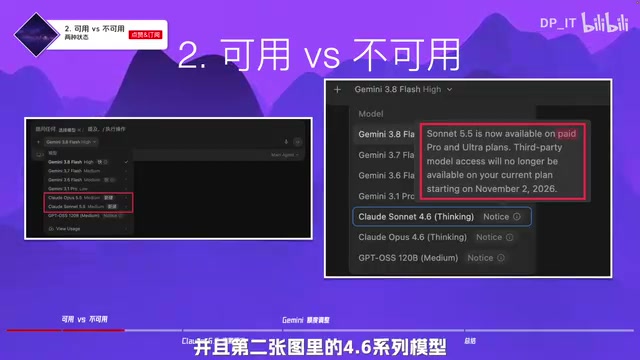
If your account is under Google One but currently ineligible, and you want to try Opus 5.5, DP mentions there's currently an exploitable bug: accounts added to a family group can gain access. However, this kind of workaround can be patched at any time and shouldn't be relied on as a long-term solution.
Antigravity is Google's AI-native integrated development environment (IDE), similar in positioning to Cursor or GitHub Copilot, focused on deeply embedding large language model capabilities into coding workflows. It natively supports the Gemini model family while also opening integration channels for third-party models — which is how the Claude series is accessed. Google One is Google's subscription service ecosystem, covering expanded cloud storage and cross-product perks. Being a Google One member doesn't automatically mean you're a direct paying subscriber to Antigravity or Gemini Advanced — which is exactly why the "Paid flag" distinction exists. In short, holding a Google One membership does not qualify you as a "genuine paying" user within the Antigravity ecosystem; the two account systems operate on different privilege tiers.
Claude 5.5 Quota Mechanics
Based on currently observed data, the Claude 5.5 series quotas across different subscription tiers are roughly as follows:
Pro Subscription
- Approximately $5 per 5-hour window
- Weekly quota approximately $13 (roughly 2.5× the 5-hour quota)
Ultra Users ($100 tier)
- Approximately $20 per 5-hour window
- Weekly quota approximately $50 (also roughly a 2.5× relationship)
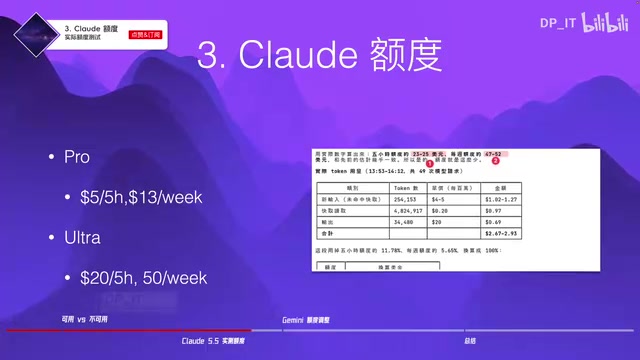
It's important to emphasize that these figures represent values observable at the current point in time. Based on past experience, quotas Google provides for third-party models are likely to change at any time. These numbers should be treated as reference only and not used as the sole basis for long-term decisions.
A Closer Look at Gemini Quotas
Google has also recently revised Gemini quotas, primarily reflected in updates to official documentation. Under the new docs, the quota tiers roughly break down as follows:
- Free accounts: Baseline quota (1×)
- Plus (~$5): 2× quota
- Pro subscription (~$20): 4× quota
- Ultra first tier (~$100): 20× quota
Many users may feel that the $20 tier offering only 4× the free quota isn't great value. But Google has now introduced clearer functional differentiation: starting October 9th, free accounts cannot access Flash or Pro models; Plus, as the first paid tier, also cannot access Pro models; full access to all models starts at the Pro subscription level.
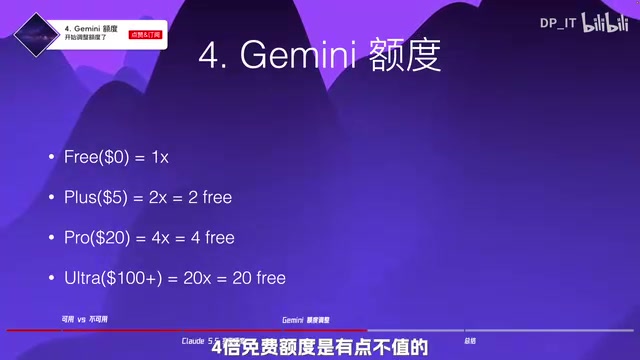
In other words, the value of paying isn't just reflected in quota multipliers — it's also expressed through tiered access to models. This pricing strategy separates "usage volume" and "feature permissions" into two distinct dimensions for differentiating user tiers.
This dual-dimension pricing approach — splitting usage volume from feature permissions — is known in the SaaS industry as Feature Gating: controlling which product features users can access based on their subscription tier, rather than merely limiting usage volume. For Google, removing access to Flash and Pro models from the free tier both drives paid conversion and reduces free users' consumption of compute resources during peak periods. Gemini Flash is Google's lightweight, low-latency model optimized for high-frequency, low-cost use cases; Gemini Pro is the primary model designed for complex tasks. Once free users lose access to both model types, their practical capabilities become significantly limited — which substantially increases the incentive to upgrade.
Quota Trends: An Overall Tightening
There's another signal worth watching. After Google I/O earlier this year, Antigravity's quotas were boosted by roughly 9× overall, and that increase is still in effect. However, whether Antigravity's quotas will be adjusted in sync with the updated Gemini documentation after October 9th remains unclear.
The overall trend toward tightening is fairly evident. For users who have relied on free or high-quota policies, this means it's time to reassess usage habits and cost expectations.
Should You Be Excited About Gemini 4 Argon?
Looking at this series of changes across Antigravity and Gemini, it's clear that Google is feeling competitive pressure — which is entirely understandable given the current AI model race.
The upcoming Gemini 4 Argon is the next major thing to watch. Based on Google's recent moves, the company appears to have considerable confidence in this model, even amid potential compute constraints. That said, DP also cautions: Gemini 3.5 Pro never shipped as expected, and whether Gemini 4 will launch on schedule carries similar uncertainty — official confirmation is still needed.
The "Argon" naming in Gemini 4 Argon follows Google's convention of using chemical element names for model variants (alongside functional names like Flash, Pro, and Ultra, as well as size-based names like Nano). Argon, as a noble gas, has no official performance positioning yet; speculation suggests it may be a high-performance variant positioned between Pro and Ultra, or a model specializing in reasoning. The Gemini roadmap shown at Google I/O 2025 generated significant interest in Argon, but given the precedent of Gemini 3.5 Pro never materializing, the actual release timeline warrants a wait-and-see approach.
Summary
This Antigravity update integrating Claude 5.5 has three core takeaways: third-party model access now requires genuine paid status, Gemini quota tiers have become more clearly defined, and the overall trend is toward tightening. For Google One users, it's worth exercising caution before making any payment or renewal decisions, and factoring in historical patterns.
All data in this article is sourced from the creator's personal observations and public information, provided for reference only. Always refer to Google's official documentation for authoritative details.
Related articles

Cursor AI Programming in Practice: Build a Student Management System from Scratch in 30 Minutes
A Bilibili creator demonstrates Cursor AI programming: generating a student management system in 30 minutes with natural language. Details on Agent mode, Claude selection, prompt techniques, and thresholds.

Top 20 AI Coding Tools Ranking: From Rock-Solid to Lackluster, a Scored Matrix
Bilibili creator releases top 20 AI coding tools ranking, tiered T0–T4 from rock-solid to lackluster, with Claude Code and Codex tied at T0. This article details the scoring dimensions (capability, reliability, robustness, durability, cost, domestic availability) and tool performances to help developers choose the right AI coding assistant.

Vibe Coding Systematic Tutorial: Master AI-Assisted Programming from Zero
A three-month Vibe Coding tutorial from a Bilibili creator covering Codex, ClaudeCode, and Cursor, from core logic to commercial project practice for beginners.