Google Cloud Launches Healthcare Version of Gemini: Integrating Clinical Data and Automating Workflows
Google Cloud launches healthcare version of Gemini, focusing on unified clinical data and automated administrative workflows.
Google Cloud has officially launched Gemini for healthcare, targeting fragmented clinical data and excessive administrative burden on medical staff. Core capabilities include a unified view of heterogeneous multi-source clinical data and automation of repetitive administrative processes such as form filling and information transcription, aiming to give time back to diagnosis and treatment. The article notes that healthcare scenarios have extremely low error tolerance, making reliability and auditability key to adoption, while the original text does not disclose accuracy metrics or customer deployment scale. With Microsoft and Amazon competing in healthcare AI, Google Cloud differentiates through a cloud platform combination of "data integration + model inference," but long procurement cycles and strict compliance reviews mean large-scale adoption remains to be seen.
Google Cloud has officially released Gemini for the healthcare industry, aiming directly at two major pain points: fragmented clinical data and excessive administrative burden on medical staff. Unlike the general-purpose Gemini, this version focuses on a unified clinical data view and automating repetitive workflows, attempting to move AI from "can chat" to "can do work."
Pain Points of Healthcare AI: Data Silos and Administrative Burnout
Clinical data is scattered across electronic medical records, imaging systems, laboratory platforms, and various specialty software, each with different formats and no interconnection. Doctors must repeatedly switch between multiple systems to piece together a complete patient profile, spending large amounts of time on retrieval and data entry rather than on diagnosis and treatment itself. The original text explicitly lists "reducing administrative burnout" as one of the product goals—this is no coincidence. Administrative tasks have long crowded out clinical time and are a widely recognized efficiency bottleneck in the healthcare industry. The entry point of Gemini for healthcare is precisely to use a unified AI layer to connect scattered data and take over processes that are clearly rule-based and highly repetitive.
Electronic Health Records (EHR) are the core systems used by healthcare institutions to record patient diagnosis and treatment information, typically containing structured and unstructured data such as medical history, diagnoses, medications, and test results. Due to historical reasons, EHR systems from different vendors (such as Epic and Cerner) use their own data models and interface standards. Cross-system data exchange relies on protocols such as HL7 and FHIR, but in practice there are still issues such as complex semantic mapping and missing fields. This is the technical root of "data silos": the data does exist, but it is difficult to understand and invoke uniformly. If healthcare AI is to truly assist clinical practice, it must first solve the semantic alignment of multi-source data, rather than merely performing surface-level integration.
Unified Clinical Data: From "Can View" to "Can Use"
"Unified clinical data" sounds abstract, but in product terms it means aggregating heterogeneous medical information from multiple sources into a consistent context for the model to understand and invoke. This places higher demands on AI than general scenarios: medical data involves privacy compliance, complex terminology systems, and sensitive time dimensions. The model must understand the clinical meaning of test values and the chronological logic of medication records, rather than simply performing text summarization. Google Cloud's choice to provide this capability at the cloud platform level is effectively selling a combination of "data integration + model inference" rather than an isolated chat entry point. For healthcare institutions that already host data on Google Cloud, the barrier to adoption is relatively lower; but for institutions whose data is scattered on-premises or on other clouds, integration costs remain a practical consideration.
FHIR (Fast Healthcare Interoperability Resources) is currently the mainstream standard for healthcare data interoperability. Developed by the HL7 organization, it uses a RESTful API style to define resource models (such as Patient, Observation, and MedicationRequest). Compared with the earlier HL7 v2 message format, FHIR is better suited to modern cloud-native architectures and makes it easier for AI models to read and write clinical data in a standardized way. Google Cloud typically emphasizes FHIR support in its healthcare AI products because it is the key middleware for connecting multi-source data and realizing a "unified clinical view." Understanding FHIR's role helps assess the actual capability boundaries of such products in data integration.
Automated Workflows: Handing Administrative Burden to the Model
Automation is the other main thread of this release. The root of administrative burnout lies in a large number of low-value but unavoidable operations—form filling, information transcription, cross-system synchronization, and routine reminders. Gemini for healthcare is positioned to complete or greatly simplify these processes in the background, giving medical staff time back to patients. The challenge here is not the model's capability itself, but reliability: the healthcare sector has extremely low tolerance for errors, and once an automated workflow fails, the cost is far higher than in general office scenarios. Therefore, whether the product can be adopted depends on its accuracy and auditability in real workflows, not just demo results. The original text does not disclose specific accuracy metrics or customer deployment scale; this information remains to be observed.
Auditability in the context of healthcare AI refers to the ability to trace, review, and assign responsibility for model outputs and automated operations. Healthcare scenarios require that every AI-generated suggestion or automatically filled record can be linked to the original data source, model version, and operation timestamp, so that clinical staff can review it and regulators can audit it. Automated workflows lacking auditability are difficult to pass hospital compliance reviews and cannot establish accountability when errors occur. Therefore, healthcare AI products usually need to be designed with logging, human review checkpoints, and version management mechanisms—fundamentally different from the "generate and use" model in general office scenarios.
Competitive Landscape and Adoption Barriers
Healthcare is a high-value vertical that major cloud vendors are competing for, with Microsoft and Amazon both advancing their own healthcare AI solutions. Google Cloud's differentiation lies in binding Gemini's model capabilities to its existing cloud infrastructure, forming a closed loop from data storage to model invocation. However, the healthcare industry has long procurement cycles and strict compliance reviews, and there is often a considerable gap between product launch and large-scale adoption. How data privacy is handled, how model outputs are reviewed by clinical staff, and how responsibility boundaries are defined—unless these issues are resolved, automated workflows will struggle to truly enter core diagnosis and treatment processes.
Directions Worth Watching
For healthcare institutions, the value of such products is not "using AI" but whether they truly reduce repetitive work and make data retrieval faster. For developers, Google Cloud's approach of encapsulating model capabilities for vertical industries is worth referencing: overlaying industry data standards and workflow orchestration on top of general models is the form that enterprise AI adoption takes. Going forward, it is worth watching actual deployment cases, the degree of refinement in compliance frameworks, and how automated workflows perform in real clinical environments.
One-line Summary
Google Cloud releases healthcare version of Gemini, focusing on unified clinical data and automated administrative workflows.
Paragraph Summary
Google Cloud has officially launched Gemini for the healthcare industry, targeting two major pain points: fragmented clinical data and excessive administrative burden on medical staff. The product's core capabilities include a unified view of heterogeneous clinical data from multiple sources, as well as automation of repetitive administrative processes such as form filling and information transcription, with the goal of giving time back to diagnosis and treatment. The article notes that healthcare scenarios have extremely low tolerance for errors, and the reliability and auditability of automated workflows are key to adoption, while the original text does not disclose accuracy metrics or customer deployment scale. Against the backdrop of Microsoft and Amazon competing in healthcare AI, Google Cloud differentiates itself with a cloud platform combination of "data integration + model inference," but long procurement cycles and strict compliance reviews mean large-scale adoption remains to be seen.
Related articles
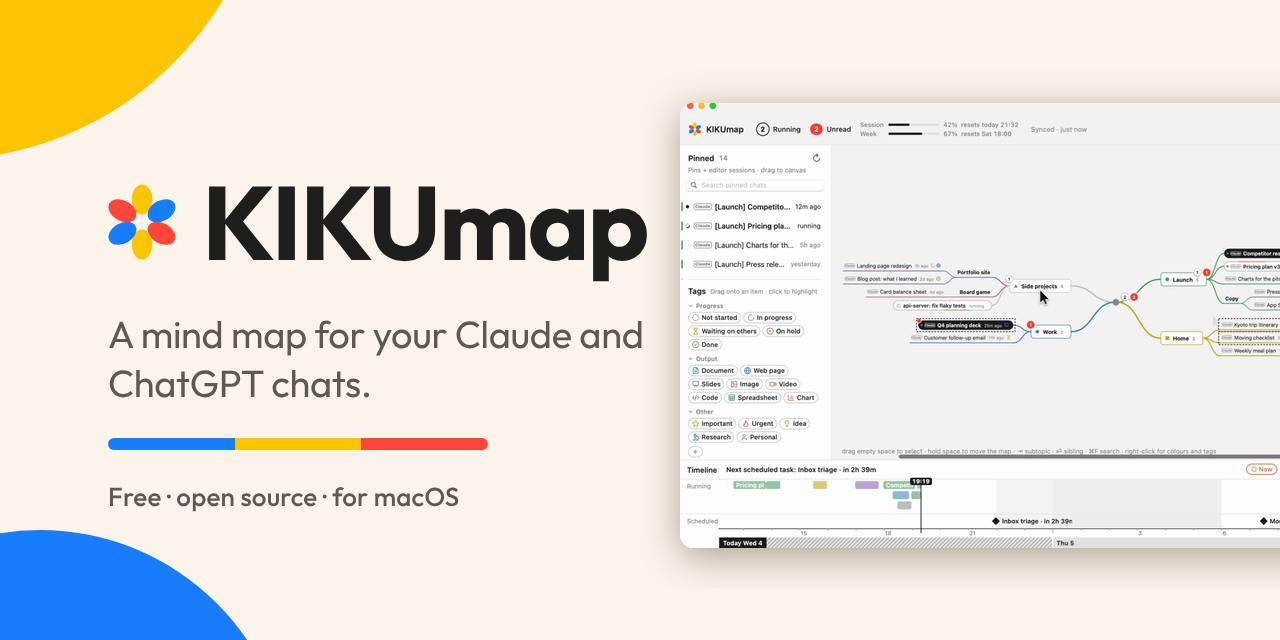
KIKUmap: Manage Your Claude and ChatGPT Conversations with Mind Maps
KIKUmap is a macOS menu bar app that visualizes Claude and ChatGPT conversations as mind maps with real-time status. Free and open source.

Hugging Face Executive Warns: Cyberattacks Are Eroding the Openness of Open-Source AI
Hugging Face executive Irene Solaiman warns that rising cyberattacks on open AI platforms may force stricter security limits, threatening the openness of the open-source community and affecting the developer ecosystem.
OpenAI's Free AI Course Goes Into Comm…
OpenAI's Free AI Course Goes Into Communities: Helping Caregivers Bring ChatGPT Into Daily Life
OpenAI Academy offers free, hands-on ChatGPT workshops for caregivers in five U.S. cities, helping non-technical people build practical AI skills for daily life. This article analyzes the training model, caregiver scenarios, and implications for AI adoption.