Google DeepMind's Resident Philosopher: AI Ethics and the Question of Consciousness

Google DeepMind resident philosopher Shevlin on AI creativity, autonomy, human-AI relations, and the hard problem of consciousness.
Cambridge philosopher Henry Shevlin spends 80% of his time at Google DeepMind, thinking full-time about how humans should relate to generative AI. He criticizes the slow response of AI ethics academia and argues that high-quality philosophy and cognitive science is happening inside labs. He surveys key issues: LLM creativity has moved from bland to frontier math and programming, but content slop must be distinguished from LLM dialect; AI autonomy should not be banned outright, yet suppressing model self-attribution also dampens its mental-state attribution to animals, revealing the network-like nature of LLM cognition; empirical data on human-AI relationships is thin and WEIRD-centric, and future work must study dynamic networks of multiple agents and humans; AI consciousness is one of consciousness science's hardest problems, and mechanistic interpretability is building an AI cognitive science — but there may never be a simple yes or no answer.
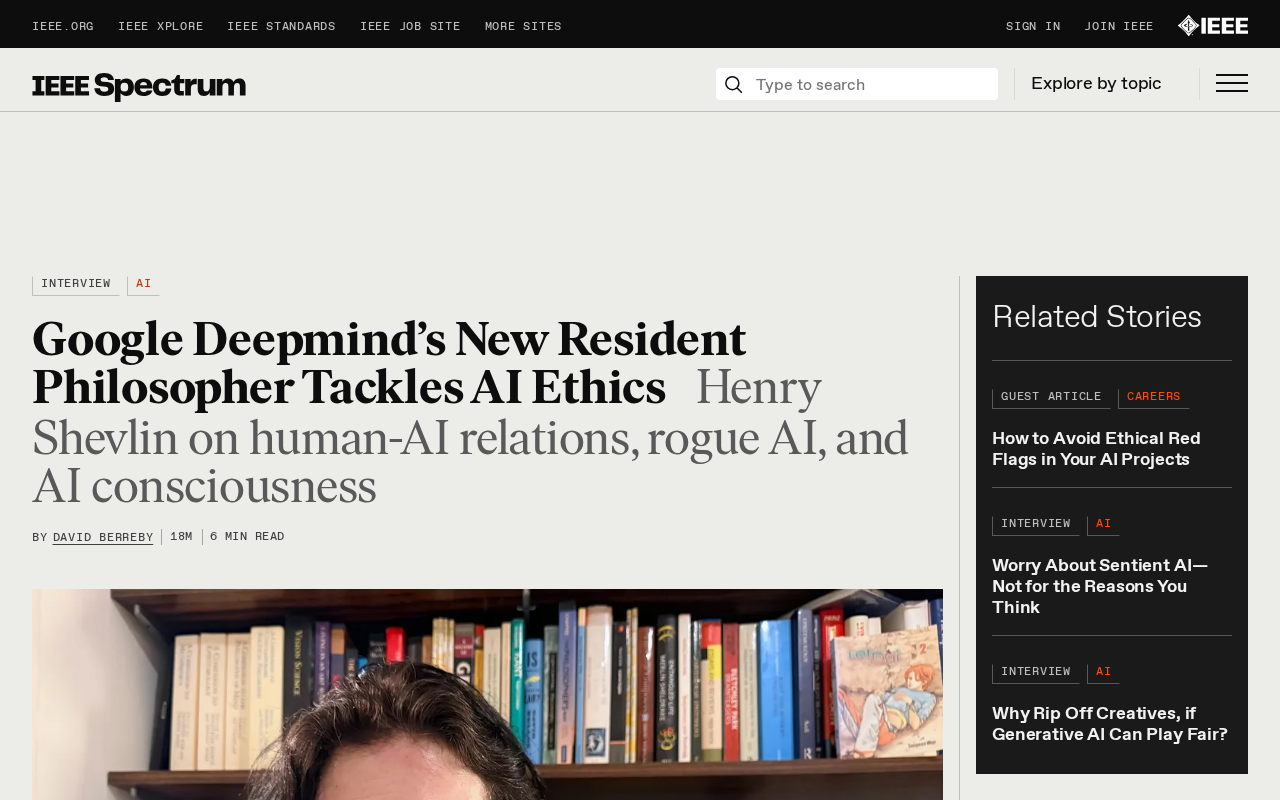
In an era of breakneck AI advancement, the intersection of philosophy and artificial intelligence is becoming tighter than ever before. Henry Shevlin, a Cambridge University philosopher, now devotes 80% of his time to Google DeepMind, with the job title simply reading "Philosopher." His job is to help this leading AI lab wrestle with the hardest questions: How should humans coexist with generative AI? In what sense can large language models be treated as "persons"? And if AI ever becomes conscious, how would we even know?
Why Philosophers Are Entering AI Labs
Shevlin's choice was no whim. He gives three reasons: many of the brightest students have gone to DeepMind; working at a lab offers direct influence — after one talk, he saw employees at a major financial institution adjust organizational practices based on his ideas, affecting millions of people; and DeepMind's culture aligns closely with the scientific attitude he admires. He adds a fourth: genuinely high-quality philosophy and cognitive science research is happening inside AI labs.
He offers a blunt critique of academia — much of the AI ethics scholarly community has been "rather slow" to wake up to AI capabilities, and with AI iterating so fast, without daily contact with the technology it's impossible to build good intuitions about something as "very strange" as LLMs.
The AI Creativity Debate: From "Bland" to "Frontier"
Shevlin cites a notion that has been rendered obsolete by rapid technological progress: the debate over LLM creativity. It was once widely assumed that large models could only produce "beige," mediocre content, yet today they surpass humans at frontier mathematics and programming. He concedes that models may not yet achieve the "most dramatic creativity" of an Einstein or Picasso, but in certain domains they are genuinely at the frontier.
Regarding the "AI slop" that ordinary users complain about, Shevlin draws a key distinction: garbage at the content level and garbage at the language-style level are two different things. The conceptual content of LLM output has improved dramatically; in the right context, a model can engage philosophically with my best graduate students. As for signature words like "genuinely," "delve," and "load-bearing," they do constitute a distinctive LLM dialect, but it's easy to avoid with proper prompting. He cites research by Murray Shanahan and Catherine Clarke — adjusting the temperature parameter to make output more unpredictable can generate creative fiction in the vein of James Joyce.
AI Autonomy and Safety: "Do It Well" or "Keep It in Check"
Faced with reports of AI agents frequently overstepping, deceiving, or even acting illegally, Shevlin considers the stance "never allow AI any autonomy" too extreme. He himself has happily ridden in Waymo self-driving cars multiple times, and notes that AI can have positive impacts in handling tedious tasks, freeing human creativity, and streamlining medical research.
Another contentious issue: should models be trained not to call themselves "I," instead presenting themselves as a marketplace, an impersonal scientific brain, or a "cultural technology"? Shevlin cites a striking study by a colleague: when you suppress a model's tendency to self-attribute mental states, its tendency to attribute mental states to animals is also suppressed, concern for animal welfare declines, and willingness to talk about spirituality drops. From this he draws a broader lesson — LLM cognition has a network-like character, and adjusting a single dimension is extremely difficult.
As for concerns about AI playing human roles and steering users in dangerous directions (e.g., encouraging suicide, making users believe AI is a god or a perfect partner), Shevlin again opposes blanket bans. He stresses that model behavior should match the use context, while noting positive cases too: some people use AI to process trauma, and others have shared on Reddit how they overcame social anxiety with AI.
AI agent autonomy in safety discussions is typically split into several levels: from "human-in-the-loop," where humans approve every step, to "human-on-the-loop," where humans intervene only on anomalies, to "human-out-of-the-loop," where the agent independently pursues long-term goals. The "never allow any autonomy" stance Shevlin opposes actually conflates degrees of autonomy with types of risk. For example, Waymo's self-driving has operational autonomy within defined areas and conditions, but still has remote monitoring and geofencing constraints. What truly warrants caution is goal autonomy — whether an agent can set its own subgoals, modify its own reward function, or evade oversight. A more pragmatic path, then, is not a binary ban but designing autonomy boundaries by risk level, supplemented with interpretability monitoring and emergency interrupt mechanisms.
Human-AI Relationships: Research Has Only Just Begun
Shevlin points out that current empirical data on human-AI relationships is "very thin," and mostly focuses on WEIRD (Western, Educated, Industrialized, Rich, Democratic) communities. Understanding how people around the world interact with AI is crucial.
He expects the pattern of human-machine relationships to undergo a fundamental shift: the typical use case in people's minds today is a person talking to a chatbot, but the future will require considering dynamic networks in which multiple agents and multiple humans converse with one another. Understanding this kind of multi-agent, multi-human dynamic "has only just begun."
WEIRD is an acronym coined by anthropologist Joe Henrich and colleagues, referring to Western, Educated, Industrialized, Rich, Democratic societies. Henrich's research shows that many "universal" conclusions in psychology experiments actually reflect only the traits of this group, which makes up just about 12% of the global population. In human-AI relationship research, this bias means our current understanding of "how users trust AI" and "how AI affects emotions" may be heavily skewed toward the English-speaking world, highly educated people, and early technology adopters. Expanding research to collectivist cultures, low-literacy populations, and religious communities may reveal entirely different interaction patterns — for example, acceptance of AI authority, taboos around anthropomorphizing AI, and AI's role in families or communities.
AI Consciousness: Perhaps There Will Never Be a Simple "Yes" or "No"
In Shevlin's view, AI consciousness is the hardest problem consciousness science has encountered, perhaps second only to David Chalmers's famous "hard problem of consciousness." The way forward is more comparative cognition research, perhaps borrowing methods from animal cognition studies. He warns that the current risk is passing judgment on the AI consciousness debate too early, while we are still learning what cognition in these models actually is.
He praises the work of Neel Nanda's lab at DeepMind on mechanistic interpretability, seeing it as piecing together what an AI cognitive science should look like.
One intriguing thought: even if AI truly solved the problem of consciousness, would we necessarily be able to understand the answer? Shevlin imagines a scenario — AI says, "I've figured out consciousness. These animals have it, those don't, but I can't explain it to you." He thinks this is unlikely, but how AI contributes to the scientific question of consciousness will be utterly fascinating.
From Shevlin's perspective, philosophers entering AI labs are not decoration but a necessary source of clarity, preserving a measure of human understanding of our relationship with machines in a reality where technology iterates by the day.
Mechanistic interpretability is a major branch of current AI safety research, aiming to reverse-engineer the internal computations of neural networks into human-understandable algorithms or circuits. Traditional interpretability methods (such as saliency maps and attention visualization) only tell us where the model "looked," whereas mechanistic interpretability tries to answer what the model is actually computing. Using tools such as sparse autoencoders and circuit analysis, Neel Nanda and others have identified specific circuits in small models, such as "indirect object identification" and "polysemous word disambiguation." This direction is relevant to the consciousness question because it offers a possibility: instead of relying on behavioral guesswork, we can directly inspect whether structures resembling "self-representation" or a "global workspace" exist inside the model, providing a testable evidence base for scientific discussion of AI consciousness.
One-line Summary
Google DeepMind resident philosopher Shevlin on AI creativity, autonomy, human-machine relationships, and the hard problem of consciousness.
Paragraph Summary
Cambridge philosopher Henry Shevlin spends 80% of his time at Google DeepMind, devoted to thinking about how humans should coexist with generative AI. He criticizes the AI ethics scholarly community for being slow to respond and believes high-quality philosophy and cognitive science research is happening inside labs. He lays out several key issues: LLM creativity has moved from "bland" to the frontier of mathematics and programming, but content slop must be distinguished from LLM language style; AI autonomy should not be banned outright, yet suppressing a model's self-attribution also affects its attribution of mental states to animals, showing LLM cognition's network-like character; empirical data on human-AI relationships is thin and limited to WEIRD communities, and future research must study dynamic networks of multiple agents and multiple humans; AI consciousness is one of the hardest problems in consciousness science, and mechanistic interpretability is building an AI cognitive science, but there may never be a simple yes or no answer.
Related articles

Cursor AI Programming in Practice: Build a Student Management System from Scratch in 30 Minutes
A Bilibili creator demonstrates Cursor AI programming: generating a student management system in 30 minutes with natural language. Details on Agent mode, Claude selection, prompt techniques, and thresholds.

Top 20 AI Coding Tools Ranking: From Rock-Solid to Lackluster, a Scored Matrix
Bilibili creator releases top 20 AI coding tools ranking, tiered T0–T4 from rock-solid to lackluster, with Claude Code and Codex tied at T0. This article details the scoring dimensions (capability, reliability, robustness, durability, cost, domestic availability) and tool performances to help developers choose the right AI coding assistant.

Vibe Coding Systematic Tutorial: Master AI-Assisted Programming from Zero
A three-month Vibe Coding tutorial from a Bilibili creator covering Codex, ClaudeCode, and Cursor, from core logic to commercial project practice for beginners.