Google Fitbit Air Launches in India, But High Pricing Could Limit Mass Adoption

Fitbit Air hits India at $146, a ~50% premium over its U.S. price, facing stiff competition from budget-friendly local brands.
Google's Fitbit brand has introduced the Fitbit Air in India at approximately $146 — around $47 more than its $99 U.S. price, representing a nearly 50% premium. This pricing has raised eyebrows in India's highly price-sensitive wearables market, where domestic and Chinese brands dominate with devices priced between $20 and $50. The premium likely reflects India's high import tariffs, logistics costs, and local operational expenses, as well as a deliberate strategy to target urban middle-class consumers. While Fitbit's health data ecosystem and Google integration offer some differentiation, whether Indian consumers will pay the premium remains uncertain.
Google's health wearable brand Fitbit has officially launched the Fitbit Air in India. Priced at approximately $146 in the Indian market — about $47 more than its $99 U.S. price tag — the nearly 50% premium has sparked industry discussion about how well the device will be received.
Pricing Strategy Raises Eyebrows
The Fitbit Air retails for around $146 in India, compared to roughly $99 in the United States. That $47 gap means Indian consumers are paying over 40% more for the same product.
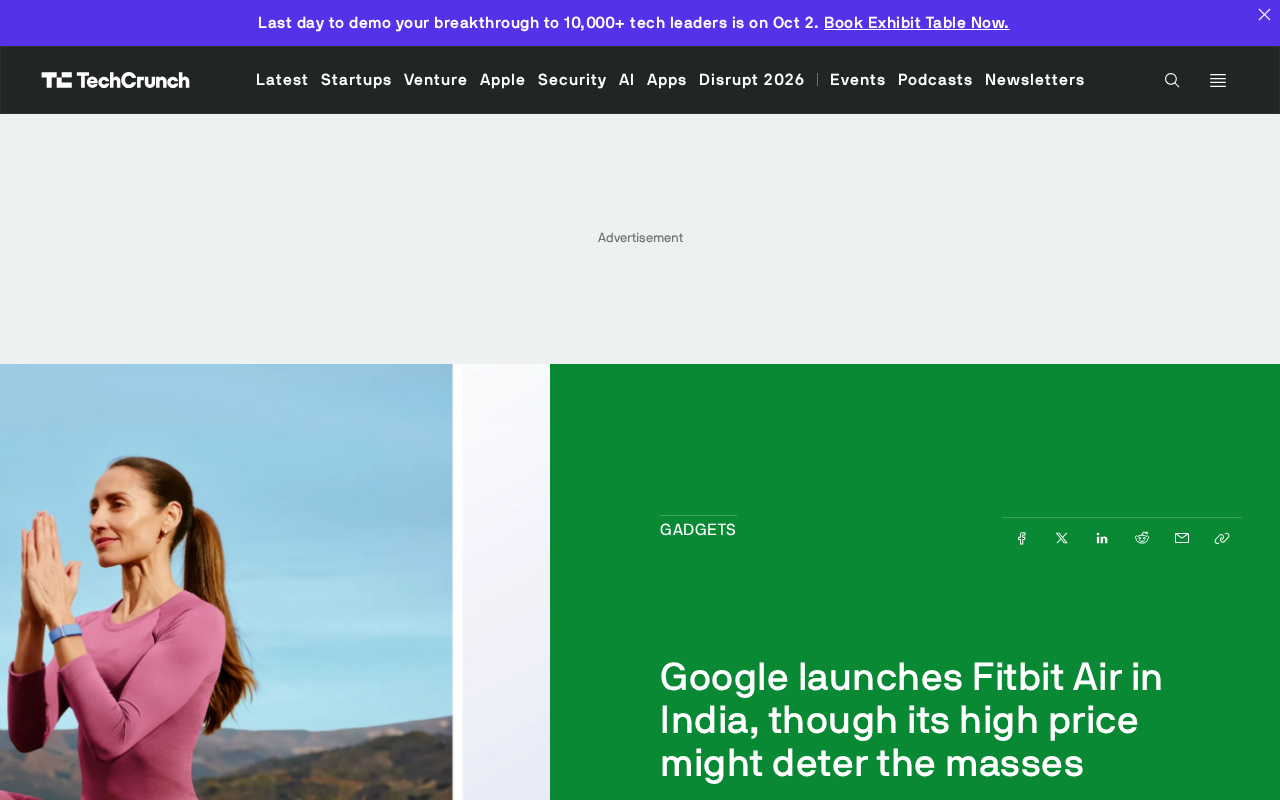
This pricing puts Fitbit at a disadvantage in India's highly price-sensitive market. India is one of the world's fastest-growing wearables markets, but local consumers place enormous value on affordability. Domestic and Chinese brands already offer health bands and smartwatches with comparable features at much lower price points. The Fitbit Air's premium pricing could significantly limit its penetration among mainstream consumers.
The Competitive Landscape in India's Wearables Market
India's smart wearables market has long been dominated by value-focused brands. When choosing a health tracking device, Indian consumers typically treat price as their primary consideration. For an international brand with a notable price premium to gain traction in this environment, it needs to deliver meaningful differentiation in brand trust, health data ecosystems, and overall user experience.
As a veteran health tracking brand, Fitbit has built a solid reputation for data accuracy and health management capabilities. Since being acquired by Google, Fitbit has been further integrated into Google's health services ecosystem — a potential selling point over low-cost domestic alternatives. Whether these advantages are enough to overcome the price disadvantage, however, remains to be seen by the market.
Major competitors in India's wearables space include domestic brands like Noise, boAt, and Fire-Boltt, as well as Xiaomi's Amazfit — all of which offer core health features like heart rate monitoring, blood oxygen tracking, and sleep tracking at price points between $20 and $50. According to market research firms like IDC, India's smartwatch and fitness band shipments have grown rapidly in recent years, but average selling prices have continued to decline, reflecting intense competition on value. Google completed its acquisition of Fitbit for approximately $2.1 billion in 2021 and has since progressively integrated Fitbit's health data into Google Fit and the Pixel phone ecosystem. However, this ecosystem synergy has limited appeal to non-Google device users — and Pixel phones have relatively low penetration in India, which undermines the practical effectiveness of ecosystem integration as a differentiating selling point.
Possible Rationale Behind the High Pricing
International brands pricing above global averages in India is typically tied to import duties, logistics costs, and local operational expenses. India has historically imposed high import tariffs on electronics, which likely accounts for part of Fitbit Air's price premium.
From a brand strategy perspective, Google may also be intentionally positioning Fitbit Air as a mid-to-premium product rather than competing head-on with low-cost domestic brands — targeting urban middle-class consumers who are willing to pay for brand credibility and ecosystem value. This segmentation approach may sacrifice sales volume in the short term, but it helps protect brand positioning.
India's import tariff structure for electronics is complex. Consumer electronics categories like smartwatches and fitness bands typically face a combination of Basic Customs Duty and GST (Goods and Services Tax), with combined rates that can reach 20–30% or higher. This means a product with a $99 U.S. retail price could see its final retail price pushed up by $15 to $20 or more from taxes alone. On top of that, authorized distribution channels, retailer margins, and local warehousing and logistics further inflate costs. In recent years, India's government has encouraged local manufacturing through its "Make in India" initiative, and brands like Samsung and Xiaomi have set up assembly lines in India to avoid some of these tariffs. If Fitbit has not achieved local production, it has no choice but to pass these costs on to consumers — an important structural backdrop for understanding the pricing premium.
Market Outlook
For the average Indian consumer, Fitbit Air's high price point is a real barrier to purchase. In a wearables market where feature differentiation is increasingly narrow, price carries significant weight. If Google wants to grow Fitbit's market share in India, it may need to make adjustments in pricing, localized promotions, or its product lineup down the road.
For now, Fitbit Air's performance in India will serve as a telling case study in whether international wearable brands can establish themselves in a price-sensitive market. The product's ultimate fate depends on whether Google can convince consumers that the brand premium is worth paying for.
Related articles

Cursor AI Programming in Practice: Build a Student Management System from Scratch in 30 Minutes
A Bilibili creator demonstrates Cursor AI programming: generating a student management system in 30 minutes with natural language. Details on Agent mode, Claude selection, prompt techniques, and thresholds.

Top 20 AI Coding Tools Ranking: From Rock-Solid to Lackluster, a Scored Matrix
Bilibili creator releases top 20 AI coding tools ranking, tiered T0–T4 from rock-solid to lackluster, with Claude Code and Codex tied at T0. This article details the scoring dimensions (capability, reliability, robustness, durability, cost, domestic availability) and tool performances to help developers choose the right AI coding assistant.

Vibe Coding Systematic Tutorial: Master AI-Assisted Programming from Zero
A three-month Vibe Coding tutorial from a Bilibili creator covering Codex, ClaudeCode, and Cursor, from core logic to commercial project practice for beginners.