Google Gemini 4 Crushed by Claude Opus 5.5: Gummy Bear Physics Comparison Gone Wrong

Google Gemini 4 Argon loses to Claude Opus in gummy bear physics simulation, exposing large models' weak physical intuition.
Google's newly released Gemini 4 Argon performed poorly in a gummy bear comparison test. Using the same prompt, Claude Opus 5.5 generated a gummy bear with realistic jelly-like soft body physics and translucent materials, while Gemini 4 Argon's version looked like solid plastic with physically implausible behaviors. Worse, Opus cost only $7.20 versus Gemini's $22. The article argues this reveals deep shortcomings in large models' physical world understanding and spatial reasoning — a problem not unique to Google.
Google's freshly released AI model Gemini 4 Argon had barely finished its promotional tour before netizens dragged it into a public flogging with a side-by-side comparison test. This time, the challenge wasn't writing code or solving math problems — it was asking the AI to generate a gummy bear, then stretch it, squash it, and throw it.
The results were night and day.
Same Prompt, Two Very Different Fates
According to an analysis by Bilibili creator Grace, a helpful netizen used the same prompt to have Anthropic's Claude Opus 5.5 and Google's Gemini 4 Argon each generate a gummy bear, then subjected them to identical treatments: pulling a paw, yanking the head, squashing, throwing, and finally dumping an entire bag of gummy bears on top.

Opus's gummy bear behaved like actual jelly: pull a paw and it stretches into a long rubbery strand before snapping back; squash one and it flattens into a pancake then bounces back up; throw it and it rebounds off the floor, knocking its neighbors aside.
Gemini's version? Completely different story.
Gemini's Gummy Bear: Solid Plastic Texture
Gemini's gummy bear looked more like a chunk of solid plastic. Its arm could turn into a rigid stick, the bear could pass through its neighbors while motionless, and the stacked pieces at the end could snap together like interlocking parts — behaviors that blatantly violate basic soft-body physics intuition.
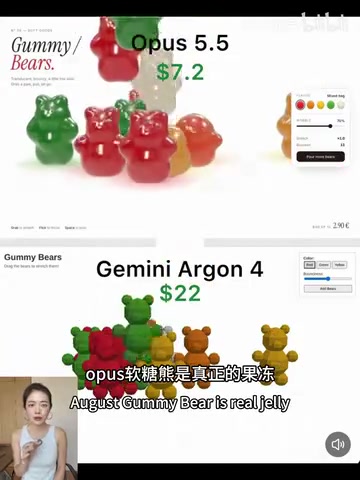
Visually, Opus also did a much better job replicating the translucent quality of gummy candy, with light passing through them; Gemini fundamentally failed to grasp the core material characteristics of "gummy."
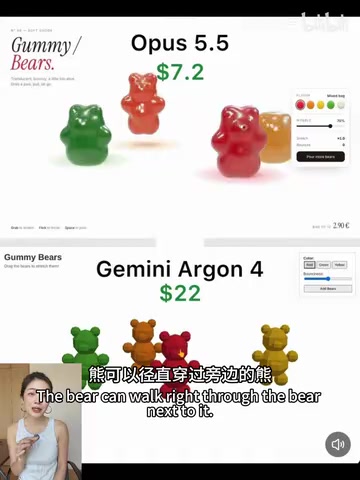
Perhaps the most brutal part is the cost comparison: Opus cost only $7.20, while Gemini cost $22. The more expensive one performed worse.
The "solid plastic" phenomenon mentioned in the video essentially comes down to missing material rendering and subsurface scattering (SSS). Real gummy candy is a translucent medium — light enters, scatters multiple times internally, then exits, creating a soft glow and edge lighting. Rendering such materials typically requires SSS models or volumetric rendering. Gemini's gummy bear looking like opaque plastic suggests it failed to correctly infer the optical properties associated with the semantics of "gummy" — refractive index, scattering coefficients, translucency, and so on. Opus, by contrast, reproduced light transmission effects, meaning it at least captured the key visual characteristics of translucent materials. This isn't just a rendering quality issue; it reflects a difference in how deeply each model understands the joint representation of "material = optical properties + mechanical properties."
This Isn't Just a "Gummy" Problem
On the surface, this is a contest about soft body physics simulation. But what it really exposes is a deeper gap in large models' intuitive understanding of physics.
Stretching, bouncing back, squashing, colliding — these physical behaviors that humans take for granted require AI to build accurate models of material properties, force transmission, collision response, and a whole chain of related concepts. Opus demonstrated stronger "comprehension" here, while Gemini's output was closer to "a 3D model that looks like a gummy bear" rather than "an object that moves like a gummy bear."
This leads to the video's core argument: Can AI truly understand the physical world, or does it just generate images that look right?
Soft body physics simulation is a class of techniques in computer graphics and physics engines specifically designed to simulate how deformable objects behave under external forces — gels, cloth, rubber, muscle, and so on. Unlike rigid bodies, soft bodies have no fixed shape; they undergo continuous deformation when forces are applied and transmit those forces through their internal structure. Mainstream implementations include mass-spring models, finite element methods (FEM), and position-based dynamics (PBD). In games and film, soft body simulation typically relies on precomputation or specialized solvers, with computational costs far exceeding rigid bodies. For generative AI, the challenge is not just rendering the appearance of gummy candy, but implicitly or explicitly modeling its material parameters, deformation constraints, and collision response — precisely the physical priors that current large models lack most.
Google Isn't the Only One Struggling
The video also notes that just the day before, the DT team returning in Mala's Miswander manifesto also suffered a crushing defeat in a similar set-by-set demonstration.

This shows that shortcomings in physical understanding and simulation aren't one company's problem — they're a widespread challenge for current large models in spatial reasoning and physical commonsense.
The road ahead for large models is still long, and so is the road of competition. When parameter scale and benchmark scores are no longer the only standard, "can it truly understand the physical world" may become the next critical competitive dimension.
Spatial reasoning and physical commonsense are capability dimensions gaining increasing attention in current large model evaluations. Traditional benchmarks like MMLU and GSM8K focus on language and math, while physical intuition tests require models to predict object states after forces, collisions, and stacking — involving 3D spatial relationships, causal chains, and continuity constraints. Existing research (such as Physion, IntPhys, and other benchmarks) shows that even the strongest multimodal models still perform significantly below the level of human toddlers on questions like "will objects pass through each other" or "is this stack stable." The reason: language models learn statistical correlations from text and images, not differentiable physics simulators. So when the task shifts from "generate images that look right" to "generate objects that behave right," the shortcomings are laid bare.
One-line Summary
Google Gemini 4 Argon lost to Claude Opus in a gummy bear physics simulation comparison, exposing large models' weak physical intuition.
Paragraph Summary
Google's newly released Gemini 4 Argon underperformed in a gummy bear comparison test. Netizens used the same prompt to have Claude Opus 5.5 and Gemini 4 Argon generate gummy bears, then subjected them to stretching, squashing, and throwing. Opus's gummy bear displayed realistic jelly-like soft body physics and translucent materials, while Gemini's looked more like solid plastic, exhibiting behaviors like clipping through objects and snapping together that defy physical intuition. More ironically, Opus cost only $7.20 while Gemini cost $22 yet performed worse. The article notes this isn't just a soft body physics simulation gap — it reveals deeper deficiencies in large models' understanding of the physical world and spatial reasoning, and the problem isn't unique to Google.
Related articles

Free Unlimited Claude Code Solution: Agnes AI + CC Switch Setup Guide
No paid subscription needed — pair the free AI platform Agnes AI with the open-source tool CC Switch to provide a backend for Claude Code, enabling unlimited free calls to text, image, and video models. This guide covers the full setup, test results, and usage boundaries.

A Complete Zero-Cost Guide to Getting Started with Claude Code for Beginners in China
A beginner's guide to Claude Code for users in China: two installation methods (command line and IDE plugin), full configuration steps for replacing the official API with the free domestic LongCat model, and a hands-on demo of building a small tool with natural language, plus tips.

When the NSA Gets Involved: The AI Supply Chain Crisis Behind Open-Source CVEs and API Key Hijacking
Multiple open-source projects disclosed severe CVEs in one day, PHP flaws alarmed the FBI, and Railway and OpenCode were breached with API keys stolen. This article breaks down the vulnerability window, AI-accelerated exploitation, and the AI supply chain crisis behind the API key black market, with a developer defense checklist.