Google Launches Gemini 3.8 TTS: From Preset Voices to a Fully Customizable Voice Studio

Google's Gemini 3.8 TTS turns voice generation into a fully directable, natural-language-programmable creative pipeline.
Google has added Gemini 3.8 Flash TTS and Flash-Lite TTS to its Gemini family — the former focused on deep creative direction and character design, the latter optimized for high-throughput, low-cost deployment. Key breakthroughs include natural language voice design across 100+ languages, a 2,000+ voice library, 30-second voice cloning, and line-by-line performance direction via stage cues, non-verbal prompts, and backchanneling markers. Flash TTS scored 71.4 on Hume AI's Voice Design Benchmark. Safety features include consent verification, SynthID watermarking, and C2PA credentials. Both models are now available to developers and will roll out to Gemini Notebook and Google Vids.
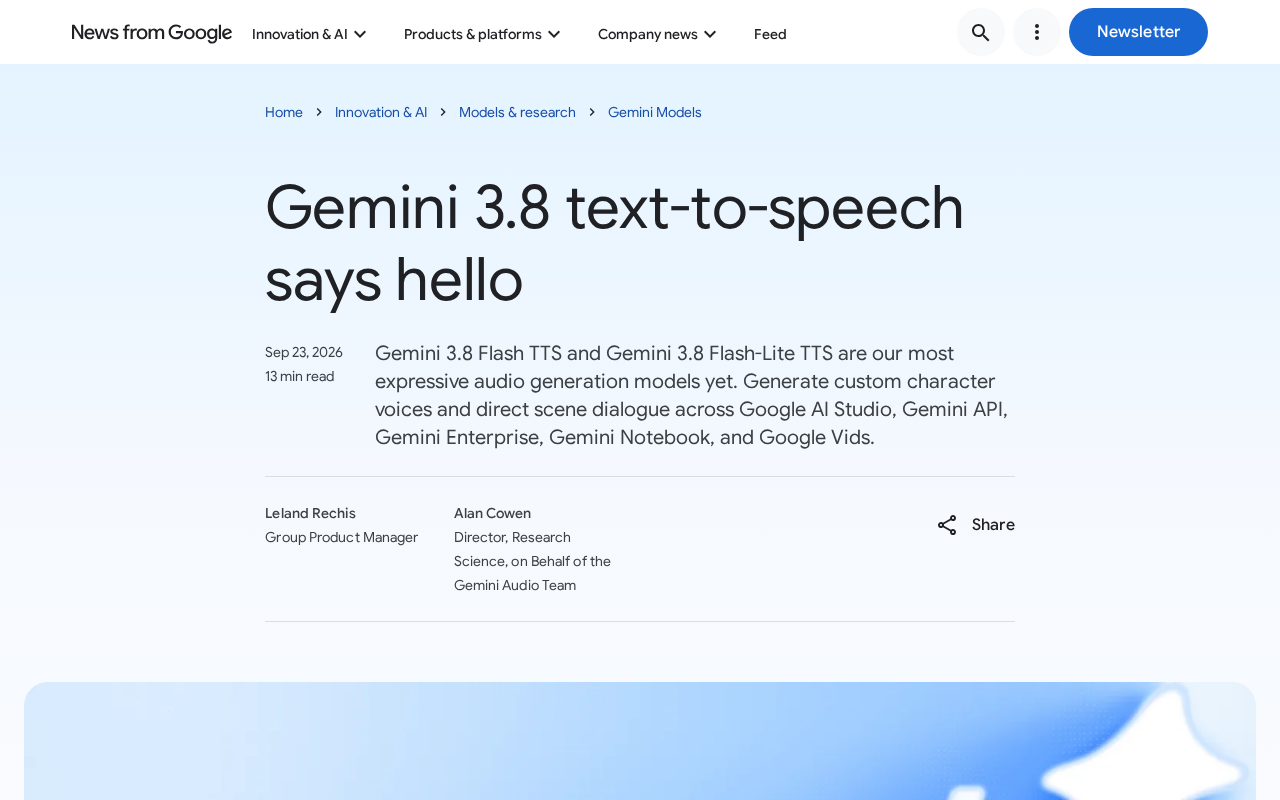
Google has added two new text-to-speech (TTS) models to the Gemini family — Gemini 3.8 Flash TTS and Gemini 3.8 Flash-Lite TTS — moving voice generation from the era of fixed presets into a creative studio where voices can be freely designed and precisely directed. This isn't just about stacking up more voice options; it's about transforming "voice" from a static asset into programmable creative material.
Two Models, Two Product Directions
The two newly released models have distinct positioning, covering the full spectrum from high-end creative work to large-scale deployment.
Gemini 3.8 Flash TTS is built for deep creative direction and character design. Developers can use natural language to build entirely new voices from scratch — crafting characters for games, immersive audiobooks, podcasts, and interactive media — with line-by-line control over performance, including acting cues, pacing, dialect switching, and conversational details like backchanneling.
Gemini 3.8 Flash-Lite TTS is optimized for high-throughput, low-cost, large-scale scenarios, making it ideal for bulk dubbing, audio content production, and expressive voice agents — while still supporting fine-grained control over tone, rhythm, and expressive nuance.
Both models join the rapidly expanding Gemini Audio family, which previously introduced 3.5 Live Translate, 3.5 Transcribe, and 3.8 Live and 3.8 Live Extended Thinking capabilities.
From 30 Presets to an Unlimited Voice Library
Traditional TTS products have long been limited to a handful of preset voices. Google has completely reversed that approach — expanding from 30 foundational voices to a theoretically unlimited voice library.
Generative voice design is the most fundamental shift. Through natural language prompts, users can customize character, accent, and tonal qualities across more than 100 languages and dialects. In official demos, the model generates voices ranging from a high-energy Melbourne DJ to an ultra-flat robotic monotone — and even gives voice to a Japanese dragon.
The voice library offers 2,000+ production-ready voices, covering regional variants such as Mexican Spanish, Québécois French, and Scottish English.
Voice cloning lets users reconstruct a consistent voice profile from as little as 30 seconds of audio — provided they have the rights to that voice — with built-in consent verification, SynthID watermarking, and C2PA credential protection. A Save & Extend feature ensures tonal consistency across long-running projects, and a Voice Mixing feature coming soon will allow prompt-based fine-tuning of timbre, pitch, speed, and accent (e.g., "add a slight American Southern drawl").
Line-by-Line Direction: Turning Scripts Into Performances
What truly sets this system apart from traditional TTS is its fine-grained control over performance. Both models allow users to "direct" each line of dialogue individually.
Users can write their own stage directions, or let Gemini automatically interpret script cues — covering everything from calm customer-service delivery to hushed, suspenseful narration. Long-form generation maintains consistent audio quality, pacing, and character voice across hours of continuous audio, with minimal speaker drift — a perfect fit for podcasts and audiobooks.
Native two-speaker dialogue orchestration supports generating multi-turn conversations from a single script, keeping two voices clearly distinct with natural turn-taking. Even more compelling is scripted tonal bursts and backchanneling — non-verbal cues like <laughs>, <sigh>, and <gasp>, along with active-listening interjections like |mhm| and |yeah|, add authentic texture and comedic timing to conversations.
These capabilities mark a shift in audio creation from "reading a script" to "giving a performance" — giving AI voice its first truly director-level controllability.
Backchanneling is a term from conversational linguistics referring to the brief responses a listener produces while another person is speaking — such as "mm-hmm," "right," or "yeah" — to signal active engagement without interrupting the speaker's flow. These signals are extremely common in real human conversation and are a key indicator of whether a dialogue sounds natural. Traditional TTS systems typically ignore this layer when generating multi-turn dialogue, making synthesized conversations sound like two people taking turns reading from a script rather than actually talking. By treating markers like |mhm| and |yeah| as explicitly controllable cues, Gemini TTS allows developers to specify precisely which speaker inserts which listening signal at which point in the script — bringing the rhythm and emotional authenticity of two-speaker dialogue much closer to a real podcast recording.
Benchmark Results and Global Capabilities
Google has shared results from several third-party evaluations. Gemini 3.8 Flash TTS topped the overall leaderboard on Hume AI's Voice Design Benchmark with a score of 71.4, and led in accent modeling with a score of 60.8.
On Hume AI's Overall Quality Index, Gemini 3.8 Flash TTS and Flash-Lite TTS ranked first and second, respectively. Compared to the previous Gemini 3.1 Flash TTS, the new models show significant improvements in long-form content and two-speaker script control scenarios.
In blind human preference evaluations on Voice Arena, both models ranked at the top across key languages including Japanese, Brazilian Portuguese, Vietnamese, Modern Standard Arabic, Mexican Spanish, and Hindi. Combined with support for 100+ languages, this lays the groundwork for multilingual voice experiences at a global scale.
Trust, Consent, and Transparency
Voice cloning inherently raises concerns around identity and misuse. Google has put in place a fairly rigorous set of safety mechanisms.
Voice cloning relies on consent verification: users must provide a recorded verbal consent from the voice owner, which must match the reference speaker, before a voice can be created. More broadly, all audio generated by Gemini Audio models is embedded with a SynthID watermark — an imperceptible watermark woven directly into the audio output, keeping AI-generated speech detectable and helping guard against the spread of misinformation.
This combination of consent, watermarking, and credentials reflects the inescapable compliance pressures that come with commercializing voice cloning technology.
SynthID is a digital watermarking technology developed by Google DeepMind, originally applied to AI-generated images and later extended to video, text, and audio. Unlike traditional metadata tags, SynthID encodes the watermark directly into the acoustic structure of the audio — embedding statistically detectable patterns in frequency ranges imperceptible to the human ear — so the watermark persists and remains detectable by specialized tools even after transcoding, editing, or recompression. C2PA (Coalition for Content Provenance and Authenticity) credentials are a content provenance standard developed by organizations including Adobe, Microsoft, and the BBC. Using cryptographically signed "nutrition labels," C2PA records the creation tool, timestamp, and edit history of a piece of content, allowing downstream platforms and users to verify whether audio was AI-generated and which model processed it. Together, the two technologies create a dual layer of protection — invisible at the perceptual level, but traceable at the metadata level. As regulators pay increasing attention to deepfake audio, this kind of technical infrastructure is becoming a de facto threshold for commercial AI voice deployment.
Ecosystem and Availability
Starting today, developers can explore these capabilities in the audio playground within Google AI Studio. It is designed as a voice design workspace where users can build entirely new voice identities from scratch or clone their own voice, then bring it directly into a two-speaker script editor for line-by-line direction.
Through the Gemini API, developer platforms such as Agora, LiveKit, Pipecat, and Vercel can easily build and deploy high-performance voice generation experiences. Google has also partnered with companies including Figma, HeyGen, Linguana, Wondercraft, 99.co, and Ollang to deploy the new TTS models for global dubbing, regional accent localization, and large-scale voice agents.
In terms of rollout, both models are available to developers via the Gemini API and Google AI Studio starting today, with enterprise access coming through the Gemini Enterprise API. For end users, Flash TTS is entering Gemini Notebook, while Flash-Lite TTS is being integrated into Google Vids.
For creators and developers, the significance of this update is clear: voice generation is no longer as simple as picking a preset. It's now a complete creative pipeline — designable, directable, scalable, and built with compliance guardrails from the ground up.
Related articles

Frontend to AI Agent Development: A Frontline Architect Explains Career Paths and Opportunities
A frontline AI architect explains the industry changes and practical paths for frontend developers transitioning to AI Agent development: why pure frontend jobs are disappearing, why Agent + full-stack has become mainstream in hiring, and three transformation routes—Agent development engineer, FDE, and remote contracting—along with corresponding learning strategies.

How to Choose an AI Agent Development Course: Five Pitfall-Avoidance Guidelines
A mechanical-engineering career changer's two-year pitfall-tested checklist for screening AI Agent development courses: complete delivery pipeline, resume-worthy projects, real development perspective, update frequency, and coaching feedback—with concrete judgment methods and pitfall-avoidance tips.

Coze AI Agent Building for Beginners: A Zero-Code AI Agent Development Guide
Coze, ByteDance's one-stop AI application development platform, supports zero-code drag-and-drop AI agent building. This article outlines Coze's core concepts, three advantages, differences between the domestic and international versions, and the distinction between agents and apps, helping beginners quickly get started with AI Agent development.