Google Open-Sources TorchTPU: A Native PyTorch Backend Bridges the TPU Ecosystem

TorchTPU replaces the XLA translation layer with a native backend, lowering the cost of migrating PyTorch to TPU.
The article centers on Google's open-source TorchTPU, which is positioned as a native back end for PyTorch rather than another graph conversion layer between PyTorch and TPU. Previously, running PyTorch on TPU required the XLA bridge, with developers handling device marking and graph capture and bearing hidden costs like incomplete operator coverage, fragmented debugging, and unmet performance. TorchTPU aims to land PyTorch execution semantics directly on TPU, absorbing compilation details into the backend to reduce migration changes—especially critical for research projects relying on dynamic control flow and custom operators. It also analyzes the signal of Google open-sourcing under an independent org and CUDA's barriers in operator libraries, debugging tools, and community, offering three metrics to evaluate: migration cost, performance delivery, and debugging experience.
From "Adaptation" to "Native": What Problem TorchTPU Aims to Solve
PyTorch has long been the de facto standard for deep learning research and engineering deployment, while Google's TPU has always been known for performance yet has remained on the periphery of the PyTorch ecosystem. In the past, running PyTorch on TPU typically required going through the XLA bridge layer for graph conversion, and developers would encounter hidden costs such as incomplete operator coverage, fragmented debugging workflows, and performance that fell short of expectations.
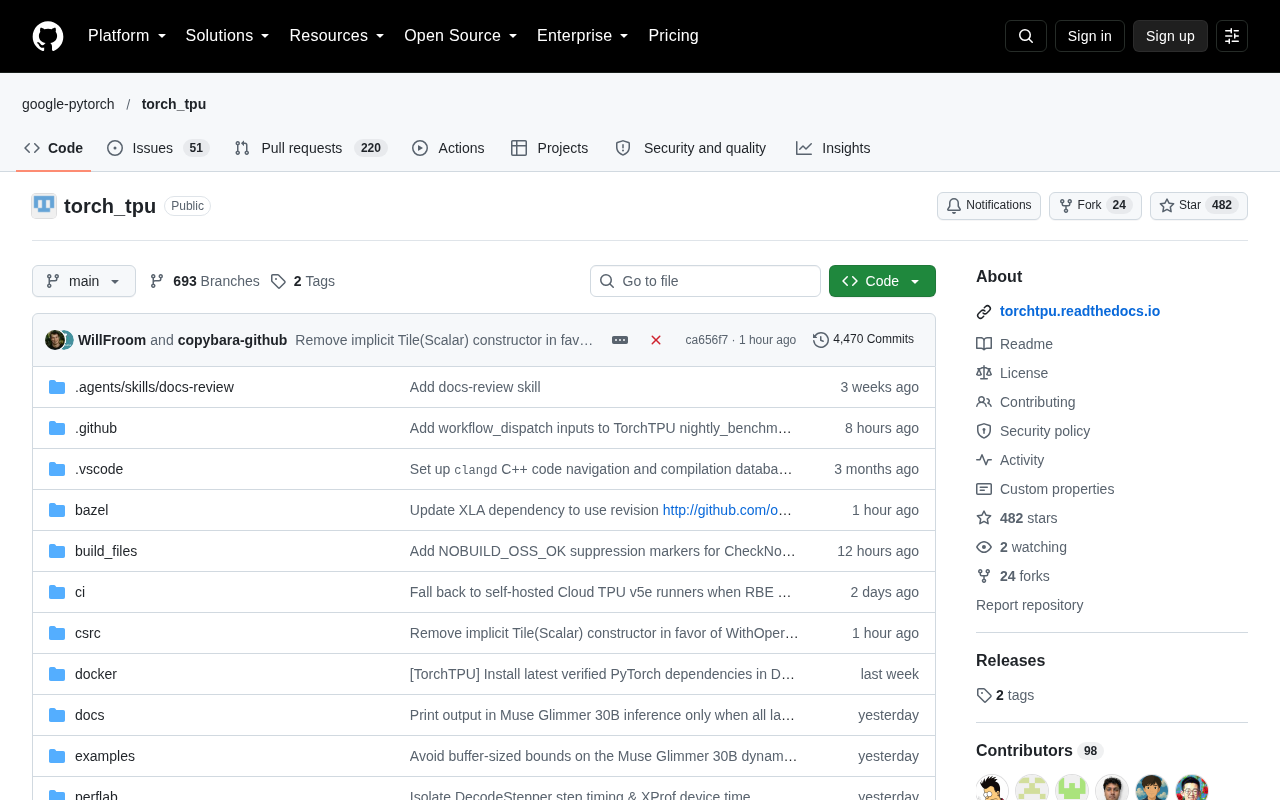
Google's open-source TorchTPU (repository: github.com/google-pytorch/torch_tpu) positions itself as a "native PyTorch back end," with the key word being native—it is not wrapping another converter layer, but rather attempting to land PyTorch's execution semantics directly on TPU. For training frameworks that have long been bound to the CUDA ecosystem, the significance of this step is more than just having one more hardware option.
The project received 344 points and 73 comments on Hacker News, with discussion heat concentrated on two points: whether PyTorch users can truly migrate at "zero cost," and whether Google is willing to release TPU from the moat of its own framework.
What a Backend Means: Where the Seam Between PyTorch and TPU Lies
Layers of Backend Abstraction
PyTorch's hardware backends typically involve several layers: device management, operator dispatch, memory allocation, and compiler coordination. As a backend project, TorchTPU's core work is mapping PyTorch's operators and scheduling onto TPU's compilation execution model while preserving the eager-mode development experience.
Operator dispatch is key to understanding PyTorch's backend mechanism. At runtime, PyTorch routes each operator to the corresponding kernel implementation via the dispatcher based on the tensor's device type and data type; the CUDA backend registers GPU kernels, and the CPU backend registers CPU kernels. The job of a "native backend" is to register a complete set of operator kernels and scheduling rules for TPU, so that calls like torch.matmul can execute on TPU without user rewriting. This also explains why operator coverage is a hard metric for backend maturity: unregistered operators fall back to CPU, causing data movement between devices and a cliff-like performance drop.
The divide between eager mode and graph mode is equally important. Eager mode executes operators one by one immediately, which is convenient for debugging but difficult for global optimization; graph mode first captures the complete computation graph and then compiles it, which facilitates fusion and memory planning. TPU's compilation execution model naturally leans toward graph mode, so a native backend must strike a balance between the two—preserving the eager development experience while completing graph capture and compilation internally.
Differences from the XLA Route
The existing PyTorch/XLA solution essentially translates PyTorch graphs to the XLA compiler, and developers often need to explicitly handle device marking and graph capture. If TorchTPU can achieve a native backend, it means compilation details are more absorbed internally by the backend, and the amount of user code changes will drop significantly. This is especially critical for research-oriented projects that rely on dynamic control flow and custom operators.
XLA (Accelerated Linear Algebra) is an open-source compiler led by Google, responsible for lowering high-level computation graphs into machine code optimized for specific hardware (TPU, GPU, CPU), with core techniques including operator fusion, memory layout optimization, and pipeline scheduling. The PyTorch/XLA solution relies on xla_device and the lazy tensor mechanism: operations on tensors are first recorded as a graph, and compilation execution is triggered only when concrete values are needed. This lazy evaluation is precisely the root cause of developers needing to explicitly handle graph capture and device marking, and it also makes support for dynamic control flow and custom operators tricky.
If TorchTPU takes the native backend route, it essentially treats XLA as an internal implementation detail rather than a user-visible programming model, with the backend deciding when to build graphs and when to compile. This layering difference determines the level of migration cost: the former requires users to understand the compiler's boundaries, while the latter absorbs the boundaries into the backend.
Ecosystem Game: TPU's Openness and CUDA's Moat
Google open-sourcing TorchTPU under the independent google-pytorch organization, rather than keeping it only within the TensorFlow system, is a noteworthy signal. TPU's competitiveness has long been limited by the stereotype of "only usable with JAX/TensorFlow"; once PyTorch can achieve a near-native experience on TPU, the decision logic for cloud compute procurement will loosen—model code will no longer need to be rewritten for hardware.
Conversely, CUDA's barrier is not only in hardware performance, but more in operator libraries, debugging tools, and community accumulation. Whether TorchTPU can form a toolchain of comparable thickness determines whether it is a "usable" supplement or a "good-to-use" alternative. Open source is the first step to lowering the trust threshold, but ecosystem building is a long-term endeavor.
The composition of CUDA's moat deserves a closer look. Beyond the hardware itself, it also includes highly optimized operator and communication libraries such as cuBLAS, cuDNN, and NCCL, the Nsight series of profilers and debuggers, and more than a decade of accumulated tutorials, Q&A, and third-party framework adaptations. These assets form a positive cycle: the more developers there are, the more complete the operators and tools become, and the stronger the willingness to migrate. On the TPU side, the corresponding XLA compiler, PJRT runtime, and JAX ecosystem are not inferior in performance, but the toolchain thickness for PyTorch users is clearly insufficient—which is precisely the part TorchTPU needs to fill.
The decision logic for cloud compute procurement is also affected by this. When enterprises select solutions, the degree of decoupling between model code and hardware directly determines the bargaining space: if migration only requires changing configuration rather than rewriting operators, multi-vendor bidding becomes feasible. TorchTPU's symbolic significance lies in lowering the threshold for such decoupling, but to truly form an alternative, it still needs to reach a level comparable to CUDA in engineering details such as profilers, distributed communication, and custom operator extensions.
What Developers Should Watch
Migration cost. The amount of changes required for existing PyTorch projects to switch backends and the degree of support for custom operators are the most direct evaluation metrics.
Performance delivery. TPU's compute advantage needs to be demonstrated on real workloads, especially communication and memory efficiency in large-model training.
Debugging experience. Whether error stacks are readable and whether profilers are available often affects daily development efficiency more than peak performance.
For researchers, having an additional path that does not depend on CUDA is valuable in itself; for enterprises, the substitutability of compute supply is directly related to cost structure. TorchTPU's maturity still needs time to verify, but it has changed the seam between PyTorch and TPU from "translation" to "docking."
One-line Summary
TorchTPU replaces the XLA translation layer with a native backend, lowering the cost of migrating PyTorch to TPU.
Paragraph Summary
The article centers on Google's open-source TorchTPU, pointing out that its positioning is a native back end for PyTorch, rather than adding another graph converter layer between PyTorch and TPU. In the past, running PyTorch on TPU required going through the XLA bridge, and developers had to explicitly handle device marking and graph capture, bearing hidden costs such as incomplete operator coverage, fragmented debugging, and performance that fell short of expectations. TorchTPU attempts to land PyTorch's execution semantics directly on TPU, absorbing compilation details into the backend, thereby reducing the amount of migration changes—especially critical for research projects that rely on dynamic control flow and custom operators. The article also analyzes the symbolic significance of Google open-sourcing under an independent organization, as well as CUDA's barriers in operator libraries, debugging tools, and community accumulation, and provides three metrics developers should focus on: migration cost, performance delivery, and debugging experience.
Related articles

Free Unlimited Claude Code Solution: Agnes AI + CC Switch Setup Guide
No paid subscription needed — pair the free AI platform Agnes AI with the open-source tool CC Switch to provide a backend for Claude Code, enabling unlimited free calls to text, image, and video models. This guide covers the full setup, test results, and usage boundaries.

A Complete Zero-Cost Guide to Getting Started with Claude Code for Beginners in China
A beginner's guide to Claude Code for users in China: two installation methods (command line and IDE plugin), full configuration steps for replacing the official API with the free domestic LongCat model, and a hands-on demo of building a small tool with natural language, plus tips.

When the NSA Gets Involved: The AI Supply Chain Crisis Behind Open-Source CVEs and API Key Hijacking
Multiple open-source projects disclosed severe CVEs in one day, PHP flaws alarmed the FBI, and Railway and OpenCode were breached with API keys stolen. This article breaks down the vulnerability window, AI-accelerated exploitation, and the AI supply chain crisis behind the API key black market, with a developer defense checklist.