Google Opens Up Smart Home: AI Agents Can Now Control Your Home via MCP
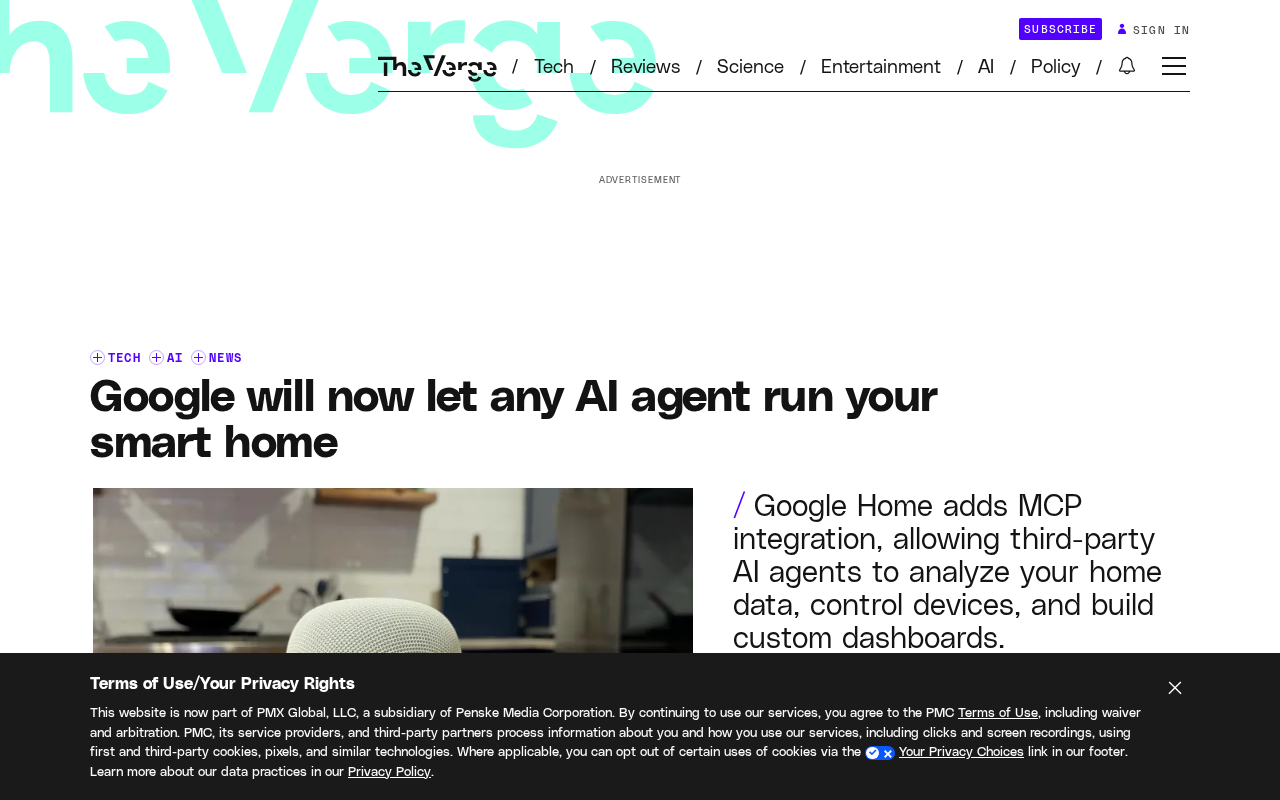
Google opens Google Home to third-party AI agents via MCP, enabling proactive smart home control.
Google has launched Google Home MCP, built on Anthropic's open Model Context Protocol, allowing third-party AI agents like Claude to read and control smart home devices directly. The core value is standardization — any MCP-compatible agent can tap into the Google Home ecosystem without custom integrations. More importantly, this shifts interactions from passive command execution to continuous monitoring and proactive decision-making. The openness also raises new privacy and security challenges, as third-party tools gain access to sensitive devices like locks and cameras, making robust authorization and permission controls critical to mainstream adoption.
Google is opening a new door for the smart home — letting any AI agent connect to and control your connected devices. Through the standardized Model Context Protocol (MCP), third-party AI tools like Claude and Open Claw will be able to access, monitor, and actively operate smart devices in your home, as well as analyze household data. This move signals a shift in smart home interaction from "app control" to "agentic collaboration."
What Is Google Home MCP
Google Home MCP is a new integration from Google that enables external AI agents to read and control a user's smart home environment. It's built on MCP — an open protocol originally introduced by Anthropic to create a unified communication bridge between large language models and external data sources and tools.
In other words, previously getting an AI assistant to connect with smart lights, thermostats, or security cameras required developers to build custom integrations for each platform separately. MCP provides a standardized interface specification: any AI agent that "speaks MCP" can connect with any service that supports the protocol. By bringing its Google Home ecosystem into this framework, Google enables developers and users to hand smart home capabilities to their preferred AI tools with far less friction.
MCP (Model Context Protocol) was officially open-sourced by Anthropic in late 2024. Its design philosophy is analogous to a "USB-C port for AI" — a universal connectivity standard that lets different large language models (LLMs) access external tools, databases, and services in a unified way. The protocol uses a client-server architecture: the AI model acts as a client, sending requests via MCP to various "servers" (i.e., specific tools or data sources), which return structured results according to the spec. This design means an AI application only needs to implement the MCP client once to connect with all supported services, dramatically reducing integration costs. Major AI players including OpenAI and Google have since announced MCP support, and the protocol is rapidly becoming the de facto standard for the AI agent ecosystem.
From "Passive Control" to "Active Action"
The key phrase in this release is "act on." Traditional smart home interactions are largely passive: you say "turn off the lights" and the device responds once. Under the MCP framework, AI agents can not only monitor device status but also proactively make decisions based on analysis of household data.
For example, an AI agent connected to Google Home MCP could theoretically observe indoor temperature, lighting levels, and user routines, then independently decide when to adjust the air conditioning or turn off unnecessary appliances — without the user issuing commands one by one. This shift from "executing commands" to "understanding intent and acting proactively" is one of the core real-world scenarios the current AI agent wave is trying to realize.
For Google, positioning Google Home as an "action environment" for AI agents also serves to connect its hardware ecosystem with rapidly evolving agentic software — and avoid being sidelined in this wave of change.
Why Standardization Matters
The value of MCP lies in standardization. Interoperability among models, tools, and devices has long been a pain point in the AI agent ecosystem. Google's decision to embrace MCP rather than build a closed proprietary interface reflects a growing industry consensus: instead of every platform going its own way, it's better to build a composable ecosystem around a shared protocol.
This open approach is especially developer-friendly. Tools like Claude and Open Claw can connect directly to Google Home via MCP without needing bespoke partnership agreements with Google. Users gain more freedom of choice — no longer locked into a single vendor's assistant, they can pick the AI agent they trust most to manage their home.
Privacy and Security Concerns
Openness comes with risk. When third-party AI agents can access household data and control sensitive devices like door locks and cameras, privacy and security become unavoidable concerns. The ability to analyze home data means AI tools could potentially learn users' daily routines, sleep habits, and even the state of their home security systems.
Before granting any AI agent access, users need a clear understanding of how these tools handle data, what their permission boundaries are, and what the potential for misuse looks like. How Google designs reasonable authorization mechanisms and permission controls — balancing an open ecosystem against user safety — will directly determine whether mainstream users feel comfortable adopting this feature.
On the permission management front, mature MCP implementations typically introduce fine-grained authorization mechanisms that let users set different access levels for different AI agents — for example, allowing a tool to read temperature sensor data while blocking it from operating the door lock. Whether the "principle of least privilege" is strictly enforced in practice, however, depends on platform design choices and user security awareness. Furthermore, behavioral models generated during local AI inference (such as "user leaves home at 8 AM every day") may persist in the cloud through model providers' logging policies, even if not actively uploaded. Choosing AI tools with explicit privacy commitments and local-first processing capabilities is a key step users can take to reduce risk.
What's Next for Smart Homes
The launch of Google Home MCP can be read as a signal of the convergence between smart homes and AI agents. As more platforms adopt open protocols like MCP, the future smart home may no longer rely on a fixed voice assistant — instead, a user-chosen AI agent could serve as the unified orchestrator.
This brings a more flexible user experience, but also raises the bar for security governance across the entire ecosystem. Whether Google's move turns out to be a pivotal inflection point in the AI-ification of the smart home — or whether it still needs considerable refinement of its authorization and security mechanisms in practice — is well worth watching.
Related articles
The Siberian Ice Maiden and the Archaeological Mysteries of the Scythian World
The Siberian Ice Maiden is a Scythian female mummy from the Ukok Plateau. Her tattoos, silk garments, and grave goods reveal ancient nomadic art, social hierarchy, and cross-regional trade — alongside ongoing repatriation controversies.
SQL Row Pattern Matching: Implementing "Row-Level Regex" with MATCH_RECOGNIZE
MATCH_RECOGNIZE gives SQL regex-like power over row sequences. Detect brute-force attacks, fraud patterns, and user behavior flows with clean, declarative syntax — no more messy self-joins.
Hackers Break Into Flock Surveillance Cameras, Exposing the Inner Workings of License Plate Recognition Systems
Hackers breached Flock Safety's ALPR cameras, exposing how license plate recognition systems collect data and the privacy and security risks they pose.