Google Play Store Redesigned for Cars: Auto-Adapts to Screen

Google rolls out an adaptive Play Store interface update for cars with built-in GMS to improve in-car app distribution.
Google is rolling out a major Play Store interface update for cars with built-in Google services, centered on adaptive layout: the store automatically adjusts to the vehicle screen's size and ratio, making app discovery and downloads smoother. Car screens vary far more than phones, and the previous mobile-port store often resulted in blank space or overcrowding. The update is rolling out gradually, though timing varies by model. Optimizing from the distribution entry point is pragmatic, but whether it motivates more developers to adapt for cars remains to be seen as in-car app store competition heats up.
In-Car App Store Gets a Major Overhaul
According to RSS sources, Google is rolling out a major interface update to the Play Store for cars with built-in Google services. The core of this redesign lies in its adaptive layout capability—the store no longer uses a fixed template, but instead automatically adjusts based on the vehicle screen's size and aspect ratio, making app discovery and download flows smoother.
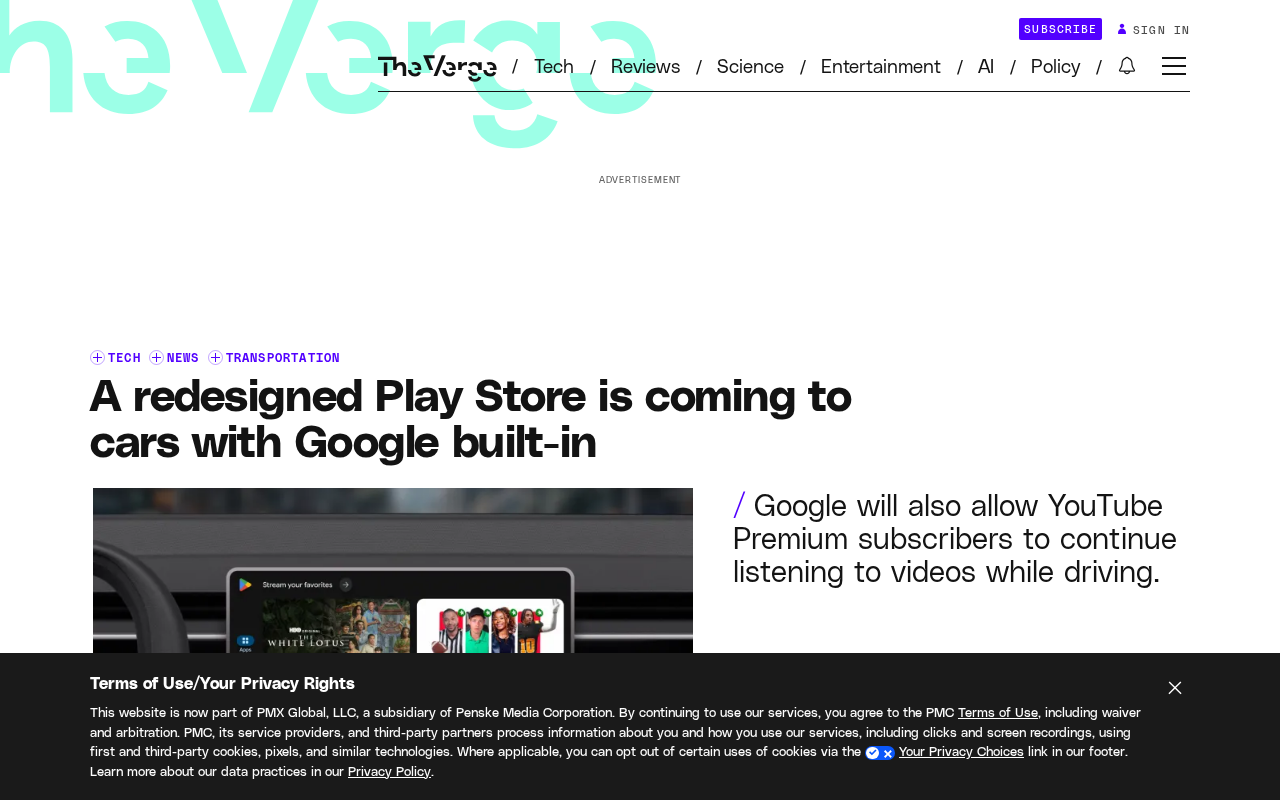
Car screens come in far more varied forms than phones. From wide horizontal displays to vertical portrait screens, from 7 inches to over 15 inches, display areas differ enormously across vehicle models. In the past, the Play Store on car systems was more like a simple port of the mobile version, resulting in excessive blank space or overcrowded information on some screens. The new adaptive layout is a direct response to this pain point.
What Adaptive Layout Means
Adaptive layout is not simply responsive scaling. It involves reorganizing the information hierarchy within the limited driving context: wide screens may use a split-column display, while portrait screens switch to single-column scrolling. The goal of this dynamic adjustment is to let drivers complete app searches in fewer steps when parked or driving at low speeds.
For the in-car ecosystem, the app store experience directly affects users' willingness to engage with their vehicle's system. If users can't find the apps they want, or if the download process is cumbersome, even the best hardware screen can't help. Google's redesign can be seen as catching up on app distribution efficiency for cars.
From an industry perspective, vehicles with built-in Google services span multiple brands, so the impact of this update is not limited to a single manufacturer. A unified store experience helps establish consistency in the in-car app ecosystem and provides developers with a more predictable distribution environment.
Responsive Design is a mature concept in front-end development, referring to interfaces that use media queries, flexible grids, and fluid layouts to automatically adapt to different viewport sizes. But in-car scenarios demand more: vehicle screen aspect ratios vary enormously, from ultra-wide horizontal to portrait, and drivers operate in an environment of highly constrained attention. Therefore, adaptation on car systems is not just about scaling elements—it also involves rebalancing touch target areas, font readability, and information density. Google's redesign is precisely about migrating mature mobile experience into the more constrained cockpit scenario.
Update Rollout and Coverage
According to source information, the update is being rolled out gradually. Since it involves car systems, the rollout pace is typically slower than on mobile, requiring coordination with vehicle manufacturers and carriers. Different models may receive the update at different times.
For users, this change requires no additional action—it's a background interface upgrade. What's worth watching is whether the adaptive layout can truly solve usability issues across different screen ratios, which still needs to be tested in real-world use.
The Long-Term Challenge of the In-Car App Ecosystem
The redesign of the Play Store for cars is essentially answering a question: what kind of app experience should car screens deliver? Direct ports of mobile apps have proven limited in effectiveness, while fully custom in-car apps face the dilemma of insufficient developer investment.
Google's choice to optimize from the distribution entry point is a pragmatic direction. As the first touchpoint where users encounter apps, improvements to the store experience can drive efficiency across the entire chain. But whether this is enough to motivate more developers to adapt for in-car scenarios remains to be seen.
From a broader perspective, competition among in-car app stores is heating up. Whoever can better balance screen adaptation, driving safety, and app richness will gain an advantage in the battle for the smart cockpit entry point. Google's redesign is the latest move in this trend.
Android Automotive OS is Google's complete in-car operating system offered to automakers. Unlike Android Auto, which casts a phone interface onto the car screen, it runs directly on vehicle hardware with built-in Google services and app framework. The Play Store for cars is the distribution entry point built on this platform. Since automakers customize interfaces and features on top of it, the app store's redesign must balance a unified user experience with each manufacturer's differentiated needs—which is the fundamental reason its rollout is slower than mobile and requires coordination with automakers.
One-line Summary
Google is rolling out an adaptive interface update to the Play Store for cars with built-in GMS to improve the in-car app distribution experience.
Paragraph Summary
Google is rolling out a major Play Store interface update for cars with built-in Google services, centered on adaptive layout: the store no longer follows a fixed template but automatically adjusts to the vehicle screen's size and aspect ratio, making app discovery and downloads smoother. Car screens are far more varied than phones—from wide horizontal to portrait, from 7 inches to over 15 inches—and the previous Play Store was essentially a mobile port that often resulted in blank space or overcrowding. The new adaptive layout directly addresses this. The update is rolling out gradually with no manual action needed, though timing may vary by model. The article argues that optimizing from the distribution entry point is pragmatic, but whether it will motivate more developers to adapt for cars remains to be seen, as competition among in-car app stores heats up.
Related articles

Free Unlimited Claude Code Solution: Agnes AI + CC Switch Setup Guide
No paid subscription needed — pair the free AI platform Agnes AI with the open-source tool CC Switch to provide a backend for Claude Code, enabling unlimited free calls to text, image, and video models. This guide covers the full setup, test results, and usage boundaries.

A Complete Zero-Cost Guide to Getting Started with Claude Code for Beginners in China
A beginner's guide to Claude Code for users in China: two installation methods (command line and IDE plugin), full configuration steps for replacing the official API with the free domestic LongCat model, and a hands-on demo of building a small tool with natural language, plus tips.

When the NSA Gets Involved: The AI Supply Chain Crisis Behind Open-Source CVEs and API Key Hijacking
Multiple open-source projects disclosed severe CVEs in one day, PHP flaws alarmed the FBI, and Railway and OpenCode were breached with API keys stolen. This article breaks down the vulnerability window, AI-accelerated exploitation, and the AI supply chain crisis behind the API key black market, with a developer defense checklist.