Google Releases Gemini 4 Argon with Output Limit Breaking One Million Tokens

Google's Gemini 4 Argon breaks the 1M token output barrier as AI races from chat tools to real-world executors.
On October 1st, the AI industry saw a wave of major updates. Google launched Gemini 4 Argon, raising the single-pass output limit from 64K to 1 million tokens and topping the Deep SWE 1.1 engineering benchmark with 77.9%. Microsoft deepened Copilot-Agent integration in VS Code 1.1, while OpenAI disclosed a coordinated model extraction attempt and launched ChatGPT Sets with one-click MCP service deployment. The MiniMax ecosystem expanded with new vertical video products, and a Nature paper showcased AI defeating top human players in imperfect-information games via self-play RL.
Multiple major AI updates landed on October 1st, with Google unveiling its next-generation model Gemini 4 Argon featuring a dramatic leap in output capacity, while Microsoft, OpenAI, MiniMax, and others rolled out new products and research findings. Here's a breakdown and analysis of today's AI news.
Google Gemini 4 Argon: Built for Engineering and Security Defense
Google's newly released Gemini 4 Argon is purpose-built for three core use cases: software engineering, enterprise knowledge work, and cybersecurity defense. The most striking change is the output limit — jumping from 64,000 tokens all the way to 1 million tokens. This gives the model significantly more room to operate on long-chain, multi-step tasks.
In official benchmarks, Argon achieved 77.9% on the real-world software engineering benchmark Deep SWE 1.1, and 51.3% on the business automation benchmark Automation Bench — both category-leading results. These numbers signal that Google is pushing large models beyond conversational tools toward automated executors capable of handling real engineering work.
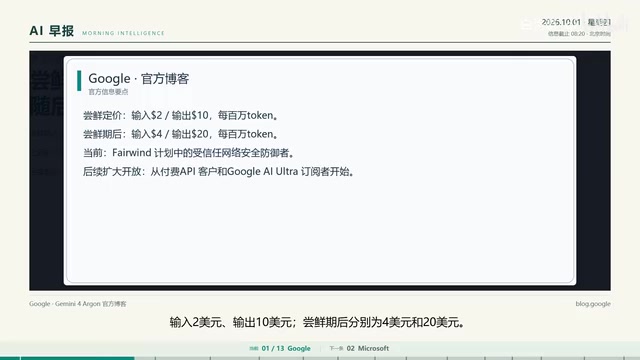
On pricing, the long-context tier is $2 per million tokens for input and $10 for output; after the introductory period, rates rise to $4 and $20 respectively. Initial access is being rolled out through the Fairwind program to trusted cybersecurity defenders, with plans to expand to paying API customers and Google AI Ultra subscribers. This phased release strategy balances safety and control with commercial pacing.
Token output limit is a core metric for measuring a model's single-pass generation capacity. A token is the basic unit of text a model processes — roughly half a word in English or one character in Chinese. Jumping from 64,000 to 1 million tokens means the model can produce content equivalent to a full-length novel in a single response. For software engineering, this enables the model to generate, review, or refactor an entire codebase in one pass rather than processing it in chunks that must be manually stitched together. For security defense, it allows the model to analyze complete log streams or threat reports in a single inference run, reducing information loss from context fragmentation. Deep SWE 1.1 is a benchmark built on real GitHub issue-fixing tasks, requiring the model to autonomously locate bugs in real code repositories and submit patches that pass tests — widely considered more reflective of practical engineering ability than synthetic tasks.
Microsoft VS Code 1.1 and OpenAI's Multiple Moves
Microsoft released VS Code 1.1, adding support for Copilot to carry conversations continuously between the editor and Agents panel. Experimental features include cross-repository or work-tree collaboration, dispatching tasks to connected remote hosts, and support for handling ignored directories. Developer tools are integrating Agent capabilities at an increasingly deep level — the editor is no longer just a place to write code, but a hub for task orchestration.
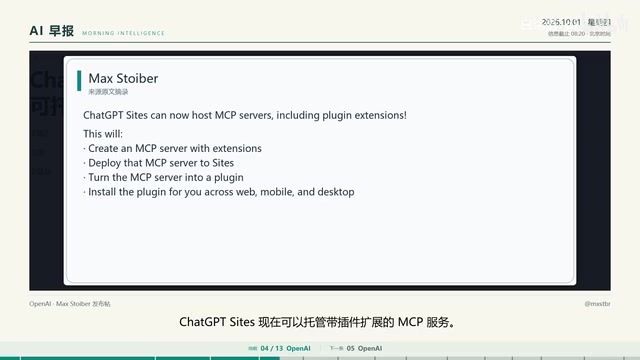
OpenAI has been busy on multiple fronts. The company disclosed and addressed a coordinated model extraction attempt, stating that the actors tried to extract protected model reasoning content. OpenAI attributed the core activity cluster to individuals linked to Moonshot AI, while noting it could not confirm whether all operators were from the same party. Additionally, OpenAI member Max Stoiber announced that ChatGPT Sets can now host MCP services with plugin extensions — a single Sets command handles creation, deployment, plugin conversion, and installation across web, mobile, and desktop.
OpenAI also published a report on AI Agent use for small businesses, covering customer acquisition, product development, and financial management, and partnered with the America's Small Business Development Centers association to provide hands-on training and local guidance — a clear move to push further into the SMB market.
MCP (Model Context Protocol) is an open protocol proposed by Anthropic in 2024, designed to provide large models with a standardized way to call tools and access context — often described as a "USB port" for AI. Through MCP, models can uniformly connect to databases, APIs, local file systems, and other external resources without requiring custom integration logic for each tool. ChatGPT Sets' support for hosting MCP-extended services means developers can package custom tools as plugins, deploy them with a single command, and share them across multiple platforms — dramatically lowering the barrier to building Agent tool chains. It's also a signal that OpenAI is aligning its Agent infrastructure with Anthropic's standard.
MiniMax Ecosystem and Domestic Vendor Activity
The video generation space continues to heat up. MiniMax announced that Creatify Labs has released Boreal H3, built on post-training of MiniMax H3, optimized for advertising video with a focus on creative instruction following and consistency of products and characters. Heizhen (黑镇) also released Heizhen Video, based on MiniMax H3 post-training and aimed at enterprise video production, with a limited-time October price of $0.01 per second.

Baidu Qianfan launched a National Day limited-time Token PlanAd. Community-shared screenshots show it uses monthly quotas and credit-based metering, supporting models including Zhipu and DeepSeekAd, with purchases available through October 7th and a notice that upgrades and renewals are not available. These holiday promotions are a common tactic vendors use to drive new user acquisition during public holidays.
Open-Source Security and Frontier Research
Security automation is an important thread running through this cycle. One developer reports that GLM 5.3 has been used to audit 389 open-source projects, uncovering 4,249 potential vulnerabilities. The service remains free, with results delivered privately to project maintainers. Peter Stamburger demonstrated changes to the OpenCloud interface that collapse inter-Agent communications into expandable single lines, reducing visual clutter in chat flows and improving information density.
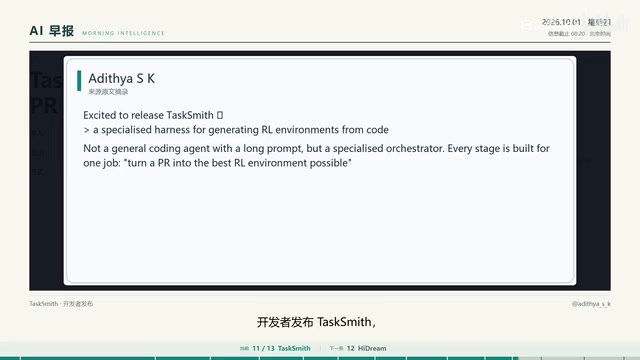
Another developer released TaskSmith, a tool specifically designed to convert code pull requests into reinforcement learning environments, with a dedicated orchestrator organizing the generation pipeline in stages. Arena officially announced that HiDream OE Video 1.0 entered the image-to-video leaderboard at 7th place with a score of 1456. HiDream's Image 2.0, Editing 1.5, and Video models are also now live on VivaGo RE Studio.
On the research front, a new Nature paper introduced Strigo AI's Atracus, which used self-play reinforcement learning under hidden information conditions combined with test-time search to defeat top human players with a record of 15 wins, 1 loss, and 4 draws across 20 games. This result further validates the remarkable potential of self-play RL in imperfect-information games.
Self-Play Reinforcement Learning is a training approach where an agent continuously improves its strategy by competing against historical or mirrored versions of itself. AlphaGo and AlphaZero are the most famous applications. In imperfect-information games (such as poker or diplomatic board games), players cannot observe opponents' private information, which limits the effectiveness of pure tree-search methods. Self-play combined with test-time search allows models to learn mixed strategies in asymmetric-information environments. The game that Atracus competed in belongs to this category, and its 15-win, 1-loss, 4-draw record demonstrates that the model can already surpass top human players in complex social reasoning involving dynamic deception, alliance, and betrayal — a result with important implications for AI's potential in real-world applications like negotiation and game-theoretic scenarios. TaskSmith's conversion of code pull requests into reinforcement learning environments represents a new attempt to bring the same training paradigm into the software engineering domain.
Summary
From Google's breakthrough in million-token output, to Agent capabilities being deeply embedded in developer tools, to continued iteration in video generation and security automation — today's updates collectively point toward a shared trend: large models are moving from "can chat" to "can work," with safety, cost, and real-world deployment scenarios emerging as the new competitive battlegrounds.
Related articles

Altman Declares: The Cybersecurity Crisis Is Unsolvable and There Are Too Many Vulnerabilities to Patch
OpenAI CEO Sam Altman publicly admits he can't fix all security vulnerabilities and that the cybersecurity crisis will keep worsening. This article analyzes the industry reality behind this statement: exploding software complexity, the double-edged sword of AI, and the need to shift security paradigms from "zero vulnerabilities" to resilient defense.

Product Hunt Launches Visual Launch Editor, Saying Goodbye to Tedious Form Filling
Product Hunt launches a Visual Launch Editor with in-place editing for name, tagline, gallery, and maker info, auto-saved drafts, and a checklist to guide creators.

Zelensky Speaks: How We Held Kyiv Against 200,000 Russian Troops
Zelensky recalls the early Russia-Ukraine war: 200,000 Russian troops drove on Kyiv while Ukraine's main forces were in the east. He explains how mobilization grew the army from 200,000 to 800,000 and how Kyiv and Chernihiv oblasts were recaptured.