Google Releases Gemini 4 Neon, Tencent Hunyuan Hy4 Flash Goes Open Source | AI Daily
Google Gemini 4 Neon targets complex engineering computing, with DeepSeek, Tencent, Ant, and OpenAI each making moves and clear vendor divergence.
The article summarizes four recent AI developments: Google's Gemini 4 Neon targeting complex engineering and scientific computing, ranking second on Values at 70.9% and first on Automation Bench at 56.3%, priced at $3 input/$15 output per million Tokens with 1M context; DeepSeek making model-invoked web search and fetch free from noon November 18, billed only by Token, with standalone APIs at 5 yuan per 1,000 calls; Tencent open-sourcing Hy4 Flash (220B total parameters, 11.3% activated, 1M context) and Ant open-sourcing Ming 3.0 Audio Flash (126B total parameters, 6.5B activated, first on speech reasoning leaderboard at 99.8%, MIT license); OpenAI having models rewrite AMD flagship chip RTL code for up to 14% PPA improvement, completing about a year's work in under 5 months, with some already sent to tape-out. The author notes vendor divergence: Google raising prices for high-value tasks, domestic vendors cutting costs and expanding context, and OpenAI delving into expert-level stages like chip design.
Google Releases Gemini 4 Neon: Filling in the Puzzle for Complex Engineering and Scientific Computing
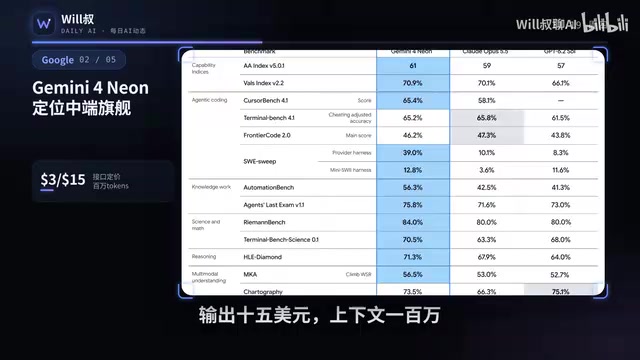
Google has officially launched Gemini 4 Neon, positioned between Hydrogen and Carbon, specifically targeting complex engineering, knowledge work, and scientific computing scenarios. Pricing is set at $3 per million input Tokens and $15 per million output Tokens, with a context window reaching 1 million Tokens.
Looking at benchmark performance, Neon scored 70.9% on the Values index for second place, ranked first on Automation Bench at 56.3%, and reached 95.2% on the long-context test Graphworks. These numbers are worth unpacking: Values and Automation correspond to value judgment and automated task execution respectively, indicating that Neon isn't just a "smarter chat model" but is moving toward a trustworthy engineering assistant. It's currently available directly to Pro and Ultra users of AI Studio, Anti-Gravity, and the Gemini app.
Context Window and Token Billing
The context window refers to the upper limit on the total input plus output Tokens a model can process in a single call; 1 million Tokens is roughly equivalent to hundreds of thousands of Chinese characters or hundreds of pages of technical documentation. For engineering and scientific computing scenarios, the value of a long context lies in being able to put an entire codebase, design document, or experimental dataset into the prompt at once, avoiding repeated slicing and information loss.
A Token is the basic unit of measurement for text processed by a model. Billing input and output separately is the current mainstream practice; output is usually more expensive because the decoding phase generates Tokens one by one with higher computational overhead. The price gap of "$3 input, $15 output" reflects this pattern, and also means that long-document analysis tasks (more input, less output) will have noticeably lower actual costs than long-form generation tasks.
DeepSeek Makes Web Search and Web Fetch Free
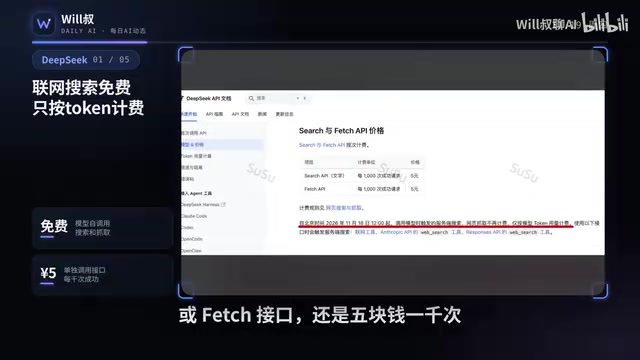
The first move on the open-source side comes from DeepSeekAd. Starting at noon Beijing time on November 18, web search and web fetch invoked by the model itself are completely free, billed only by Token; if developers call the official Search or Fetch APIs separately, they are still billed at 5 yuan per 1,000 calls. Note that the fetched web page content is still counted toward Token consumption.
The real impact of this adjustment lies in the cost structure: previously "search + fetch" was a separate bill, now it's merged into the Token system, significantly improving bill predictability for Agent-type applications that frequently invoke web capabilities.
Tencent Hunyuan Hy4 Flash Goes Open Source, Ant's Ming 3.0 Audio Flash Follows
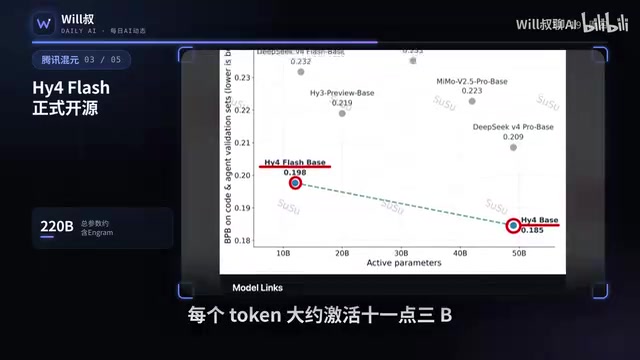
Tencent Hunyuan has officially open-sourced Hy4 Flash, releasing the instruct version, FP8 version, and base model together, with total parameters of about 220B, roughly 11.3% activated per Token, supporting image-text input and 1 million context. The sparse activation design means inference cost is decoupled from total parameter scale, and cost-effectiveness in long-context scenarios is its main selling point.
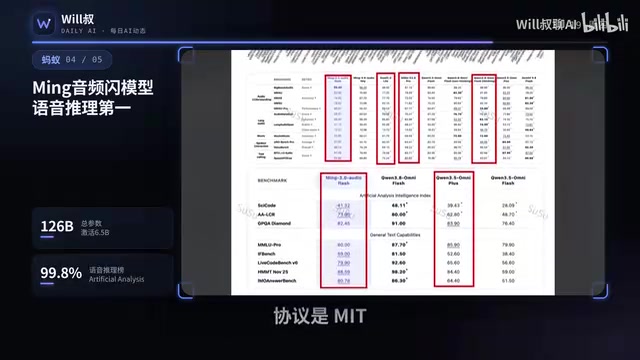
Ant open-sourced Ming 3.0 Audio Flash at the same time, with 126B total parameters and 6.5B activated, ranking first on Artificial Analysis's speech reasoning leaderboard at 99.8%, under the MIT license. The MIT license is commercial-friendly, and open-sourcing this type of audio model is a substantial benefit to the entire voice interaction ecosystem.
Sparse Activation and MoE
The description "total parameters of about 220B, roughly 11.3% activated per Token" refers to the typical characteristics of the Mixture of Experts (MoE) architecture: the model contains a large number of expert sub-networks, but each forward computation only routes to a few of them, so the parameters actually involved in computation are far fewer than the total. This sparse activation means inference cost is mainly determined by the number of activated parameters rather than total parameters, thereby controlling per-inference overhead while maintaining large-capacity knowledge storage.
For long-context scenarios, the significance of sparse activation is especially evident: the longer the context, the greater the attention computation and cache pressure; if all parameters had to be mobilized for every inference, costs would rise rapidly. Sparse activation allows the model to handle 1-million-level context at a lower per-Token cost, which is the technical basis for Hy4 Flash's main selling point of "long-context cost-effectiveness."
OpenAI Has Models Rewrite AMD Flagship Chip RTL Code
OpenAI announced a hardware-side result: models directly rewrote the RTL code of AMD flagship chips, bringing up to 14% PPA (power, performance, area) improvement, completing roughly a year's worth of optimization work in under 5 months, with some of it already sent to tape-out. The same method also completed silicon verification on the in-house Payne chip.
The weight of this news isn't in "AI writing code" but in the closed loop—from code generation to tape-out verification, it's been proven through, showing that models are usable in highly constrained, highly verified engineering stages like register transfer level. For the chip design industry, PPA is a hard metric; a 14% improvement is not rhetoric.
Background on RTL and PPA
RTL (Register Transfer Level) is a key abstraction layer in chip design, using hardware description languages (such as Verilog, SystemVerilog) to describe data transfer and logic operations between registers. It's the intermediate link connecting architecture design and physical implementation (synthesis, placement and routing). The quality of RTL code directly determines the success of subsequent tape-out, and changes must undergo strict functional verification and timing verification, so traditionally it's manually optimized by senior engineers, with long iteration cycles and high barriers.
PPA (Power, Performance, Area) is the core metric system for evaluating chip design quality: power determines heat dissipation and energy efficiency, performance determines operating frequency and throughput, and area determines manufacturing cost. The three often constrain each other, and optimization is essentially multi-objective trade-off. The industry typically uses PPA improvement as a hard acceptance standard, so the 14% improvement mentioned here should be understood in that context—it's not linguistic rhetoric but a quantifiable engineering metric.
A Few Observations
Looking at these items together, the divergence in approaches is quite clear. Google is raising prices for "high-value complex tasks," with the $15 per million output Tokens pricing corresponding to willingness to pay in engineering and scientific scenarios; DeepSeek and Tencent Hunyuan are cutting costs and expanding context, competing for developer call volume; OpenAI is pushing models into deep waters like chip design that are traditionally guarded by experts.
For developers, the choices today are more practical than half a year ago: if you need long context and mixed image-text input, Hy4 Flash is an open-source option; if you need web retrieval Agent applications, DeepSeek's billing method is more friendly; if you need to handle complex engineering reasoning, Neon's benchmark data provides a reference point.
One-line Summary
Google Gemini 4 Neon targets complex engineering computing, while DeepSeek, Tencent, Ant, and OpenAI each make moves, with clear divergence in vendor approaches.
Paragraph Summary
The article summarizes four recent developments in the AI field: Google released Gemini 4 Neon, targeting complex engineering and scientific computing, ranking second on the Values index at 70.9% and first on Automation Bench at 56.3%, priced at $3 input and $15 output per million Tokens, with 1 million context; DeepSeek, starting at noon on November 18, made model-invoked web search and web fetch free, billed only by Token, with standalone APIs still at 5 yuan per 1,000 calls; Tencent open-sourced Hy4 Flash (about 220B total parameters, about 11.3% activated, 1 million context), Ant open-sourced Ming 3.0 Audio Flash (126B total parameters, 6.5B activated, first on speech reasoning leaderboard at 99.8%, MIT license); OpenAI had models rewrite AMD flagship chip RTL code, bringing up to 14% PPA improvement, completing roughly a year's work in under 5 months, with some already sent to tape-out. The author notes the divergence in vendor approaches: Google is raising prices for high-value tasks, domestic vendors are cutting costs and expanding context, and OpenAI is delving into expert-level stages like chip design.
Related articles

Gemini 4 Neon's Comeback: How Google's 'American Doubao' Shipped Five Models in Two Weeks
Google shipped five models in two weeks. Gemini 4 Neon ranks third globally and first on the coding agent leaderboard, at half the cost of Opus 5.5. A Bilibili creator breaks down the three-layer comeback story: regulatory relief, sparse MoE architecture, and in-house TPUs—plus Carbon promo savings tips and AntiGravity quota rules.

What Is Hermes Agent? An Always-On AI Agent That Grows With You
Hermes Agent is an always-on AI agent running on a VPS, reachable via WhatsApp, Telegram, and Discord. It manages lists, calendars, and scheduled tasks and grows with use.

Building AI Animated Videos with Claude Code: A Hands-On Local Toolchain Guide
A hands-on demo of using Claude Code with local open-source tools like Kokoro and Remotion to generate AI videos with narration, animation, and music in minutes. Workflow, efficiency gains, and limitations analyzed.