Google Research Introduces Harness2: A Recursive Agent Framework Draws Attention

Google Research releases Harness2, exploring recursive nesting of agent control frameworks.
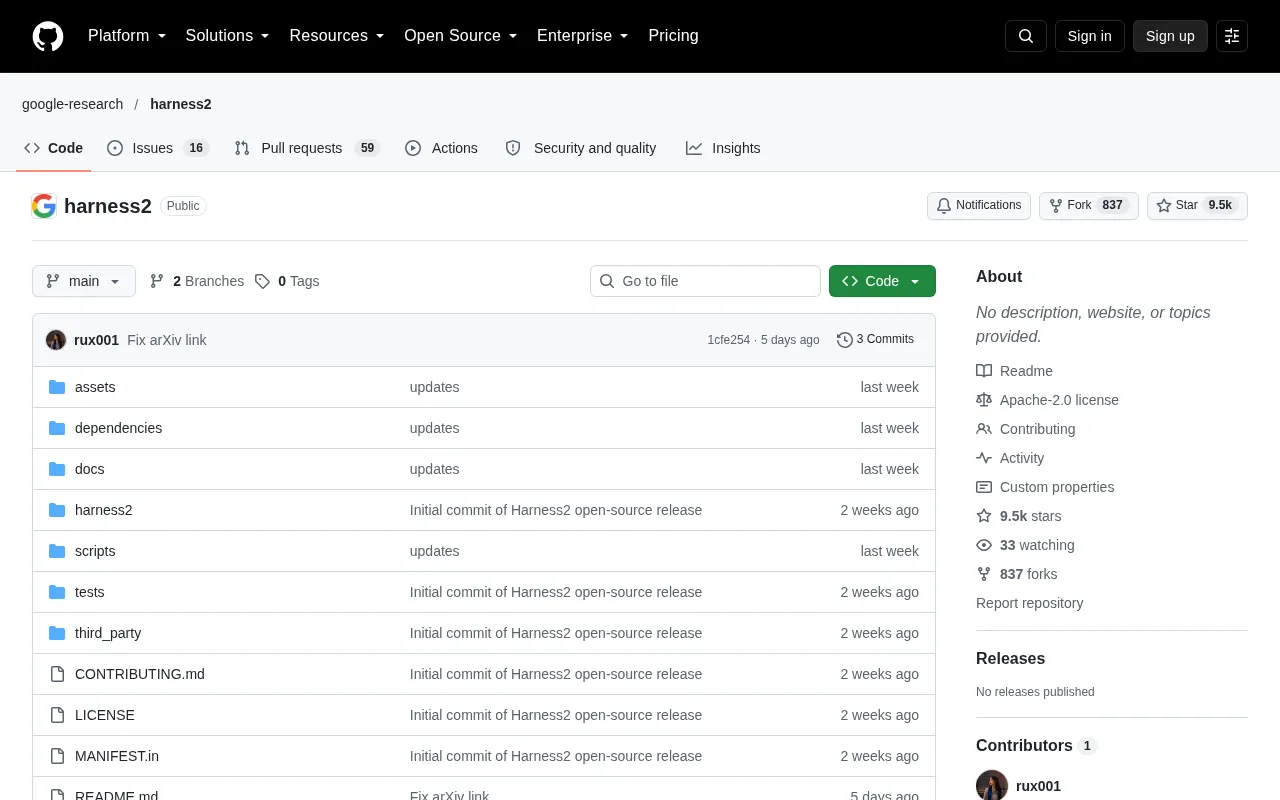
Google Research has released a new project called Harness2, whose core concept is "Recursive Agent Harnessing," namely enabling agent systems to nest and invoke their own control framework (harness) at runtime. The article notes that most current mainstream agent frameworks use single-layer control structures, and when tasks require sub-agents, they face issues such as context inheritance, permission boundaries, and error traceback; the recursive harness attempts to respond to these challenges systematically. However, public information about the project is extremely limited, with only a single Hacker News link and zero comments, making it impossible to confirm whether it is a paper, a code repository, or a technical blog post, so the analysis is mostly inferred from the naming and domain common sense. The article argues that if the design matures, recursive architectures could simplify task-tree applications and push frameworks such as LangChain and AutoGen from flat orchestration toward hierarchical control, but recursion depth control and observability remain difficult points in implementation.
Google Research Introduces Harness2: A Recursive Agent Framework Draws Attention
What Is Harness2?
Google Research recently released a new project called Harness2, whose core concept is "Recursive Agent Harnessing." After the news appeared on Hacker News, although initial discussion was modest (5 points, 0 comments), the combination of "recursive" and "agent" is still worth watching—both words currently carry a great deal of unsolved challenges in the AI engineering context.
In the context of AI systems, the term Harness usually refers to the peripheral control framework built around a model: including tool calling, state management, error recovery, and the orchestration logic for multi-turn tasks. Harness2 pushes this framework itself into the "recursive" dimension, implying that its design touches on the layered question of how agent systems invoke, nest, and even improve their own harness.
Harness (mounting/control framework) In LLM and agent engineering, it refers to a layer of software infrastructure outside the model that is responsible for organizing "a single model call" into "a system capable of completing tasks." Typical responsibilities include:
- Tool calling: exposing functions, APIs, and retrievers to the model and parsing its invocation intent;
- State management: maintaining conversation history, intermediate results, and task progress;
- Error recovery: catching parsing failures and tool exceptions, then retrying or degrading gracefully;
- Orchestration loop: deciding when to continue, when to terminate, and when to hand off to a human.
Common implementations such as the ReAct loop, OpenAI's function calling wrapper, and LangChain's AgentExecutor all fall within the scope of a harness. Its quality often determines the actual reliability of an agent more than switching to a stronger base model, so "recursively mounting a harness" means giving this control layer itself a hierarchical structure, rather than merely being a prompt engineering trick.
Recursive Agents: Why This Direction Matters
The "Matryoshka" Challenge of Agent Systems
Most current mainstream agent frameworks adopt a single-layer control structure: one scheduler is responsible for planning, calling tools, observing results, and proceeding to the next round. But when task complexity rises to the point of requiring "sub-agents," problems emerge. How does a sub-agent inherit the parent's context? How much autonomy should it have? When something goes wrong, how is responsibility traced back?
Recursive agent harnessing attempts to answer these questions systematically. From the naming, it can be inferred that Harness2 focuses not on improving the capability of a single agent, but on the overall behavior that emerges once agents and harnesses form a nested relationship. In theory, this kind of design can make systems more natural when handling hierarchical tasks—for example, an agent responsible for writing code can recursively delegate subtasks to more specialized harnesses, instead of cramming all logic into a flat prompt loop.
Sub-agent refers to a lower-level agent dynamically created or invoked by the main agent during runtime, used to decompose complex tasks into subtasks with narrower responsibilities, such as a "retrieval sub-agent" or a "code review sub-agent." Unlike ordinary tool calls, a sub-agent itself has its own planning loop and context, which brings several engineering issues:
- Context inheritance: Should the sub-agent receive the parent's full conversation, or only a distilled task description? The former is costly, while the latter easily loses constraints;
- Permission boundaries: Should the set of tools available to the sub-agent be narrowed to avoid unauthorized operations?
- Result traceback: When a sub-agent fails, how should error information propagate upward and be digested by the parent?
Mainstream frameworks such as AutoGen's GroupChat and CrewAI's hierarchical processes handle these issues to varying degrees, but most still use fixed hierarchies rather than runtime recursive generation.
Differences from Existing Paradigms
Recursive structures are nothing new in traditional software engineering, but in the agent context they introduce several unique challenges: the cost of passing state across recursive layers, the determination of termination conditions, and risk control when recursion depth spirals out of control. Public information on Harness2's specific implementation details is currently limited, but judging from Google Research's release channel, it is more likely a research prototype or conceptual framework than a ready-to-use product.
As a side note, from a single link on Hacker News alone, it is impossible to confirm whether Harness2 is a paper, an open-source code repository, or a technical blog post. This information gap means that the analysis in this article is based more on inference from the naming and domain common sense.
Recursion depth control is an engineering constraint that recursive agent architectures must confront directly. In traditional recursive functions, depth is managed by the call stack and explicit counters; in agent scenarios, each level of recursion means one or more additional model calls, with cost and latency growing multiplicatively with depth. If termination conditions are poorly designed, sub-agents may keep spawning new subtasks and fail to converge, the so-called "recursion runaway." Common mitigation measures include: setting maximum depth and maximum total call budgets, requiring subtasks to be more specific than parent tasks, and introducing an independent verifier at each layer to judge whether a result is already deliverable. Observability is equally critical—nested call chains need to be recorded as tree-shaped traces, otherwise debugging becomes nearly impossible.
Potential Significance for Developers
For teams building agent systems, what makes Harness2 worth watching is the abstraction pattern it may provide. If the design of a recursive harness is clear enough, it could simplify the implementation of "task tree"-type applications—such as automated research assistants, multi-stage code generation pipelines, or complex data analysis workflows that require layer-by-layer decomposition.
Another signal worth noting is Google Research's investment in this direction. If recursive agent architectures prove effective, they may influence the design orientation of subsequent frameworks (such as the LangChain and AutoGen ecosystems), pushing them from flat orchestration toward hierarchical control.
Questions to Watch
Insufficient public information is currently the biggest obstacle. Harness2's actual capabilities, evaluation methods, and relationship to Google's other agent work all remain unclear. The zero-comment status on Hacker News also indicates that the community has not yet formed effective discussion.
For readers who want to follow this project, it is advisable to keep an eye directly on Google Research's official release channels and watch for whether accompanying papers or code repositories are released. Although the concept of recursive agents is appealing, issues such as recursion depth control and debugging observability in engineering implementation still require specific implementation details for verification.
One-line Summary
Google Research releases Harness2, exploring recursive nesting of agent control frameworks.
Paragraph Summary
Google Research has released a new project called Harness2, whose core concept is "Recursive Agent Harnessing," namely enabling agent systems to nest and invoke their own control framework (harness) at runtime. The article points out that most current mainstream agent frameworks use single-layer control structures, and when tasks require sub-agents, they face issues such as context inheritance, permission boundaries, and error traceback; the recursive harness attempts to respond to these challenges systematically. However, public information about the project is extremely limited, with only a single Hacker News link and zero comments, making it impossible to confirm whether it is a paper, a code repository, or a technical blog post, so the analysis is mostly inferred from the naming and domain common sense. The article argues that if the design matures, recursive architectures could simplify task-tree applications and push frameworks such as LangChain and AutoGen from flat orchestration toward hierarchical control, but recursion depth control and observability remain difficult points in implementation.
Related articles

Bilibili's Hit Dify Tutorial: A Practical Guide to Building 20+ AI Apps from Scratch
A distilled guide to Bilibili's top-rated Dify tutorial: Windows + Docker deployment, MySQL connection, five app types, model integration strategy, and publishing.

Agent Skills Beginner's Guide: From Concepts to Multi-Agent Collaboration in Practice
A comprehensive guide to Agent Skills: core concepts, components, the importance of Description, standardization, beginner learning paths, and multi-agent collaboration.

One Neuron Detects Both Cats and Cars? We Reproduced It and Found a New Explanation
The cat-car neuron reinterpreted: researcher Cammarata argues it distinguishes pointy from round, not cats from cars. We reproduced the experiment and found the new explanation holds on most inputs—but cars are the exception. The interpretability debate continues on language models.