Google's New Video Model Upgrade: 15-Second Clips and More Natural Dialogue
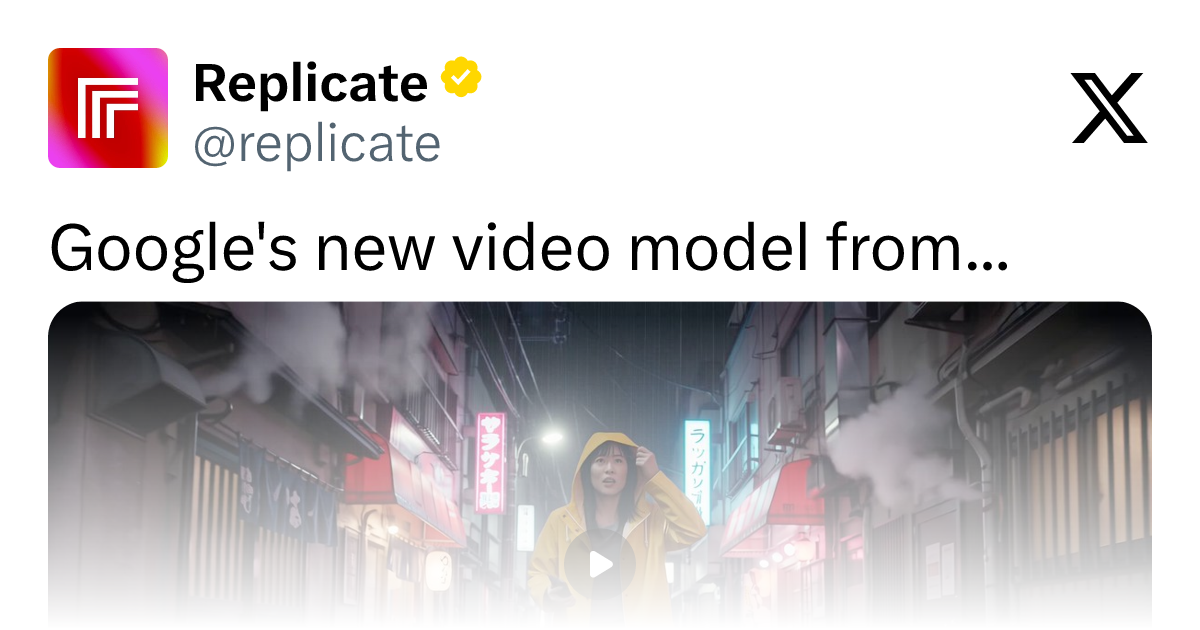
Google's video generation model upgrade: duration increased to 15 seconds, with improved dialogue sync, character consistency, and prompt editing.
Google DeepMind released a new generation of its video generation model, extending single-generation duration from 10 seconds to 15 seconds and improving dialogue and lip sync naturalness, cross-shot character consistency, and support for editing the same clip with new prompts. The article argues these improvements signal a shift in video generation competition from image quality to narrative coherence and controllability. The 15-second duration expands narrative space and reduces splicing work; better lip sync and character consistency bring outputs closer to usable production material; prompt editing lowers iteration costs. However, the information comes from official social media disclosure and lacks technical details and third-party evaluation, so actual performance remains to be verified.
Google's Video Model Gets a Key Upgrade
Google DeepMind recently released a new generation of its video generation model, achieving significant improvements across multiple dimensions. According to a brief disclosure on social media, the new model extends the length of a single generated video clip from 10 seconds to 15 seconds, while also improving dialogue naturalness and character consistency, and supporting editing of the same clip through new prompts.
Although this update may appear to be an incremental parameter-level improvement, it reflects a shift in the focus of competition in the video generation field—from the单纯 pursuit of image quality to the pursuit of narrative coherence and controllability.
The Narrative Space Brought by Longer Duration
The difference between 15 seconds and 10 seconds is superficially just a few extra seconds, but it actually changes the use cases for video generation. A 10-second clip can often only carry a single action or the display of one scene, while 15 seconds is enough to accommodate a simple dialogue scene or a plot twist.
For content creators, this means less splicing work. Previously, producing a complete narrative video required multiple generations and editing to stitch clips together, whereas longer single-generation clips reduce the complexity of post-processing. Of course, 15 seconds is still far from the threshold for long-video generation, but under current technical conditions, this direction of improvement has practical value.
Improved Naturalness of Dialogue and Lip Sync
Officials specifically emphasized "more natural dialogue and lip sync." This is widely recognized as one of the difficult challenges in video generation. Aligning a person's lip movements with audio during speech involves cross-modal coordination between vision and hearing. Previously generated videos often suffered from issues such as lips falling out of sync with speech and stiff facial expressions.
The improvement in this area means that dialogue scenes involving characters in generated videos will be more credible. This capability is especially critical for marketing videos, educational content, and virtual character applications. However, officials did not disclose specific technical details or evaluation data, and the actual effect still awaits more testing and verification.
Lip sync in technical implementation usually relies on audio-driven facial animation generation: the system first extracts a phoneme sequence and its time boundaries from the speech, then maps these phonemes to corresponding visemes (that is, the mouth shapes used during pronunciation), and finally drives the generation model to render matching mouth movements in each frame. The difficulty lies in the fact that phonemes and visemes do not correspond one-to-one; the same phoneme can produce different mouth shapes in different contexts, and the generation model must also simultaneously maintain the natural coordination of other facial regions (eye gaze, expressions, head pose). Commonly used metrics for evaluating lip sync quality include LSE (Lip Sync Error) and confidence scores based on SyncNet, but there is a gap between such metrics and human subjective perception. Therefore, when officials do not disclose evaluation data, the actual effect is difficult to judge.
Character Consistency: The Key to Cross-Shot Coherence
"Characters remain consistent across different shots" is another focus of this update. In multi-shot videos, the stability of the same character's appearance, clothing, and facial features directly affects the viewing experience. Previously, video generation models were prone to a character "face-changing" phenomenon between different shots, limiting their application in series content and brand videos.
The improvement in character consistency makes generated content closer to usable production material rather than merely demo clips. This is also a necessary condition for video generation to move from technical demonstration to a practical production tool.
Cross-shot character consistency usually has two technical approaches: one is to use a reference image or character ID as conditional input and constrain the generation result of each shot through identity-preserving modules (such as face embeddings and IP-Adapter-like mechanisms); the other is to inject cross-frame and cross-shot feature sharing into the attention layers of the diffusion model so that the appearance representation of the same character remains stable at different points in time. The challenge is that video diffusion models gradually accumulate errors during generation, and when shots switch or viewpoints change significantly, details such as clothing texture, hairstyle, and facial features of the character are prone to drift. Character consistency is therefore often regarded as a key threshold for video generation to move from "single-shot demonstration" to "multi-shot narrative," and it is also a rigid requirement that commercial content production such as advertising and short dramas imposes on models.
Prompt Editing: Further Improvement in Controllability
The new model supports "editing the same clip with new prompts," a feature that points to the need for controllability in video generation. Creators can adjust content by modifying prompts while preserving the basic structure of the original clip, without having to regenerate from scratch.
This editing approach is similar to the idea of local repainting in image generation. When applied to the video field, it can significantly reduce iteration costs. For commercial scenarios that require repeated creative adjustments, this capability has practical significance.
Prompt editing in video generation is similar to local inpainting in the image field, but it is more complex. Image inpainting only needs to specify the editing region in the spatial dimension and keep the remaining pixels unchanged; video editing must also maintain coherence in the temporal dimension, meaning that the modified content must transition smoothly between preceding and following frames without flickering or jumps. Common implementation ideas include imposing spatiotemporal constraints on unedited regions during the diffusion sampling process, or using the latent variables of the original video as a structural prior and re-denoising only the parts related to the editing prompt. Such methods can significantly reduce the randomness and cost brought by "regenerating the entire video," but when the editing amplitude is large, the ability to preserve the original structure is still limited by model capability.
Competitive Landscape and Outlook
Competition in the video generation track continues to heat up, with major vendors pushing forward on duration, consistency, and controllability. Although Google's update this time did not publish a detailed technical report or benchmark results, from the feature list, its improvement direction is closely tied to pain points in practical applications.
That said, the current information mainly comes from a brief release on official social media and lacks third-party evaluation and independent verification. The actual image quality of 15-second clips, the accuracy of dialogue sync, and the effect of the editing feature all still need support from more empirical data. Whether video generation models can evolve from "stunning demos" into "reliable production tools" still requires observing their performance in actual workflows.
One-line Summary
Google's video generation model upgrade: duration increased to 15 seconds, with improvements to dialogue sync, character consistency, and prompt editing.
Paragraph Summary
Google DeepMind released a new generation of its video generation model, extending single-generation duration from 10 seconds to 15 seconds, improving the naturalness of dialogue and lip sync and cross-shot character consistency, and supporting editing of the same clip with new prompts. The article argues that these improvements mark a shift in the focus of video generation competition from image quality to narrative coherence and controllability. The 15-second duration expands the narrative space of a single generation and reduces splicing work; improved lip sync and character consistency bring generated content closer to usable production material; prompt editing lowers iteration costs. However, the information comes from official social media disclosure and lacks technical details and third-party evaluation, so the actual effect still needs verification.
Related articles

What Happens When AI Sleeps? Anthropic Agent Memory #TechMalayalam #AgenticAI #ClaudeAI
Starting from Anthropic's Claude and Agent Memory mechanisms, this article explains how AI agents load, organize, and discard memory between sessions, and what self-evaluation loops and note-taking rules mean for developers.
Behind the Nvidia CEO Scandal: The Key Person Risk of AI Infrastructure
Jensen Huang's scandal triggers an independent Nvidia board probe as chip stocks rally and Nvidia falls alone. We break down AI infrastructure's key person risk and how real estate investors can protect deals with a three-step check.
13 Practical AI Tips: Save Money, Protect Privacy, Upgrade Your Digital Life
A roundup of 13 practical AI tips from The Explainer: AI agents for cost-saving negotiations, data deletion requests, Claude Code for computer diagnostics, local offline models, in-car voice learning, and motion pose analysis—with emphasis on human oversight and safety boundaries.