Google's Space Data Center Dream: Starship Would Need 1,600 Launches to Make It Real

Google orbited its first AI chip, but space data centers need ~1,600 Starship launches to become real.
Google recently launched its first advanced AI chip into Earth's orbit, taking a tangible first step toward space-based data centers. The core premise: as generative AI drives explosive demand for computation, ground-based data centers face dual bottlenecks in power and cooling, while orbital environments offer continuous solar energy, radiative heat dissipation, and no land use. A key calculation cited in reports shows SpaceX Starship would need roughly 1,600 launches to provide the physical foundation for this concept — highlighting how the plan hinges on falling launch costs. From a single chip in orbit to scaled operations, major engineering hurdles remain: hardware reliability under radiation, high-speed space-to-ground data links, and on-orbit maintenance. A true space computing era remains a long-term vision.
Google Sent an AI Chip to Orbit
Google recently launched its first advanced chip into orbit, laying the groundwork for an ambitious vision: a space-based data center. This move signals that a tech giant is seriously evaluating the feasibility of moving computational infrastructure to Earth's orbit — the core idea being to tap into the near-unlimited solar energy available in space while using the vacuum environment for heat dissipation, addressing the increasingly pressing power and cooling challenges facing ground-based data centers.
As generative AI drives explosive growth in computing demand, data center power consumption is becoming a bottleneck for the entire industry. Moving computation to orbit could theoretically bypass constraints on terrestrial power grids and land resources — and that is the deeper motivation behind Google's experiment.
1,600 Launches: A Critical Threshold
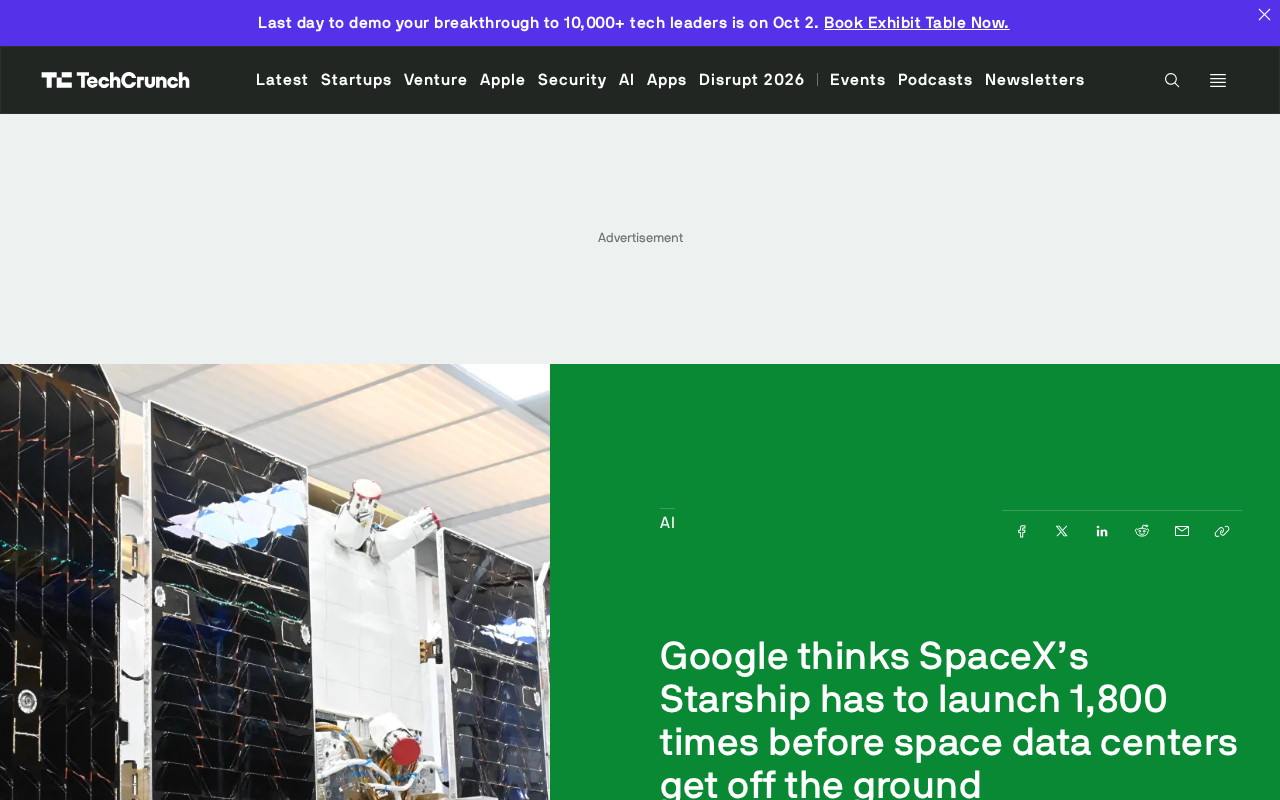
The most striking detail in the report is a specific calculation Google put forward: SpaceX's Starship would need to complete approximately 1,600 launches before the space data center vision could truly "take off."
This number reflects the real-world constraints of scale and cost. Deploying enough hardware in orbit to support large-scale AI computation requires sending massive quantities of chips, thermal management systems, and structural components into space. The critical variable determining whether any of this is feasible is whether per-launch costs can fall low enough. Starship — a fully reusable super-heavy-lift launch vehicle — is the assumed workhorse in Google's calculations.
In other words, whether space data centers become viable depends not only on Google's chip technology, but heavily on SpaceX's launch cadence and cost reduction trajectory. The 1,600-launch threshold is both a technical challenge and a financial equation.
Starship is SpaceX's largest and most powerful launch vehicle system ever developed, consisting of the "Super Heavy" booster and the "Starship" upper stage, designed to be fully reusable — with both stages recoverable and rapidly reflown. The core significance of this design is dramatically reducing cost per launch: traditional expendable rockets cost thousands to tens of thousands of dollars per kilogram to orbit, while Starship targets tens to hundreds of dollars per kilogram. Starship is still in intensive testing and has not yet achieved full commercial operations. The reason the 1,600-launch estimate uses Starship as its baseline is precisely that only with high-frequency, low-cost Starship launches would transporting such a massive volume of hardware to orbit be economically viable. Using current rocket launch costs, the overall investment required for a space data center would be so enormous as to make almost no commercial sense.
Why Space? The New Frontier for Computing and Energy
The appeal of space-based data centers stems primarily from three factors:
- Energy: Continuous solar power is available in orbit, unaffected by day-night cycles or weather, with far higher energy density than ground-based photovoltaics.
- Thermal management: The vacuum and low-temperature environment of space offers potential advantages for dissipating heat from high-density computing hardware.
- Scalability: No terrestrial land or water resources are consumed, and capacity can theoretically be expanded indefinitely.
However, these advantages currently remain at the concept and early-experiment stage. Sending the first chip into orbit is more about verifying whether hardware can survive the space radiation, extreme temperature swings, and vacuum environment — it is a far cry from an actually operational "data center."
Power consumption in ground-based data centers has become a substantive barrier to AI expansion. A large-scale supercomputing data center can consume hundreds of megawatts of electricity — equivalent to a mid-sized city — and roughly 30% to 40% of that power goes solely to cooling systems. Meanwhile, the heat generated by high-density GPU clusters is extremely difficult to manage: traditional air cooling is approaching its limits, while liquid cooling solutions consume enormous amounts of water — a large data center can use millions of liters per day. The space environment offers a fundamentally different set of physical conditions: radiative heat dissipation in orbit requires no additional energy input, as heat can be radiated directly into deep space, with a theoretical cooling ceiling far exceeding what is achievable on the ground. This — beyond the energy supply advantage — is the other dimension of space data centers that is most compelling from an engineering logic standpoint for AI compute infrastructure.
Inspiring Vision, Sobering Reality
The gulf between a single chip in orbit and 1,600 Starship launches needed to make this real reveals the true situation facing space data centers: this is a long-term vision, not a commercial product around the corner.
The challenges pile up — how to maintain and upgrade orbital hardware, how to transmit data at high speed between space and the ground, chip reliability and lifespan in a radiation environment, and the overall return-on-investment timeline. Each of these alone is enough to keep this concept in the lab-and-test-satellite phase for a long time to come.
But the fact that Google is willing to take the first step itself demonstrates that tech giants are searching for disruptive solutions to the computing bottleneck of the AI era. Regardless of whether it ultimately proves viable, this experiment opens up an entirely new dimension to the question of "where should computation live."
The challenge that the space radiation environment poses to chip reliability is one of the most critical technical obstacles today. Earth's orbit is permeated by high-energy particle streams — primarily from solar wind and cosmic rays — that trigger "single-event effects" (SEE) when they strike semiconductor devices: at best causing bit flips (soft errors), at worst causing permanent device damage. Traditional aerospace chips resist radiation through specialized fabrication processes and redundant designs, but these "radiation-hardened" approaches typically sacrifice performance and increase cost, creating significant technical tension with the high-performance commercial chips needed for AI training. Google's experiment sending advanced chips into orbit is largely aimed at gathering real in-orbit radiation effect data to assess the actual lifespan and error rates of commercial AI chips in the space environment — foundational validation that cannot be skipped on the path from concept to engineering reality.
Conclusion
Google's first advanced chip reaching orbit marks the beginning of the space data center narrative, not its conclusion. The calculation of 1,600 Starship launches serves as a ruler, measuring the distance between aspiration and reality. At a time when AI computing demand is expanding without end, this kind of exploration deserves attention — but also clear-eyed perspective: a true era of space-based computing still depends on breakthroughs across launch costs, hardware reliability, and long-term economic viability.
Related articles

Frontend to AI Agent Development: A Frontline Architect Explains Career Paths and Opportunities
A frontline AI architect explains the industry changes and practical paths for frontend developers transitioning to AI Agent development: why pure frontend jobs are disappearing, why Agent + full-stack has become mainstream in hiring, and three transformation routes—Agent development engineer, FDE, and remote contracting—along with corresponding learning strategies.

How to Choose an AI Agent Development Course: Five Pitfall-Avoidance Guidelines
A mechanical-engineering career changer's two-year pitfall-tested checklist for screening AI Agent development courses: complete delivery pipeline, resume-worthy projects, real development perspective, update frequency, and coaching feedback—with concrete judgment methods and pitfall-avoidance tips.

Coze AI Agent Building for Beginners: A Zero-Code AI Agent Development Guide
Coze, ByteDance's one-stop AI application development platform, supports zero-code drag-and-drop AI agent building. This article outlines Coze's core concepts, three advantages, differences between the domestic and international versions, and the distinction between agents and apps, helping beginners quickly get started with AI Agent development.