Google Significantly Boosts Gemini 4 Argon Quota: New Antigravity IDE Limits and Hands-On Comparison
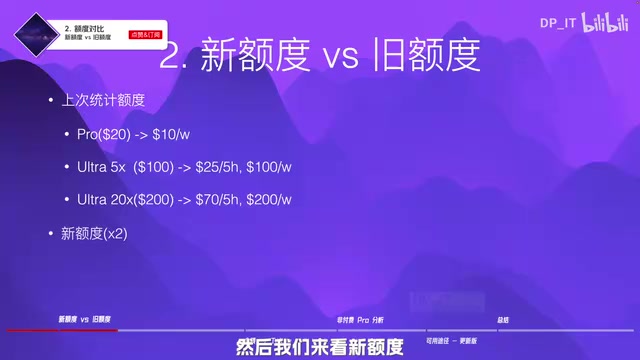
Google quietly raised Gemini 4 Argon quota in Antigravity IDE: Pro tier to $15/week, Ultra tiers multiplied, non-paid Pro access is tight.
Without an announcement, Google raised the Gemini 4 Argon quota in Antigravity IDE: the Pro $20 tier's weekly quota rose from $10 to $15, the Ultra $100 tier to $50 per 5 hours and $200 per week, and the Ultra $200 tier to $200 per 5 hours and $800 per week—roughly doubling the old quotas. Creator DP converted dollar amounts to tokens and noted that non-paid Pro users can already use Argon in AI Studio, Gemini Web, and the App, but only at $15 per week, which is tight for heavy tasks. Community complaints centered on quota rather than model capability, and the quota increase plus weekly reset was well received. On paying, the creator advises monthly billing and caution about long-term commitments, with official docs as the final authority.
Title
Google Significantly Boosts Gemini 4 Argon Quota: New Antigravity IDE Limits and Hands-On Comparison
Meta Description
Google has quietly increased the available quota for Gemini 4 Argon in Antigravity IDE, raising the Pro tier to $15 per week and multiplying the Ultra tiers. This article compiles hands-on data from Bilibili creator DP, comparing old and new quotas, dollar amounts, and token conversions, and analyzes the access options and paid subscription advice for non-paid Pro users.
Article Content
Google recently and quietly raised the available quota for the Gemini 4 Argon model in Antigravity IDE, but did not issue a formal announcement. Bilibili creator DP combined publicly available information with personal hands-on testing to systematically sort out the old quotas, new quotas, dollar-to-token conversions, and availability for non-paid Pro users. This article provides a complete recap and interpretation based on that.
Quota Doubled: How Exactly the New Quotas Changed
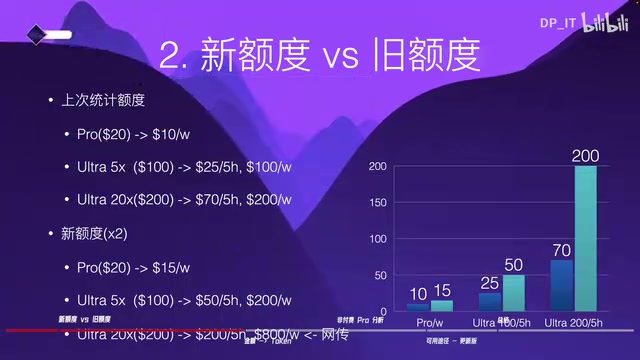
According to the summary by creator DP, under the old quota system, the Pro subscription (the $20 tier) offered $10 per week; the Ultra $100 tier offered $25 per 5 hours and $100 per week; the Ultra $200 tier offered $70 per 5 hours and $200 per week.
The new quotas can simply be understood as "times two." The Pro $20 tier has been raised to $15 per week; the Ultra $100 tier to $50 per 5 hours and $200 per week; the Ultra $200 tier reaches $200 per 5 hours and $800 per week. The creator specifically notes that the first two data points come from hands-on feedback from himself, group members, and the comments section, while the Ultra $200 tier data comes from publicly available online information and was not personally tested.
Looking at the bar chart comparison, the Ultra $200 tier appears quite cost-effective. The creator mentions that the Pro tier data came from "Big Boss C" in the group and "Big Boss A" in the comments section, with hands-on results basically landing at $15 per week; the Ultra $100 tier was tested by the creator himself, with 6% quota consumed in 5 hours, corresponding to roughly a few dollars.
There are a few key points to clarify here: the quota increase was a proactive move by Google, but the company did not publish an announcement explaining it; on the other hand, the company also performed a weekly quota reset. The creator believes this "increase quota first, then reset" attitude is commendable.
Antigravity IDE is an AI-native integrated development environment launched by Google, whose core capability is to let developers call Gemini series models directly within the editor for code generation, completion, and debugging. Unlike ordinary APIs that charge by token, Antigravity uses a "quota pool" mechanism: users receive a certain amount of model call budget based on their subscription tier, and the platform converts the tokens consumed by each request into dollars deducted from the pool. This design frees developers from calculating token unit prices request by request, but it also means that once the quota is exhausted, they must wait for the cycle to reset or upgrade their subscription. Understanding this billing logic helps judge the actual usage boundaries of figures like "$15 per week" and "$50 per 5 hours" in this article—they are essentially spending caps within different time windows.
Converting Dollar Amounts to Tokens: A More Intuitive View of Usable Volume
Many viewers reported that dollar amounts alone lack intuitive feel, so the creator converted them into units of millions (Million). Based on his chart estimates, each dollar roughly corresponds to a certain amount of token quota.
By this conversion, the Pro $20 tier can use roughly tens of millions of tokens per week; the Ultra $100 tier can use nearly a million per 5 hours and millions per week; the Ultra $200 tier can use millions per 5 hours and tens of millions per week. The creator showed detailed conversion charts in the video so viewers can compare against their own usage intensity.
It should be noted that these conversions are based on the creator's hands-on testing and estimates; actual consumption will fluctuate depending on task type, context length, output length, and other factors, and can only serve as an order-of-magnitude reference rather than a precise promise.
A token is the basic unit of text processed by large language models. Typically, one English word corresponds to about 1 to 1.3 tokens, while in Chinese, due to different tokenization methods, one character may correspond to 1 to 2 tokens. Model billing considers both input tokens (prompts, context) and output tokens (generated content), and output unit prices are generally higher than input. Therefore, "how many tokens per dollar" is not a fixed value but changes dynamically with model pricing, input-output ratio, and context length. The article's conversion in millions is intended to translate abstract dollar quotas into a developer-perceivable sense of "how much code can be written, how many conversations can be run," but actual consumption will fluctuate significantly with task complexity, making the order-of-magnitude reference more meaningful than a precise promise.
Non-Paid Pro Users: Usable, but Limited Quota
Non-paid Pro users are a group the community particularly cares about. According to the information summarized by the creator, in AI Studio, Gemini Web, and the App, non-paid Pro users can already use the Gemini 4 Argon model, and the official rollout is gradually expanding coverage, so opening it up to non-paid Pro users in Antigravity IDE is also to be expected.
But the creator then "poured a bucket of cold water": the quota for non-paid Pro is only $15 per week—note, per week, not per 5 hours. The creator said bluntly that this quota might not even be enough to write a paper. As for whether it will be halved further from $15, there is currently no clear information.
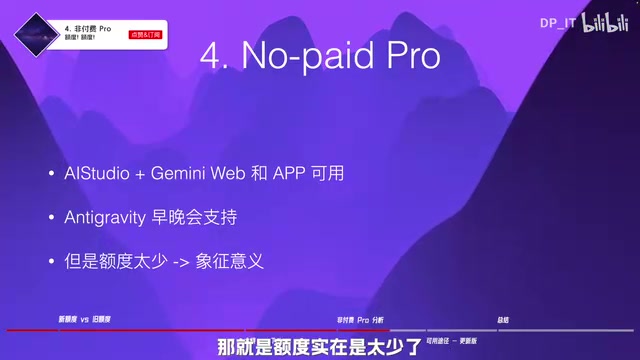
Looking at updates to access channels: Vertex remains available to paid API users, unchanged; AI Studio has expanded from being available to paid Pro and Ultra to being available to both paid and non-paid Pro; Gemini App and Web remain available to all Pro and Ultra; Antigravity IDE remains available to paid Pro plus Ultra.
Gemini 4 Argon is a new-generation model codename in Google's Gemini series, with Argon continuing Google's tradition of naming internal model versions after chemical elements. This model is primarily aimed at code generation and complex reasoning scenarios and is offered as an optional backend model in Antigravity IDE. Non-paid Pro users refer to users who have not subscribed to the Google AI Pro or Ultra plan but have obtained Pro-level access through the free tier or educational/regional policies. Google has recently been gradually expanding Argon's availability from paid subscribers to this group, but the quota policy has clearly tightened—free Pro receives only a fixed weekly quota rather than the rolling-window quota of the paid tier, reflecting that while Google expands model reach, it still uses quota as leverage to steer heavy users toward paid subscriptions.
Community Feedback and Paid Subscription Advice
After its release, Gemini 4 Argon went through a typical cycle of reputation fluctuation: trial, complaints, then adjustments. The creator observed that what the community complained about most was not the model's capability itself, but the quota being too small. The company subsequently proactively increased the quota and reset the weekly quota; although no announcement was made, the overall attitude is acceptable.

As for whether it is worth paying, the creator advises caution: if you are going to pay, prioritize monthly billing and avoid long-term commitments; if you are unfamiliar with Google's past policy changes on Antigravity-related products, it is recommended to watch his previous videos before deciding.
Summary
The core information of this quota adjustment can be summarized as follows: the Pro tier's weekly quota has been raised to $15, the Ultra tiers have been multiplied by tier, and the Ultra $200 tier stands out for cost-effectiveness; although non-paid Pro users can already use Argon through multiple entry points, the $15-per-week quota is still tight for heavy tasks. All data is based mainly on the creator's hands-on testing and publicly available online information, and official documentation and announcements should ultimately prevail.
One-line Summary
Google quietly raised the Gemini 4 Argon quota in Antigravity IDE, with the Pro tier's weekly quota rising to $15 and the Ultra tiers multiplied, while non-paid Pro access is available but tight.
Paragraph Summary
Without an announcement, Google raised the available quota for Gemini 4 Argon in Antigravity IDE: the Pro $20 tier's weekly quota rose from $10 to $15, the Ultra $100 tier rose to $50 per 5 hours and $200 per week, and the Ultra $200 tier reached $200 per 5 hours and $800 per week—overall, old quotas can be understood as doubled. Creator DP combined hands-on testing with public information to convert dollar amounts into tokens, and noted that although non-paid Pro users can already use Argon in AI Studio, Gemini Web, and the App, the quota is only $15 per week, which is tight for heavy tasks. Community complaints focused on quota rather than model capability, and the company's attitude of increasing quota and resetting the weekly quota was recognized. On paid subscription advice, the creator reminds users to prioritize monthly billing, be cautious about long-term commitments, and defer to official documentation.
Related articles
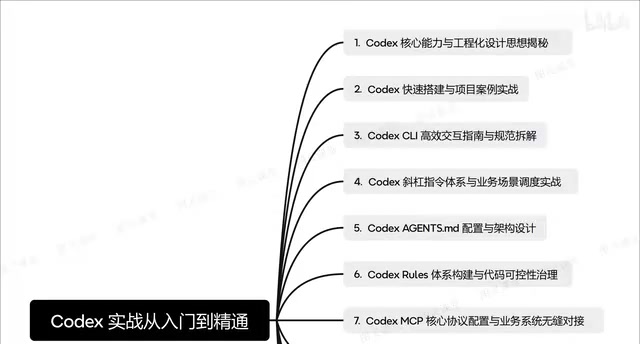
Codex in Practice: From Installation and Configuration to Multi-Agent Collaboration
Based on a Bilibili Codex course overview, this guide maps the full path of AI coding assistants from installation and agents.md context design to CLI commands, MCP integration, and multi-agent collaboration.
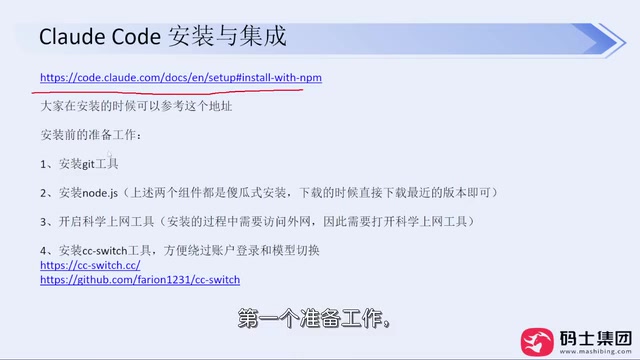
Claude Code Installation and Model Switching Guide for Users in China
How can developers in China install Claude Code reliably? This article compiles a Bilibili creator's hands-on solution: install via NPM, skip official login, use CC Switch to configure API Keys and freely switch between DeepSeek, Kimi, and other models to avoid account bans.
AI Supply Chain Security: What Canary Tokens Reveal
Starting from a Hacker News discussion, this article analyzes the role of canary tokens in AI supply chain security: how they detect abnormal access to model weights, training data, and credentials, as well as coverage blind spots and cost constraints during implementation.