GoPro Accepts $285 Million Acquisition — CEO Promises Camera Business Will Continue
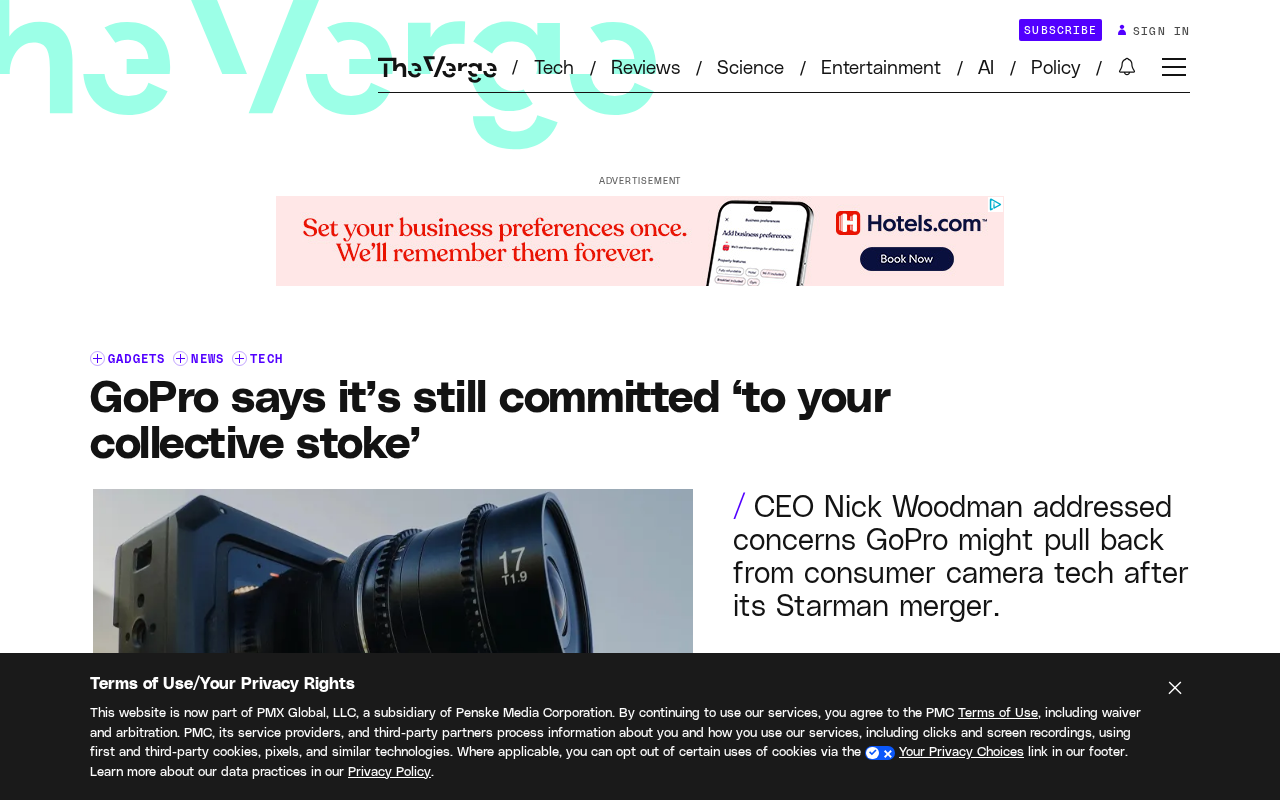
GoPro accepts a $285M acquisition from Starman as CEO Woodman vows to keep cameras at the core.
Action camera icon GoPro has accepted a $285 million acquisition offer from investment firm Starman. CEO Nick Woodman issued an open letter assuring users that camera manufacturing remains the company's "core DNA." The deal reflects GoPro's struggles against smartphones and rivals like DJI, with its market cap falling from a $13B peak. Privatization may offer room for long-term transformation, including a shift toward a hardware-plus-subscription content ecosystem.
GoPro Faces a Critical Turning Point
GoPro, the iconic brand in the action camera space, is undergoing a major transformation. This week, investment firm Starman proposed a $285 million acquisition plan to bring the industry-pioneering camera maker under its umbrella. Starman is an investment company focused on consumer technology and brand asset management. The $285 million offer signals a classic "distressed asset acquisition" — a purchase made well below the company's historical peak valuation, where the buyer is typically eyeing the long-term monetization potential of brand equity, patent portfolios, and a loyal user base. Such deals are not uncommon in the consumer electronics industry; Foxconn's acquisition of Sharp and Lenovo's purchase of Motorola Mobility in recent years followed similar logic. The news has sparked widespread concern in the user community, with many worried that GoPro's camera business could be sidelined as a result.
In response to the skepticism, GoPro founder and CEO Nick Woodman quickly issued an open letter. He made it clear that manufacturing cameras remains the company's "core DNA" and pledged to continue serving the needs of sports and outdoor enthusiasts worldwide.
The Strategic Significance of the Acquisition
In his letter, Woodman stated that the merger with Starman would put GoPro in a "more favorable position for growth," enabling continued investment in content creation technology R&D. This aligns with the official acquisition announcement — through capital injection and resource integration, GoPro would receive ample support for technological upgrades.
GoPro has faced significant operational challenges in recent years. As a public company, its financial struggles and depressed stock price are well known across the industry. Founded by Woodman in 2004, GoPro almost single-handedly created the "action camera" consumer electronics category with its Hero series. At its 2014 IPO, the company's market cap briefly approached $13 billion. However, the rapid improvement of smartphone stabilization and wide-angle capabilities — such as iPhone's Action Mode and Samsung's advanced stabilization algorithms — has significantly eroded demand for entry-level action cameras. Meanwhile, DJI's Osmo Action series has directly challenged GoPro's core product line with competitive pricing and excellent image quality, while brands like Insta360 have carved out differentiated niches through 360-degree cameras. GoPro isn't facing a single competitor — it's contending with a fundamental restructuring of the entire market ecosystem. In this context, accepting a privatization deal may be the most realistic path for the company to escape short-term capital market pressures and pursue strategic transformation.
Room for Transformation Through Privatization
For hardware companies hitting growth ceilings, delisting and accepting private equity often means greater strategic freedom. Free from the pressure of quarterly earnings reports, management can focus resources on long-term R&D and product innovation instead of catering to shareholder demands for short-term returns.
There is precedent in the tech industry for consumer hardware companies going private to pursue transformation. In 2013, Michael Dell partnered with Silver Lake Partners to take Dell private from the NYSE for $24.4 billion. Through massive acquisitions and business restructuring — including the $67 billion acquisition of EMC in 2015 — Dell successfully transformed from a PC manufacturer into an enterprise IT solutions provider and re-listed in 2018 with a significantly higher valuation. BlackBerry, after its collapse in the smartphone market, also gradually pivoted toward cybersecurity and automotive software through capital maneuvering. These cases demonstrate that stepping away from the short-term performance pressures of public markets can indeed provide the breathing room necessary for deep transformation. The "more favorable position" Woodman emphasized likely refers to exactly this kind of transformation opportunity.
What's Behind the "Core DNA" Promise
Woodman repeatedly emphasized in his open letter that camera manufacturing is GoPro's "core DNA" — and these weren't idle words. In the tech industry, hardware brands acquired by investment firms often face the risk of being "value-extracted" or even gradually phased out. Buyers may be more interested in brand assets, patent portfolios, or user data than in sustained product innovation.
This concern is far from unfounded. The fates of tech hardware brands after acquisition vary dramatically. On the positive side, Instagram flourished after being acquired by Meta with abundant resources. But negative outcomes are far more common — Nokia's mobile business nearly vanished after Microsoft's acquisition, Jawbone was liquidated, and Pebble's product line was immediately terminated after being acquired by Fitbit. The typical playbook for investment firms (especially private equity) is: strip non-core assets post-acquisition, cut operating costs, quickly recoup capital through brand licensing or patent licensing, and then seek an exit within 3–5 years. This is precisely the scenario the GoPro user community fears most — the brand name is preserved, but real investment in product innovation is drastically reduced.
GoPro's user base remains vigilant. Woodman's decision to reassure the community immediately, using emotionally resonant language to signal to core users that the brand's fundamental philosophy won't change due to capital maneuvering, was a deliberate move.
From Hardware to a Content Ecosystem
Woodman specifically mentioned the continued development of "content creation technology," revealing GoPro's future direction. In an era of severe hardware commoditization, cameras alone cannot establish a competitive moat. GoPro's true differentiator lies in the complete content ecosystem built around its action cameras — from shooting and editing software (like Quik) to cloud storage and community sharing.
In fact, GoPro has been actively transitioning from a pure hardware sales model to a "hardware + subscription service" hybrid model in recent years. Its GoPro subscription service ($49.99/year) offers unlimited cloud storage, camera replacement coverage, and premium features in the Quik video editing tool. As of recent earnings reports, GoPro's subscriber count has surpassed 2.4 million, with subscription revenue accounting for a growing share of total revenue. This model draws from Adobe's successful transition from selling boxed software to its Creative Cloud subscription service — recurring revenue not only carries higher profit margins but also significantly boosts valuation multiples.
In other words, GoPro's future may not be about selling more cameras, but about becoming a one-stop platform for sports enthusiasts to record and share their lives. The "content creation technology" investment Woodman mentioned is essentially about strengthening this complete value chain — from shooting to editing, storage, and sharing — creating ecosystem dependency rather than just one-time hardware purchases. This also explains why Woodman specifically emphasized his commitment to content creation technology investment amid the acquisition news.
The Industry Challenge Facing Hardware Brands
GoPro's acquisition case reflects, to some extent, the universal challenges faced by consumer electronics hardware companies. When a category creator that once defined an entire product segment hits a growth ceiling, the available paths are usually limited: get acquired and integrated by a larger giant, accept privatization and seek room for transformation, or continue struggling in the public market.
GoPro's predicament reflects a recurring industry pattern: category creators often struggle to sustain their first-mover advantage. TiVo invented the digital video recorder but was ultimately replaced by cable companies' built-in DVR functionality. Fitbit created the consumer fitness tracker market but was forced to sell to Google for $2.1 billion under pressure from Apple Watch and various low-cost smart bands. Flip Video once led the portable camcorder trend but was shut down outright by Cisco after smartphone video capabilities improved. The common pattern across these cases: when a hardware category's core functionality gets absorbed by a larger platform (usually the smartphone), standalone hardware brands must find differentiated value that phones cannot replicate — otherwise, decline is inevitable.
For GoPro, the $285 million acquisition price is admittedly dim compared to its peak market cap of nearly $13 billion (the high point after its 2014 IPO). But on the bright side, shedding the constraints of being a public company may allow this brand — built on a core identity of "passion" — to rediscover its innovation rhythm.
Ultimately, whether Woodman's promises can be fulfilled depends on whether the new shareholders genuinely support long-term technology investment after the acquisition closes, rather than rushing to cash out. For the millions of GoPro users worldwide, what matters isn't the capital maneuvering — it's whether this camera that captures extreme moments can continue to evolve.
Post-Acquisition Outlook
GoPro's open letter serves as both crisis management and a preliminary roadmap for the future. In an era where hardware innovation is increasingly difficult, whether a brand can stay true to its "core DNA" often determines how far it can go. The acquisition is just the beginning — the real test comes after the deal closes. Whether GoPro can harness new capital to reignite the passion of sports enthusiasts is a story worth watching closely.
Related articles

DeepCell: One-Click AI Generation of Documents, Spreadsheets, and Slides
DeepCell tops Product Hunt with one-click generation of documents, spreadsheets, and slides, using the .deepcell format for linked updates, designed for System 2 tasks like modeling and sales reviews.

Doneas: 15-Minute Daily Accountability Calls That Keep Indie Developers From Procrastinating
Doneas is a daily accountability tool for indie developers: plan tasks on Monday, join a 15-minute call with five builders each day, and log deliveries on a public progress page. This article analyzes its core mechanics, effectiveness, and potential issues around retention and matching.

Fastlane 2.0: Fully Automated AI Ad Campaigns, From Creative to Optimization
Fastlane 2.0 is an AI ad automation tool: enter your website and it learns your brand, generates video and image ads, and runs and optimizes them on Meta, TikTok, Instagram, and YouTube.