GPT-2 + Seedance 2.5 Real-World Test: Where Are the Limits of AI Dark Fantasy Combat Filmmaking?

Stress-testing AI filmmaking limits with GPT-2 and Seedance 2.5 through dark fantasy combat scenes.
A creator combined GPT-2 and Seedance 2.5 to produce dark fantasy combat scenes, stress-testing AI filmmaking across four dimensions: character consistency, camera movement, visual continuity, and cinematic action. The experiment reveals both significant progress and remaining limitations in AI video generation, while highlighting multi-model workflows as the emerging paradigm for AI content creation.
A Stress Test for AI Filmmaking
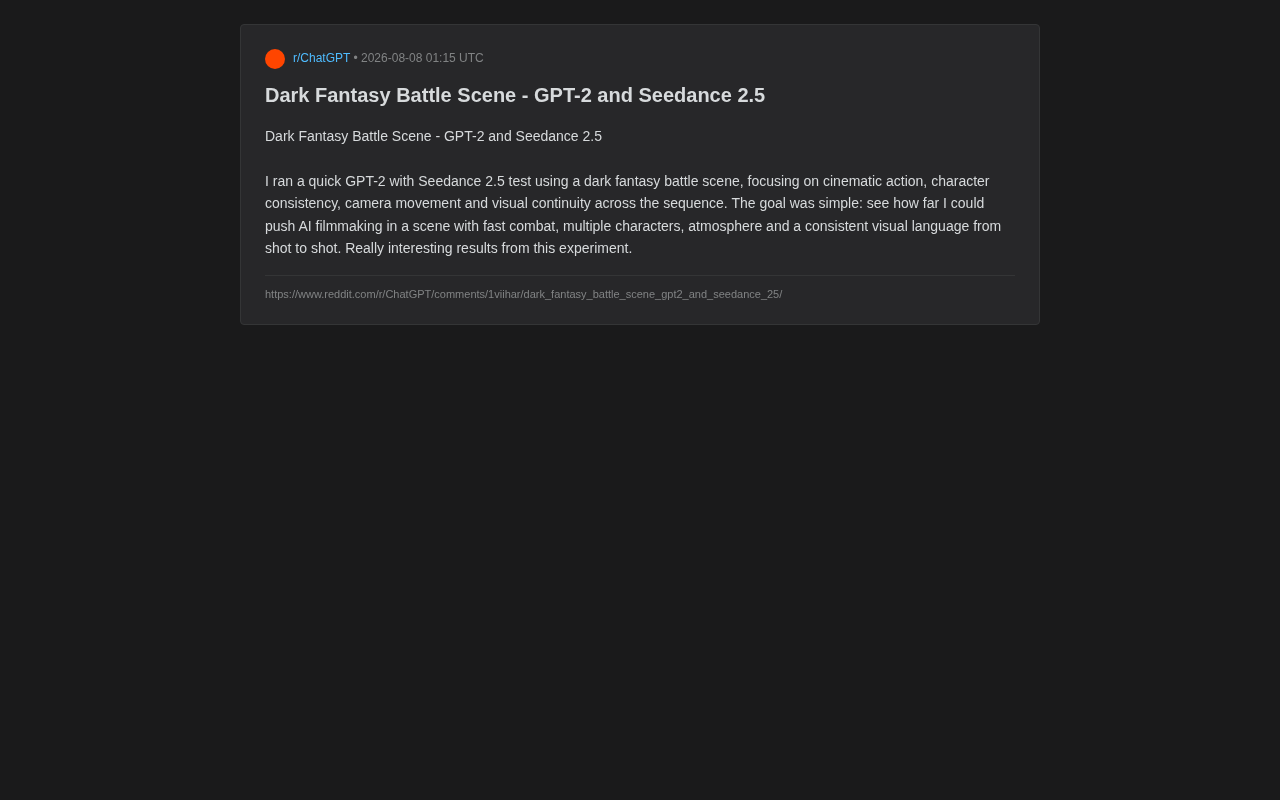
Recently, a creator shared on Reddit their experiment using GPT-2 combined with Seedance 2.5 to produce dark fantasy combat scenes. This wasn't an ordinary AI video generation attempt—it was a stress test targeting the capability boundaries of AI filmmaking.
The creator set very clear objectives: within a scene featuring fast combat, multiple characters, rich atmosphere, and a unified visual language across shots, just how far can AI technology be pushed? They focused on four dimensions: cinematic action performance, character consistency, camera movement, and visual continuity across the entire sequence.
These four dimensions happen to be the most difficult pain points in current AI video generation, and they represent the critical dividing line between "AI toy" and "AI productivity tool."
The Role of GPT-2 and Seedance 2.5
In this experiment, GPT-2 handled the text-level intelligence. Released by OpenAI in 2019, this generative pre-trained language model with 1.5 billion parameters was likely used to generate structured prompts or scene description scripts, helping the creator translate creative intent into precise instructions that the video model could understand. Prompt Engineering has become a critical skill in AI creation—good prompts can significantly improve generation quality.
Seedance 2.5, on the other hand, is a video generation model released by ByteDance, placing it in the first tier of current video generation products. Similar to competitors like Sora, Runway Gen-3, and Kling, it's based on Diffusion Model architecture or variants, capable of converting text descriptions into continuous video frames. Version 2.5 shows significant improvements over its predecessor in motion coherence and image quality, particularly when handling complex dynamic scenes.
The Four Core Challenges of AI Video Generation
Character Consistency: The Biggest Obstacle to Multi-Shot Narratives
One of the most frustrating problems in AI video generation is character consistency. The same character often "changes face" across different shots—costume details shift, facial features drift, and body proportions become distorted. For combat scenes requiring multi-shot storytelling, if the audience can't recognize the protagonist in the next shot, the entire story's immersion collapses instantly.
The root cause lies in how current video generation models work. Diffusion models essentially generate content frame-by-frame or segment-by-segment, with each generation carrying a degree of randomness (noise sampling). The model lacks a persistent memory mechanism for "the same entity" and cannot establish identity anchoring the way humans do. Current industry solutions include: reference image injection (IP-Adapter), LoRA fine-tuning for specific characters, and enhancing inter-frame consistency through controlling random seeds and attention mechanisms. While these techniques continue to improve, they still face enormous challenges in complex multi-character scenes.
The creator deliberately chose a complex scene with "multiple characters" to test Seedance 2.5's performance in this area—an inherently high-difficulty challenge. Dark fantasy themes typically involve armor, weapons, magical effects, and numerous other details, where any inconsistency is immediately noticeable to viewers.
Camera Movement and Visual Continuity: The Core of Film Language
Real film language isn't just about beautiful images—it's about the logical relationships between shots. Camera movements like push, pull, pan, and tilt; editing rhythm; and spatial continuity of scenes—these are all part of a language system that the traditional film industry has built over more than a century.
Film Language began to take shape in the early 20th century. Griffith established parallel editing, Eisenstein developed montage theory, and Hitchcock perfected suspense shot grammar. This system includes hundreds of conventions such as the 180-degree rule, rule of thirds composition, and shot-reverse-shot. For AI video models to truly serve filmmaking, they need not only to generate beautiful images but also to understand the narrative logic behind these rules—why a close-up is needed here rather than a wide shot, why the camera should move left to right rather than the opposite. This understanding of narrative intent is one of the weakest aspects of current AI models.
Getting AI to understand and execute "how to naturally transition from one shot to the next" requires the model to have considerable understanding of space, time, and narrative. The creator's focus on "consistent visual language from one shot to the next" as a core evaluation criterion shows they weren't pursuing individual stunning frames, but rather systematic visual storytelling capability.
Fast Combat Scenes: The Litmus Test for Dynamic Generation
Dark fantasy combat scenes mean extensive fast motion—sword swings, dodges, collisions, and special effects bursts. This represents an extreme challenge for AI video models, because fast dynamic footage most easily exposes a model's weaknesses:
- Limb twisting and deformation
- Loss of detail due to motion blur
- Violations of physical laws (weapon clipping, gravity failure)
- "Jelly effect" from inter-frame continuity breaks
The deeper reason for these issues is that current video generation models are essentially learning the statistical distribution of video data rather than truly understanding physical laws. A model has "seen" sword swings through training data, but doesn't understand the relationship between a sword's mass, inertia, and air resistance. This causes weapon trajectories in fast combat scenes to potentially violate Newtonian mechanics, and cloth movement to potentially ignore the direction of gravity. Cutting-edge approaches to solving this include introducing physics engines as constraints, adding physics annotations to training data, and coupling physics simulation modules with generative models.
The creator's choice of "cinematic action" as the core evaluation criterion effectively places Seedance 2.5 in the most demanding test environment. Compared to static or slowly moving scenes, combat scenes more accurately reflect the actual productivity ceiling of a video generation model.
What the Results Tell Us About AI Filmmaking Today
The creator described the experiment with "Really interesting results"—a somewhat reserved expression worth noting. It implies the output was watchable, while also indicating that current technology remains in an exploratory phase, not yet reaching a fully controllable industrial standard.
The Workflow Value of the GPT-2 + Seedance 2.5 Combination
What's interesting is that this experiment adopted a tool combination approach: GPT-2 handled text/script-level generation or prompt construction, while Seedance 2.5 handled visual output. This "text model + video model" workflow is becoming the mainstream paradigm for AI content creation.
Multi-Model Pipeline collaboration is becoming the standard paradigm for AI content creation. A complete AI filmmaking workflow might include: large language models for scripts and scene descriptions, image generation models for concept design and keyframes, video generation models for dynamic footage, audio models for music and sound effects, and post-production models for color grading and VFX compositing. This resembles the division of labor in traditional filmmaking where screenwriters, art directors, cinematographers, and editors each handle their specialties—except every role is fulfilled by an AI model. The rise of workflow orchestration tools like ComfyUI and Dify provides the infrastructure support for this trend.
No single model can simultaneously handle both narrative logic and visual presentation well. By assigning different roles through a tool chain, better overall results can actually be achieved. This suggests that future AI creation is more likely to involve multi-model collaborative workflows rather than one omnipotent model doing everything.
Technical Democratization for Independent Creators
In the past, producing even a few minutes of dark fantasy combat footage required large teams, expensive CG rendering, and lengthy production cycles. Now, a single independent creator can complete a "cinematic-level" experiment in a short time using only AI tools.
This trend of technical democratization is redefining the barriers to content creation. Looking back through history, digital cameras freed photography from the darkroom, non-linear editing software freed editing from physical film, and YouTube freed distribution from television networks. Each time a technical barrier was lowered, it spawned new groups of creators and content formats. AI video generation tools are placing "CG special effects"—a capability that once belonged exclusively to large studios—into the hands of individual creators. However, it's worth noting that tool accessibility doesn't equal professional capability—aesthetic judgment, narrative ability, and creative thinking remain irreplaceable human core competencies.
While AI-generated work cannot yet match top-tier film industry standards in terms of professionalism, it already provides unprecedented creative possibilities for independent creators, concept designers, and storyboard production.
Conclusion: The Real Boundaries and Future Direction of AI Filmmaking
Although this experiment was small in scale, it's quite representative—it reflects the real boundaries of current AI video generation technology: significant progress has been made in character consistency, camera movement, and visual continuity, but there's still clear room for improvement in stability and precise controllability of fast dynamic scenes.
For practitioners following AI creation, these "field tests" from frontline creators often carry more reference value than official demos. They showcase not the best results under ideal conditions, but the actual level achievable in real-world use.
It's foreseeable that as video models like Seedance continue to iterate, AI filmmaking will get increasingly closer to true industrial application. For creators, now is the best time to familiarize themselves with these tools and explore their capability boundaries.
Related articles

EmbeddedSass for .NET: A Sass Compilation Solution Without Node.js Dependencies
EmbeddedSass for .NET uses the official Embedded Sass Protocol, enabling .NET developers to compile Sass/SCSS natively without Node.js. Learn how it works and integrates with ASP.NET.

San Francisco to Singapore Time Difference: The Trans-Pacific Routine of Silicon Valley Tech Workers
SF and Singapore are 15-16 hours apart, and frequent travel between them is now routine for tech workers. Explore the time difference challenges, AI industry globalization, and talent flows.

Anthropic Launches Official Claude Code Plugin Directory: A Curated High-Quality Extension Ecosystem
Anthropic launches claude-plugins-official, a curated directory of high-quality Claude Code plugins. Learn about its positioning, core value, and impact on the AI coding ecosystem.