GPT-5.6 Full Model Lineup Hands-On Guide: A Deep Dive into API Relay Stations and Their Risks

A practical guide to accessing the full GPT-5.6 lineup via API relay stations, plus a deep dive into their risks.
The full GPT-5.6 model lineup is now live. This article explains how API relay stations work (reverse proxy, TLS termination, SSE forwarding), walks through the three-step access process, and rationally analyzes risks around data security, service stability, and model authenticity—helping developers try new models safely.
GPT-5.6 Models Go Live: A New Access Option for Domestic Developers
As the pace of large model iteration continues to accelerate, the release of the full GPT-5.6 model lineup has once again drawn widespread attention across the developer community. As OpenAI's latest iteration, GPT-5.6 represents systematic improvements in multimodal understanding, long-text processing, and reasoning capabilities for large language models.
It's worth noting that GPT-5.6's progress in multimodal understanding is not merely a matter of parameter scaling, but involves deep fusion between the vision encoder and the language model. Mainstream implementations typically employ a CLIP-style contrastive-learning pretrained vision encoder (such as ViT-L/14), then align visual features with the text embedding space through cross-attention mechanisms or linear projection layers. Improvements in long-text processing rely on the continued evolution of positional encoding techniques—from Absolute Positional Encoding (APE) to Rotary Positional Encoding (RoPE), Attention with Linear Biases (ALiBi), and further to sliding-window attention and sparse attention mechanisms. Together, these techniques break through the hard limit that the standard Transformer's O(n²) attention computation complexity imposes on context length, enabling the model to reason coherently over longer conversation histories and documents.
From GPT-3 to GPT-4 and now the GPT-5 series, although the core mechanisms of OpenAI's Transformer architecture remain unchanged, continued validation of the Scaling Laws and fine-grained tuning through RLHF (Reinforcement Learning from Human Feedback) have driven significant leaps in core tasks such as instruction following, code generation, and complex reasoning.
The Scaling Laws were systematically quantified by OpenAI researcher Kaplan and colleagues in their 2020 paper Scaling Laws for Neural Language Models, revealing a near power-law relationship between model loss and parameter count, dataset size, and compute—meaning model performance improves predictably as parameters, data, and compute increase. DeepMind's Chinchilla research (2022) further refined this theory, pointing out that earlier models like GPT-3 were "undertrained," and that optimal training should scale data volume and parameter count at roughly a 1:1 ratio—a finding that profoundly influenced subsequent industry strategies for allocating training resources. RLHF was formally established as an industrial standard workflow by OpenAI in the InstructGPT paper, divided into three stages: Supervised Fine-Tuning (SFT), Reward Model training (RM), and Proximal Policy Optimization (PPO). This transforms a model from a "next-token predictor" language model into a conversational assistant that can genuinely understand and follow human intent. It is precisely because the Scaling Laws guide the allocation of training resources while RLHF converts capability into usability that together they form the theoretical and engineering foundation for the GPT series' continued iteration.
However, for domestic users in China, how to access these cutting-edge models in a low-cost and convenient way has always been a practical barrier. Recently, some bloggers have shared methods for freely experiencing the full GPT-5.6 lineup through "API relay stations," offering a viable path for developers eager to try them quickly.
This article objectively analyzes the operating logic and applicable scenarios of relay stations, while also outlining the associated usage risks to help readers make rational judgments.
What Is a Large Model API Relay Station?
The Basic Principle of Relay Stations
An API relay station is essentially a proxy service platform that sets up an intermediate layer between users and the original APIs from providers like OpenAI. Users invoke models through the interface and API Key provided by the relay station, and the platform handles the connection to upstream services in a unified manner.
From an architectural standpoint, this is a commercialized application of the Reverse Proxy pattern. A reverse proxy is a server architecture pattern where the client sends requests to the proxy server, which then forwards them to the actual backend server and ultimately returns the response to the client. Unlike a forward proxy (which the client actively configures), a reverse proxy is completely transparent to the client—the client cannot directly perceive the existence of the real server. Tools like Nginx and Cloudflare are typical implementations of reverse proxies.
In cloud-native architectures, the role of a reverse proxy goes far beyond traffic forwarding—it also serves the core governance functions of an API gateway. These three key mechanisms each hold irreplaceable engineering value in the AI API proxy scenario:
The Circuit Breaker pattern originates from electrical engineering and was introduced to the microservices domain by Martin Fowler to prevent cascading failures in distributed systems. It operates in three states: the normal "closed" state allows requests through; when the error rate exceeds a threshold, it enters the "open" state, where all requests immediately return a degraded response without attempting to call the upstream; after a preset cooldown period, it enters the "half-open" state, allowing a small number of probe requests through to check whether the upstream has recovered. In AI API proxy scenarios, when the upstream OpenAI service experiences timeouts or an error rate above the threshold, the circuit breaker can automatically cut off requests to that channel within seconds, preventing large volumes of concurrent requests from piling up and causing an overall service avalanche.
The Token Bucket rate-limiting algorithm injects tokens into a bucket at a fixed rate; each request consumes one token, and when the bucket is empty, requests are rejected or queued, effectively smoothing bursts of traffic. Unlike the Leaky Bucket algorithm, which strictly outputs at a fixed rate, the token bucket allows tokens to accumulate when the bucket is not full, thereby supporting a certain degree of burst traffic—this is especially important in LLM API scenarios, since developers' invocation behavior often exhibits peaks, and completely prohibiting bursts would significantly harm the user experience. Mainstream gateways such as AWS API Gateway and Kong have this mechanism built in.
Consistent Hashing, proposed by Karger et al. in 1997, has a core idea of mapping both server nodes and request keys onto the same hash ring, so that when nodes are added or removed, only a small number of requests need to be remapped—rather than the full-scale reallocation caused by traditional modulo hashing. In AI API proxy scenarios, multi-turn conversations depend on the continuity of context history; if requests from the same session are routed to different backend nodes, context may be lost or state may become inconsistent. By using consistent hashing routing based on Session ID or user identifier, one can ensure that all requests in the same conversation session are always handled by the same backend node, maintaining session state continuity while preserving horizontal scalability.
In the special scenario of AI APIs, a reverse proxy must also support streaming response forwarding (Server-Sent Events Proxying)—that is, transparently relaying the SSE events that OpenAI returns token-by-token to the client in real time, to achieve the ChatGPT-style typewriter effect. Server-Sent Events (SSE) is a unidirectional real-time communication standard established by the W3C, based on long-lived HTTP connections, allowing the server to continuously push event streams to the client. In large language model scenarios, SSE solves the core experience problem of autoregressive generation: if one waits for the model to fully generate all tokens before returning, users would have to wait several seconds or even tens of seconds; whereas token-by-token streaming via SSE lets users see the generation process instantly, significantly improving perceived latency. Relay stations face unique challenges when proxying SSE streams: they must disable response buffering, maintain persistent connections lasting several minutes, and perform real-time parsing and pass-through of the event stream in memory. This imposes far higher demands on the proxy server's concurrent connection management and memory efficiency than ordinary HTTP proxying.
API relay stations leverage precisely this architecture: they receive standard OpenAI-format HTTP requests sent by users, then—after authentication, billing deduction, and other processing—forward them to OpenAI servers using the platform's own original API Key, ultimately returning the response back to the user along the same path.
Since the interface exposed by the relay station is fully compatible with OpenAI's official specification (including endpoint paths, request body format, and response structure), user-side code requires almost no modification—one need only replace the Base URL and API Key to switch seamlessly. This relies on the de facto standard that OpenAI has established in the industry over the years: when OpenAI launched the GPT-3 API in 2020, it defined a set of HTTP interface specifications, including core endpoints like /v1/chat/completions and a standardized JSON format.
A de facto standard differs from a de jure standard set by standardization organizations, in that its formation relies on market forces rather than administrative authorization. The reason OpenAI's API standard was able to become the industry benchmark within just a few years lies in a classic process of Network-Effect-Driven Standard Lock-in: GPT-3's technical leadership attracted a large number of early developers, who accumulated toolchains, tutorials, and open-source projects on top of this specification, forming a positive flywheel; the RESTful+JSON design choice followed web developers' existing habits, lowering the learning curve; and when competitors like Anthropic and Google actively chose to be compatible with this standard, they were effectively acknowledging OpenAI's ecosystem dominance—and this compatibility behavior in turn further reinforced the standard's authority, forming a self-reinforcing positive feedback loop. From the perspective of information economics, this closely mirrors the standardization paths of the VHS videotape format and the TCP/IP protocol stack: first-mover advantage layered with ecosystem accumulation ultimately turns a technical choice into an effectively irreversible industry constraint. This high degree of protocol-level compatibility allows tools like Cursor and CherryStudio to integrate directly without any custom development, greatly boosting the prosperity of the entire large-model tooling ecosystem, while also laying the technical foundation for the commercialization of the relay station model.
This model addresses several core pain points for domestic users: recharging is possible without overseas payment methods; stable domestically accessible routes are provided; and it supports the aggregation of models from multiple vendors, so a single platform can switch between different models.
The Core Selling Points of Relay Stations
Currently, mainstream relay stations typically emphasize three things: free trial balance upon registration, limited-time low-price promotions, and support for the latest model series such as GPT-5.6. The try-before-you-buy model substantially lowers the barrier to experimentation, making it quite appealing to developers with strong technical validation needs.
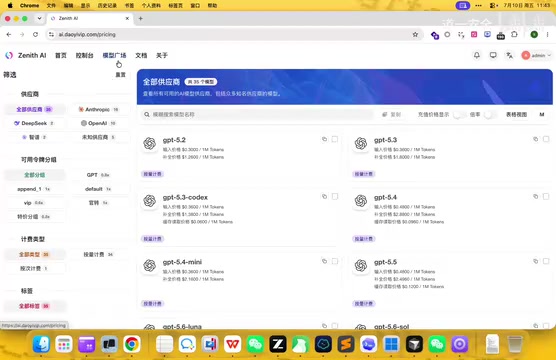
From the perspective of promotional pricing strategy, platforms typically use low prices to attract traffic during the launch window of a new model, attempting to quickly accumulate a user base. Understanding this pricing logic requires understanding the basic billing unit of large model APIs—the Token. A token is the smallest unit of measurement when a model processes text, produced by a tokenizer that splits raw text. The BPE (Byte Pair Encoding) algorithm used by OpenAI was first introduced to the NLP field by Sennrich et al. in 2016; it is essentially a lossless data compression technique that builds a subword vocabulary by iteratively counting and merging the most frequent byte pairs in the corpus, finding the optimal balance between character-level and word-level representations.
The BPE algorithm faces inherent challenges when processing Chinese: because Chinese corpora make up a far smaller share of the internet than English (around 5%-10% vs. English's 50%+), the merge frequency of Chinese characters during vocabulary training is relatively low, causing the cl100k_base vocabulary to be less efficient at compressing Chinese than English. The cl100k_base vocabulary used by GPT-4 contains about 100,000 token units, and the correspondence between English words and tokens is relatively stable (roughly 75 English words ≈ 100 tokens), whereas Chinese, due to its higher character density, typically maps each character to 1.5 to 2 tokens. In practical testing, this difference is significantly amplified into cost in long conversation scenarios. Developers can use OpenAI's official tiktoken library to precompute the number of tokens in a prompt locally, enabling more precise cost-control decisions when designing system prompts and avoiding unnecessary expenditure caused by prompt redundancy.
API billing typically distinguishes between input tokens (the prompt and context history sent by the user) and output tokens (the reply generated by the model), and the unit price of output tokens is generally higher than that of input tokens. This differentiated pricing essentially reflects the computational cost structure of the Transformer architecture: processing input tokens can be highly parallelized in the encoding phase, whereas the autoregressive generation of output tokens must proceed serially—each forward pass can only generate one token and must apply all attention weights to the already-generated sequence. As the output sequence grows, the memory footprint of the KV Cache (Key-Value cache) increases linearly, and GPU memory pressure rises accordingly. This computational characteristic makes the marginal cost of output tokens inherently higher than that of input tokens. The cost structure of relay stations is symmetric with this: their profit margin comes from the difference between bulk-purchase discounts and the retail price spread, and when platform traffic is insufficient to sustain economies of scale, the sustainability of a low-price strategy faces a fundamental challenge.
The price of GPT-4-class models typically ranges from a few dollars to tens of dollars per million tokens. Whether a relay station's low prices can be sustained essentially depends on whether the bulk discount on the tokens it purchases from the original provider covers its operating costs—this is also the core metric for evaluating a platform's sustainability.
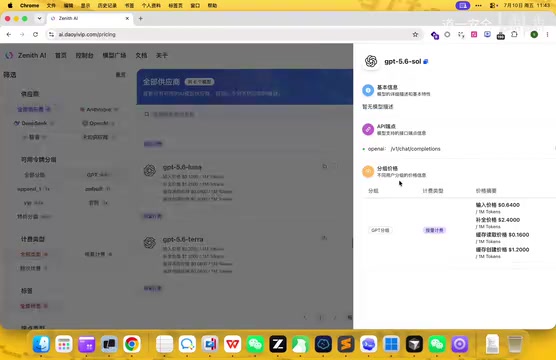
Hands-On Workflow: Three Steps to Access GPT-5.6
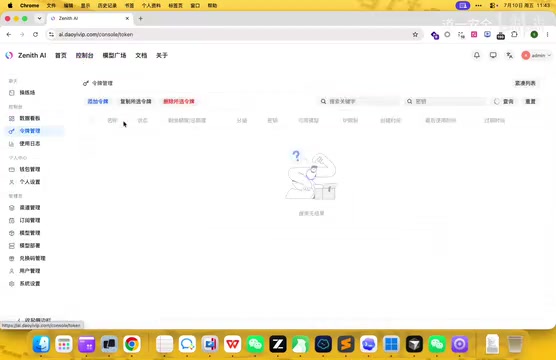
Step 1: Create an API Token
After completing registration, the user enters the platform console and creates a new API token in the "Token Management" module. The generated key serves as the credential for subsequent model invocation, so keep it safe and avoid leaking it.
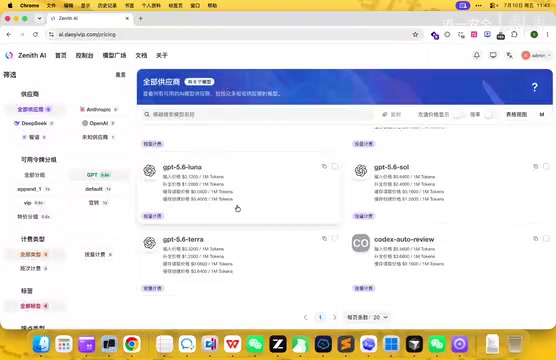
Step 2: Select a Model Group
When creating a token, you need to select the corresponding model group. If the goal is to invoke the GPT series, you should choose the "GPT group" to ensure the token has full permission to call the entire GPT-5.6 lineup. Grouping is a common practice at most relay stations for managing permissions and separately billing models from different vendors. Different groups often correspond to different upstream supplier channels or price tiers—for example, Azure OpenAI, official direct-connect channels, etc.—which differ in latency, stability, and price. Through grouping, the platform lets users make explicit choices when using the service.
From a network topology perspective, the difference between the Azure OpenAI channel and the official direct-connect channel is reflected not only in billing but also in Data Residency policies and SLA guarantee levels—Azure OpenAI offers enterprise-grade compliance commitments, whereas the direct-connect channels used by some relay stations may come from resold API quotas with a relatively weak compliance foundation.
Step 3: Import into an AI Client
Once the token is created, import it into mainstream AI tools that support custom API endpoints, such as Cursor and CherryStudio. Simply fill in the API address (Base URL) and token provided by the relay station in the client configuration, and you can start using GPT-5.6 for tasks such as conversation and coding.
This broad compatibility with mainstream development tools is an important reason API relay stations are favored by developers—they seamlessly integrate into the existing ecosystem of AI programming and conversation tools. The reason AI coding tools like Cursor can support custom endpoints is precisely because OpenAI established a de facto API standard in the industry; many tools reserved compatible interfaces from the outset, allowing users to swap out the backend service provider. This standardization effect has greatly promoted the prosperity of the AI tooling ecosystem while also laying the technical foundation for the commercialization of the relay station model.
Advantages and Risks: Rational Use Is the Right Approach
Three Major Advantages of Using Relay Stations
For domestic developers, the value of relay stations is mainly reflected in the following three dimensions:
- Payment convenience: Supports mainstream domestic payment methods, with no need for an overseas credit card
- Stable access: Provides optimized domestic access routes, reducing the connection failure rate
- Model aggregation: A single account manages models from multiple vendors, with flexible switching
In the early stage of a new model's release, a relay station allows capability evaluation at the first opportunity, sparing developers the tedious process of registering overseas accounts. For developers who only need to validate a technical approach, the cost-effectiveness is quite prominent.
Three Categories of Risks That Cannot Be Ignored
Using a third-party relay station also comes with clear risks, and a clear-eyed awareness is essential:
Risk 1: Data security hazards. All requests pass through the relay station's servers, and the platform technically has the ability to record and review the content of users' inputs and outputs. Here it is important to understand a key technical boundary: there is a fundamental difference between "the ability to log" and "whether it actually logs." Any server sitting in the network path is technically capable of performing deep packet inspection (DPI) on the transiting traffic and persistently storing request and response bodies.
Even if the transport layer uses HTTPS encryption, the relay station—as a TLS Termination Point—can fully access the plaintext content after decryption. This is key to understanding the data risk of relay stations. TLS (Transport Layer Security) termination is standard practice in modern web architecture: when a request reaches the relay station's edge node, the TLS handshake has already completed, and the server processes the request content (including the prompt and context) in plaintext after full decryption, then establishes a brand-new TLS connection to forward the request to OpenAI. This means the encryption protection of HTTPS is limited to the transport link, not the application-layer data itself. In other words, the TLS connection between the relay station and the user protects the data from being intercepted by a network man-in-the-middle, but the relay station itself, as the endpoint of the link, inherently possesses the technical ability to read all request content.
Fundamentally solving this problem requires end-to-end encryption (E2EE) or a Zero-Knowledge Architecture. However, a zero-knowledge architecture is fundamentally at odds with the inference process of large language models: the Transformer's attention mechanism needs to compute the Query, Key, and Value matrices over plaintext token sequences, and any encryption of the input data would make it impossible for the model to produce meaningful output. Homomorphic Encryption theoretically allows computation directly on ciphertext, but current schemes offer extremely limited support for the nonlinear activation functions heavily used in neural networks (such as GELU and SoftMax), and the computational overhead is 3 to 6 orders of magnitude higher than plaintext inference—leaving it years or more away from production-grade LLM deployment. Trusted Execution Environments (TEE/SGX) offer another approach—running inference inside a hardware-isolated secure enclave that even the cloud provider cannot access—but they likewise face performance bottlenecks for large-scale Transformer inference, as well as hard limits on TEE memory capacity for large model weights. Therefore, no legitimate LLM relay service can technically achieve true zero-knowledge data isolation.
Privacy policies and "no-logging commitments" are constraints at the compliance level, not isolation at the technical level. By contrast, the data-processing terms of OpenAI's official API are subject to legal regulation, and enterprise users can also apply for Zero Data Retention agreements ensuring their data is not used for model training. For application scenarios involving trade secrets, personal privacy, or sensitive data, the use of relay services of unknown origin should be firmly avoided.
Risk 2: Questionable service stability. The sustainability of the low-price traffic-acquisition model depends on the platform's operational health. There have been cases in the industry where a platform accumulated recharge balances and then shut down its service, so it is strongly discouraged to make large prepayments.
Risk 3: Difficulty verifying model authenticity. Some relay stations claim to support the "latest models," but what they actually invoke may be a downgraded version or cached results.
Verifying model authenticity is a technically challenging problem, because large language model output is stochastic (governed by a sampling strategy jointly determined by the Temperature and Top-p parameters), making it hard to reach a conclusive judgment from a single comparison. More systematic verification strategies include: first, constructing Knowledge Probes based on a specific training cutoff date, asking about events that GPT-5.6 is known to be able to answer but older versions cannot; second, designing reasoning test questions that leverage the model's specific capability boundaries, cross-referencing against officially published benchmark results (such as scores on standard test sets like MATH, HumanEval, and MMLU); and third, using statistical methods to compare the output distribution across many samples (a recommended N≥30), performing model fingerprinting based on stylistic features such as word frequency distribution, sentence-structure preferences, and the frequency of specific idiom usage. It should be noted in particular that some relay stations may forge version information by modifying the model field in the HTTP response header, so technical black-box behavioral testing is more credible than relying on metadata claims. It is advisable to perform statistical comparisons after multiple samplings rather than relying on a single output result.
Conclusion: Free Trials Are Fine, but Be Cautious with Large Recharges
The release of the full GPT-5.6 lineup represents yet another leap in large model capabilities, and API relay stations provide domestic developers with a relatively low-barrier channel to experience them. For teams hoping to quickly evaluate new models and conduct technical pre-research, sensibly using the free credit granted upon registration for a trial is a pragmatic choice.
But it must be emphasized once again: behind free and low-price offerings often lie costs in various forms. It is advisable to always follow these three principles: do not upload any sensitive data, do not make large prepayments, and cross-verify key information through official channels. Only through rational use can you embrace cutting-edge AI technology while genuinely holding the line on security and finances.
Key Takeaways
- API relay stations are based on a reverse proxy architecture, leveraging OpenAI's de facto standard interface to achieve seamless compatibility with user-side code; in cloud-native scenarios, reverse proxies also handle API governance functions such as circuit breaking (Circuit Breaker, three states: closed/open/half-open), token bucket rate limiting, consistent-hashing session persistence, and streaming SSE forwarding
- The Scaling Laws and RLHF together form the theoretical foundation for the iteration of the GPT series: the former guides the allocation of training resources, while the latter transforms a language model into an assistant that can genuinely follow human intent; the Chinchilla research further optimized the ideal ratio between parameter count and data volume
- GPT-5.6's improved multimodal capabilities involve deep fusion between the vision encoder (ViT) and the language model, while its long-text capability relies on positional encoding techniques like RoPE and ALiBi to break through the context-length limits imposed by O(n²) attention computation
- The token is the core billing unit of large model APIs; the BPE tokenization algorithm has lower coverage of Chinese characters, so Chinese developers should note that the token conversion efficiency of Chinese characters (about 1.5-2 tokens/character) is lower than English, and can use the tiktoken library to estimate costs; output tokens generally cost more per unit than input tokens due to the computational characteristics of serial autoregressive generation (linear growth of KV Cache memory)
- HTTPS encryption protects the transport link, but the relay station as a TLS termination point can fully access request plaintext; E2EE schemes like homomorphic encryption are fundamentally at odds with the Transformer attention mechanism's strong reliance on plaintext input, and TEE/SGX schemes also face performance bottlenecks in large-scale inference, so data security ultimately depends on compliance constraints rather than technical isolation
- The de facto standard status of the OpenAI API stems from network effects and ecosystem lock-in—a classic case of standard formation in technology ecology—with major competitors like Anthropic and Google all proactively adopting compatibility; this standardization effect is the technical basis of the relay station business model
- Model authenticity verification should use black-box testing methods with multiple samplings (N≥30) (knowledge probes, capability-boundary tests, model fingerprinting) rather than relying on forgeable response-header metadata
- It is advisable to use only the free credit granted upon registration for functional validation, to not upload sensitive data, and to not make large prepayments
Related articles

Apple HomeView Hands-On Review: Is the $300 Smart Home Hub Worth It?
Apple HomeView hands-on: a $300 smart home hub with facial recognition for quick account switching, but no App Store or voice recognition. Is the wall-mounted version worth it? Should you buy the first generation?

Meta Muse Wonder Launch: What It Means for Meta's Return to the Frontier AI Race
Meta releases Muse Wonder and WonderFull, benchmarks reach the frontier, community feedback is polarized. An in-depth look at Meta's return to the frontier AI race, its personal agent strategy, and Zuckerberg's different path.

Apple Home Smart Home Lineup Leaked: LG and Schneider Team Up, UWB Door Lock on Board
Apple Home ecosystem gains new LG and Schneider devices: UWB smart lock with proximity unlock, 2.5K dual-camera doorbell, privacy indoor camera, and AirPods-like seamless pairing.