GPT-5.6 Proves 50-Year Math Conjecture in One Hour — AI Independently Cracks a Scientific Problem

GPT-5.6 solves a 50-year math conjecture in one hour, while Apple sues OpenAI and Google open-sources Gemma 4.
OpenAI's GPT-5.6 Sol Ultra used 64 parallel agents to prove the Cycle Double Cover Conjecture in one hour for under $500 — a first for AI. Meanwhile, Apple sued OpenAI for trade secret theft via talent poaching, Google open-sourced the edge-ready Gemma 4 (31B), and China's Zhipu AI raised HK$31.4B to chase AGI.
AI Independently Solves an Unsolved Math Problem for the First Time
OpenAI's GPT-5.6 Sol Ultra model has achieved a landmark milestone: in just one hour, it proved a mathematical conjecture that had remained unsolved for 50 years — the Cycle Double Cover Conjecture. This marks the first time a large language model has independently solved an unsolved mathematical problem listed on Wikipedia.
About the Cycle Double Cover Conjecture: Independently proposed by Seymour and Szekeres in the 1970s, this is one of the most famous unsolved problems in graph theory. It asserts that for any bridgeless connected graph, there exists a collection of cycles such that every edge of the graph is covered by exactly two of those cycles. Its significance lies in its deep connections to classical problems like the Four Color Theorem and the Petersen Conjecture, making it a central proposition in topological graph theory. Over half a century, mathematicians made partial progress on special graph classes, but a complete proof for the general case remained elusive — a testament to the problem's extraordinary difficulty.
From a technical standpoint, this proof was not achieved through brute-force reasoning by a single model. Instead, it was completed through the coordinated work of 64 parallel sub-agents. Notably, the system also employed dedicated "adversarial agents" to verify the rigor of the reasoning chain, ultimately producing a complete proof.
Multi-Agent Collaboration and Adversarial Verification: Multi-agent collaboration is one of the core paradigms for expanding the capability frontier of large models today. Parallel sub-agents can explore the same proposition via different paths, cross-checking each other to effectively prevent error accumulation in long reasoning chains. The "adversarial agent" is specifically tasked with identifying logical flaws and refuting intermediate conclusions — functioning much like a peer reviewer in mathematical academic circles. This architecture of "multi-agent collaboration + adversarial verification" computationally simulates, to some degree, the peer review process in the human mathematics community.

Cost and Significance
The total estimated cost of this reasoning run was just $275 to $485. That figure is striking — solving a problem that baffled mathematicians for half a century at the cost of a few hundred dollars' worth of compute is virtually unimaginable under traditional research paradigms.
It's worth tempering expectations: the proof has not yet undergone peer review, and its correctness still awaits confirmation from the mathematics community. But regardless of the final verdict, AI's role in scientific discovery is undergoing a qualitative shift — evolving from an assistive calculation tool into a research partner capable of independent, creative mathematical reasoning. In the future, AI may not merely assist mathematicians, but potentially discover entirely new theorems on its own.
Apple Sues OpenAI for Trade Secret Theft
Alongside this technical breakthrough, OpenAI has found itself embroiled in legal trouble. Apple has formally filed a lawsuit against OpenAI, alleging that by poaching more than 400 former Apple employees, OpenAI stole large amounts of trade secrets — including physical component details — to accelerate its own hardware development.
Legal Background on Trade Secret Litigation: In Silicon Valley's tech industry, such cases are typically grounded in the federal Defend Trade Secrets Act (DTSA, effective 2016) and state-level Uniform Trade Secrets Acts (UTSA). The central dispute usually revolves around whether knowledge carried by a departing employee constitutes personal accumulated expertise or the former employer's proprietary information. The AI industry's unique nature — where algorithmic architectures, training data processing methods, and hardware design schematics can all constitute trade secrets — combined with high employee mobility and knowledge concentrated in individual minds, makes the evidentiary boundary particularly blurry. If this lawsuit involves chip or sensor design, its intensity could far exceed typical software IP disputes.
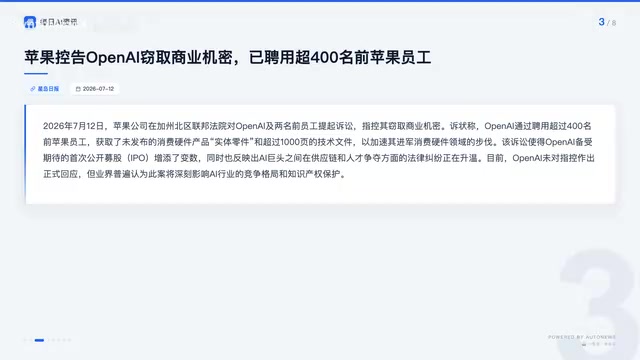
The timing of the lawsuit is particularly sensitive, coming at a critical moment as OpenAI prepares for its IPO, casting a shadow over its listing prospects. At a deeper level, it reflects the AI industry entering a phase of fierce competition — talent and intellectual property have become the core battlegrounds among tech giants.
Lawsuits over talent poaching between Silicon Valley's major players have historically been rare, making this direct confrontation between an AI upstart and a traditional hardware giant especially noteworthy. Legal analysts suggest that if Apple ultimately prevails, it could have a far-reaching regulatory impact on how the entire AI industry acquires talent. As of press time, OpenAI had not yet issued a public response.
GPT Live Redefines the Voice Interaction Experience
OpenAI simultaneously released a new voice model, GPT Live, which aims to break the traditional "question-and-answer" interaction pattern of voice assistants. Unlike passive-response systems of the past, GPT Live can judge in real time when to listen, when to interject, and can even proactively initiate conversations based on specific contexts.
The Evolution of Voice Interaction Technology: Traditional voice assistants (such as early Siri and Alexa) relied on a sequential pipeline of "wake word detection → ASR speech recognition → NLU intent understanding → TTS speech synthesis," resulting in high latency and weak contextual awareness. The core breakthrough of the new generation of voice models represented by GPT Live lies in end-to-end unified modeling — integrating auditory input, semantic understanding, and speech generation into a single neural network, enabling millisecond-level real-time responses and a more natural turn-taking mechanism that fundamentally addresses the awkward interruption handling endemic to traditional architectures.
Internal data shows that user preference for GPT Live is more than 75% higher than the previous generation. A key innovation is its ability to dynamically dispatch backend large models to handle complex questions — akin to a cognitive hierarchy of "fast thinking + slow thinking": simple commands are handled instantly by a lightweight front-end model, while complex reasoning tasks are routed to a more powerful backend model, balancing latency with capability. This means voice assistants are no longer simple command executors, but conversational partners capable of deep reasoning. As these models are deployed, the natural, fluid human-machine voice interaction depicted in science fiction is steadily becoming reality.
Google Open-Sources Gemma 4: A New Inflection Point for Edge AI
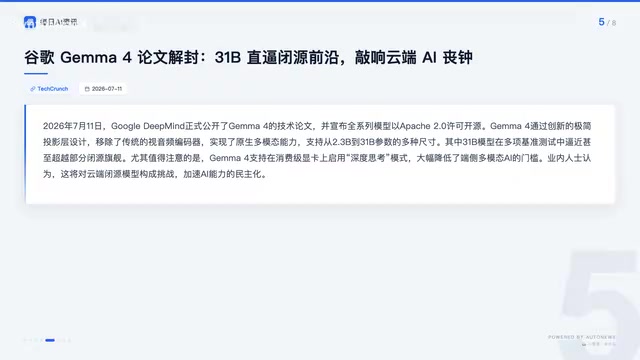
Google DeepMind's newly open-sourced Gemma 4 model delivers impressive performance on multimodal tasks with just 31B parameters, approaching the capabilities of closed-source frontier models.
Native Multimodal Design Lowers the Deployment Barrier
Gemma 4 adopts a unique native multimodal design that eliminates the traditional encoder structure, allowing even smaller-scale models to perform deep reasoning tasks on consumer-grade GPUs.
The Technical Significance of the Architecture Innovation: Traditional multimodal large models typically use a "dual-tower" architecture (e.g., CLIP + GPT), where a visual encoder compresses images into feature vectors before feeding them to the language model. Gemma 4's native multimodal design eliminates the separate visual encoder, processing image tokens and text tokens in a unified manner, reducing architectural complexity and VRAM consumption. This is hugely significant for edge deployment: consumer-grade GPUs (such as the RTX 4090 with 24GB VRAM) previously struggled to run large-parameter models with multimodal reasoning capabilities, but a 31B-scale native multimodal model has the potential to break through this bottleneck, enabling users to experience near-cloud-level AI on their own laptops or even smartphones.
Coupled with the permissive Apache 2.0 open-source license — which allows commercial use and code modification, substantially reducing legal risk for companies building products on Gemma 4, unlike more restrictive licenses such as GPL or CC-BY-NC — Gemma 4 is poised to catalyze a wave of edge AI applications. Some commentators have called this "the death knell of cloud AI," but a more measured assessment might be that it will drive the AI ecosystem toward a more vibrant cloud-edge collaborative model, genuinely accelerating the democratization of AI technology.
China's AI Race: Zhipu AI Launches "Altitude Challenge" to Pursue AGI
The domestic AI sector also delivered major news. Zhipu AI completed a HK$31.4 billion placement — the largest tech fundraising in Hong Kong's equity markets this year — and simultaneously launched its "Altitude Challenge" initiative to make a full push toward AGI.
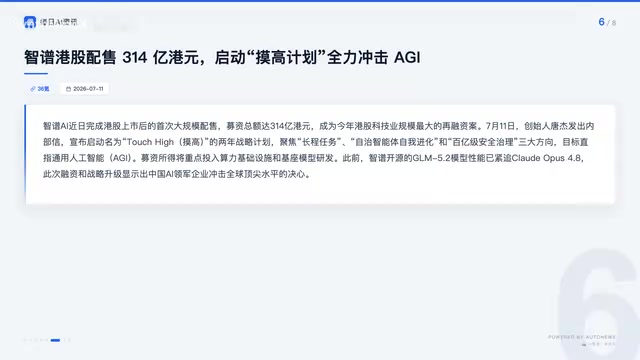
The company's founder stated that over the next two years, Zhipu will concentrate resources on tackling key technical challenges including long-horizon tasks and agent self-evolution, while also strengthening safety governance. This massive fundraise will inject significant momentum into Zhipu's compute infrastructure buildout and foundation model iteration. Against the backdrop of its open-source model GLM-5.21 achieving strong results, Zhipu's next moves are drawing close attention globally. This also reflects a broader trend of Chinese AI companies advancing from application innovation toward upstream core technologies.
Embodied AI in the Field: State Grid's Inspection Robot Wins Geneva Award
China Southern Power Grid's embodied AI robot won an award at the Geneva AI Summit, setting a benchmark for intelligent transformation in the power industry. Built on a VLA (Vision-Language-Action) architecture, this robot can see, hear, execute actions, and autonomously plan inspection routes, dramatically compressing routine inspection times and significantly improving emergency response efficiency.
VLA Architecture and the Technical Substance of Embodied AI: VLA (Vision-Language-Action) architecture is the mainstream technical approach in the embodied AI field today, with representative works including Google's RT-2 and PaLM-E. Its core idea is to unify visual perception (camera images), language instruction understanding, and low-level action control (motor commands) into a single end-to-end neural network, enabling robots to directly derive "what action to take" from "what they see" and "what they are told," without manually coding large volumes of rules. Compared to the fixed program control of traditional industrial robots, VLA architecture endows robots with the ability to handle unstructured environments — particularly critical for power transmission line inspection, where lines often traverse complex terrain such as mountains and rivers, equipment failures take diverse forms, and traditional automation solutions struggle to provide comprehensive coverage.
Its 24/7 uninterrupted monitoring capability has the potential to address the long-standing challenge of labor shortages at remote power stations. As large models and embodied AI become more deeply integrated, industrial deployment cases of this kind will become increasingly common, providing a Chinese model worthy of reference for AI applications in the global energy sector.
Key Takeaways
Related articles

Cursor AI Programming in Practice: Build a Student Management System from Scratch in 30 Minutes
A Bilibili creator demonstrates Cursor AI programming: generating a student management system in 30 minutes with natural language. Details on Agent mode, Claude selection, prompt techniques, and thresholds.

Top 20 AI Coding Tools Ranking: From Rock-Solid to Lackluster, a Scored Matrix
Bilibili creator releases top 20 AI coding tools ranking, tiered T0–T4 from rock-solid to lackluster, with Claude Code and Codex tied at T0. This article details the scoring dimensions (capability, reliability, robustness, durability, cost, domestic availability) and tool performances to help developers choose the right AI coding assistant.

Vibe Coding Systematic Tutorial: Master AI-Assisted Programming from Zero
A three-month Vibe Coding tutorial from a Bilibili creator covering Codex, ClaudeCode, and Cursor, from core logic to commercial project practice for beginners.