GPT-5.6 Released: Sol/Terra/Luna Three-Tier Model Family Takes On Claude Head-On

OpenAI launches GPT-5.6 with Sol/Terra/Luna tiers, with flagship Sol taking on Claude head-on.
OpenAI has released GPT-5.6, splitting into a three-tier model family—flagship Sol, mid-tier Terra, and lightweight Luna. Sol surpasses Claude on coding benchmarks while being twice as fast and a third cheaper. The launch also features programmatic tool calling, ChatGPT Work, and real-time voice GPT Live, signaling AI's shift toward refined product-line operations.
GPT-5.6 Arrives: From a Single Model to a "Three-Tier Family"
OpenAI has officially released GPT-5.6, and this launch carries some serious weight—it introduces three different model variants all at once, plus an enterprise office tool and a real-time voice model.
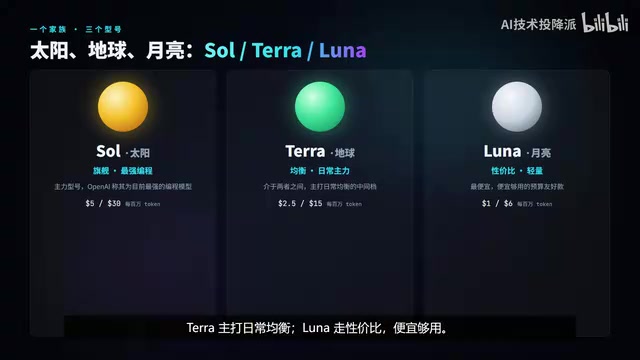
The biggest change is that GPT-5.6 is no longer a single model but has been split into a "family" of three variants. The flagship is called Sol (the Sun), the mid-tier is Terra (the Earth), and the lightest is Luna (the Moon). Sun, Earth, Moon—from strongest to weakest, the naming is quite deliberate.
The positioning of the three tiers is clear: Sol is the workhorse, which OpenAI calls the most powerful coding model available today; Terra is designed for everyday balance; and Luna takes the value route—cheap and good enough. This is also the first time OpenAI has divided its models into three tiers, with a logic somewhat resembling the smartphone industry's "Standard, Pro, Pro Max" approach, allowing users with different budgets and needs to pick what suits them.
Behind this tiered strategy lies a more fine-grained segmentation of user scenarios. In the past, large models tended to "take on the whole world with a single spec," but in real-world applications, code generation, everyday Q&A, and batch lightweight tasks have vastly different demands on compute and cost. The emergence of three tiers signals that large models are shifting from being "general-purpose monsters" toward "product-line operations."
Model Tiering: An Inevitable Path Toward Industry Maturity
The move from a single product to a tiered family is essentially a hallmark of the AI industry maturing. Early large-model competition centered on the "parameter count" narrative—whoever had more parameters had the flagship. But as inference costs and commercial deployment became the main battleground, the limitations of a single ultra-large model grew increasingly apparent: too expensive to cover long-tail scenarios, and too general-purpose to offer clear differentiation. The chip industry long ago validated the business logic of "product-line tiering"—NVIDIA has the A100, H100, and consumer-grade RTX series, while phone makers have flagship, standard, and entry tiers. Large models moving toward this model shows that AI has entered a phase of refined operations. For the developer ecosystem, this means being able to flexibly choose based on task complexity and budget, rather than being forced to pay top-tier prices for every call.
Performance Benchmarking: Clearly Aimed at Anthropic
On performance, OpenAI has made it clear this time that it's targeting Anthropic—the company behind Claude, now widely recognized as OpenAI's strongest competitor.
Citing third-party coding benchmarks, OpenAI says the flagship Sol scored 80 points, 2.8 points higher than Claude's comparable model. More importantly, Sol's output volume is less than half that of its rival, it's twice as fast, and it costs a third less. In a computer-operation test called OS World, Sol also surpassed Claude's Opus series while consuming 85% less compute.
OS World: The Industry Yardstick for Measuring "Hands-On Ability"
OS World is a comprehensive AI capability benchmark designed by academia, specifically testing a model's ability to operate a real computer environment—including executing complex tasks like file management, browser operations, and application interactions within an operating system. Unlike traditional Q&A benchmarks, OS World requires the model to possess the complete closed-loop capability of "perceiving the screen, planning steps, executing operations, and verifying results," which is much closer to agent behavior in real work scenarios. This benchmark has become an important reference for measuring a model's "hands-on ability," and Claude's Opus series previously led on this test, making Sol's surpassing it a significant milestone.
In a nutshell: stronger, and more economical.
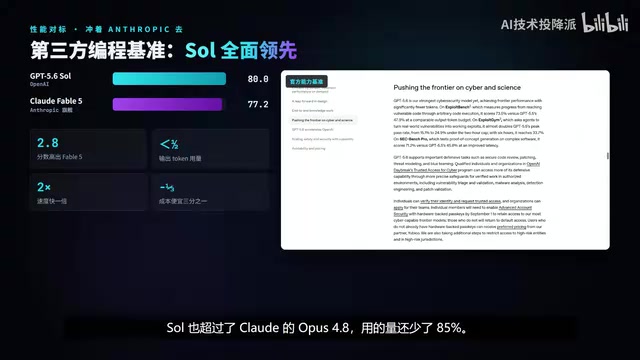
The narrative of "a double win in performance and cost" is the most lethal weapon in today's large-model competition. Simply piling up scores can hardly impress developers anymore, because in real commercial applications, token costs and response speed often matter more than a few extra points on a leaderboard. OpenAI has clearly seized on this pain point, differentiating itself through efficiency advantages.
Three-Tier Pricing: Luna Approaches Last-Gen Peak at Half the Cost
Just how much cost is saved? The pricing makes it crystal clear. Per million tokens:
- Sol: $5 input, $30 output
- Terra: $2.5 input, $15 output
- Luna: $1 input, $6 output
Token Cost: The Core Variable in Large-Model Commercialization
A token is the basic unit for measuring and charging in large models—typically, one English word equals about 1-2 tokens, and one Chinese character equals about 1-2 tokens. For high-frequency call scenarios, token costs quickly accumulate into substantial operating expenses. Take a mid-sized SaaS company making a million API calls per day: reducing output tokens from $30/million to $15/million can save millions of dollars a year. Response speed likewise affects the product experience: in conversational scenarios, users are extremely sensitive to latency, and responses exceeding 2 seconds often cause a noticeable drop in experience. This is exactly why Sol's narrative of being "twice as fast at a third less cost" is more commercially persuasive than a mere leaderboard score.
Luna is the cheapest tier, and OpenAI specifically emphasizes that it approaches the peak performance of the previous generation at less than half the cost of GPT-5.5. In other words, even choosing the cheapest tier won't compromise the experience much.
This pricing strategy sends a clear signal: OpenAI wants to lower the barrier to model usage, making it affordable for more developers and small-to-medium teams, thereby expanding its ecosystem and market share. In head-to-head competition with Anthropic, price is an extremely important card to play.
Technical Highlights: A Leap in Programmatic Tool Calling and "Aesthetics"
On the technical side, GPT-5.6 has one highlight worth calling out separately—Programmatic Tool Calling.
Previously, a model's tool calling worked like "you ask it to look up one thing, it looks up one thing"—many back-and-forth trips, which was both slow and token-consuming. Now, GPT-5.6 can write a small program itself, chaining multiple tools together, filtering out useless intermediate results, and then deciding what to do next. One trip does the work of several, saving tokens and running faster.
Why Programmatic Tool Calling Is a Key Leap in Agent Capabilities
Traditional large-model tool calling (Function Calling) uses a "single-step serial" model: the model can only call one tool at a time, waits for the result, then decides the next step, forming an inefficient loop of "think-call-wait-think again." The breakthrough of programmatic tool calling is that the model can generate an executable orchestration script that parallelizes or pipelines multiple tool calls, filters out redundant data in between, and significantly reduces the number of round trips and token consumption. The bottleneck of early agent frameworks like LangChain and AutoGPT was largely due to insufficient tool-orchestration capabilities—the model couldn't autonomously plan multi-step operations and had to rely on external frameworks to force the logic together. GPT-5.6 internalizes this capability into the model itself, marking the shift of "autonomous agents" from engineering patchwork to native support.

More interestingly, OpenAI says the model's "design judgment" has made a significant leap. Give it a broad direction, and it can produce tasteful, usable interfaces, and even check the rendered results itself, spot problems, and iterate. To put it a bit tongue-in-cheek: AI is starting to develop aesthetic sense.
Taking these two points together, it means GPT-5.6 isn't just more accurate at "answering questions"—it has taken a key step forward in autonomy for "completing complex tasks." Tool-orchestration capability and design judgment are precisely the core capabilities for moving from "conversational assistant" to "autonomous agent."
Safety Interlude: Held Back by the Government for Weeks Before Clearance
There was a small episode before GPT-5.6's release. Because OpenAI positioned it as the "most powerful cybersecurity model"—capable of threat modeling, code auditing, and even helping enterprises simulate hacker attacks to discover vulnerabilities—the U.S. government at one point held back the release for weeks on national security grounds before clearing it.
To prove its safety, OpenAI invested roughly 700,000 GPU hours in red-team testing this time—that is, having its own people repeatedly attack its own model to find and patch vulnerabilities one by one.
Red-Team Testing: A Systematic Methodology for AI Safety Evaluation
Red teaming originates from military terminology, referring to assembling a dedicated team to proactively find system vulnerabilities from an attacker's perspective. In the AI safety field, red-team testing has developed into a systematic evaluation method: testers use carefully crafted prompts to attempt to induce the model to output harmful content, bypass safety guardrails, leak training data, or be exploited for offensive purposes. The scale of a 700,000 GPU-hour investment means thousands of parallel test instances running continuously for weeks—one of the largest safety evaluations ever conducted before a large-model release. This level of investment also reflects the special regulatory pressure faced by "dual-use AI" (cybersecurity models that can be used for defense but also abused for attacks)—the capability boundaries of such models directly bear on national cybersecurity posture.

This episode reflects an increasingly real question: when AI becomes powerful enough to conduct offensive cyber operations, it's no longer just a tech product but a sensitive asset involving national security. The more capable the model, the deeper regulatory involvement becomes—this will be the norm that all frontier models must face going forward.
More Than Models: ChatGPT Work and Real-Time Voice GPT Live
Beyond the models themselves, OpenAI also brought two new products this time.
One is ChatGPT Work, an enterprise office assistant that can handle documents, spreadsheets, and presentations, available on desktop, web, and mobile. The other is GPT Live, a real-time voice model that delivers conversation-level instant responses.
Enterprise AI Assistants: The Most Crowded Battlefield
The enterprise office AI market that ChatGPT Work is entering is one of the most fiercely contested arenas among tech giants today. Microsoft has deeply integrated the GPT series into Microsoft 365 with Copilot; Google is reshaping Workspace around Gemini; and SaaS platforms like Notion and Slack have also built in AI capabilities. The core proposition of this race isn't "whether the model is smart enough" but "whether it can seamlessly embed into existing workflows." Enterprise users face extremely high migration costs and complex data security and compliance requirements, so "last-mile" productization capability often determines success more than underlying model performance. OpenAI launching a standalone Work product line means it's no longer content being just an API provider but is directly competing with Microsoft and Google on the enterprise front—and Microsoft happens to be OpenAI's most important investor, making this coopetition relationship increasingly delicate.
OpenAI's intent is clear: to push AI from the chat box into real workflows. This is also the shared direction of the entire industry—pure Q&A is no longer enough, and whether it can embed into actual productivity scenarios is the watershed that determines commercial value.
Conclusion: Fierce Rivalry Beneath a Routine Upgrade
GPT-5.6 looks like a routine iteration, but the competitive tension behind it is quite intense. OpenAI and Anthropic—one on the offensive, one biting back hard—while Meta is also densely releasing new models during the same period. Under this kind of "rat race," users are indeed the beneficiaries: for the same money, the models they can call are getting stronger and stronger.
As for whether GPT-5.6 can secure the flagship position, that still depends on real feedback from developers. Leaderboard scores and official marketing are certainly impressive, but the ultimate verdict is always decided in real-world deployment.
Key Takeaways
Related articles

Build an AI Super Employee System at Zero Cost: A Full Breakdown of Automated Agent Workflows
A deep breakdown of the AI super employee system demoed on Bilibili: agent orchestration, digital human voiceovers, map and enterprise lead generation, 24/7 customer service, and legal modules. We analyze the business logic and compliance risks behind zero-cost signup to help entrepreneurs judge the real ROI of this AI digital employee system.

The Essential Difference Between Chatbots and AI Agents: Crossing from Conversation to Execution
What's the difference between a chatbot and an AI agent? Based on the MCP series on the Learn Tech channel, this article uses examples like booking flights and summarizing notes to explain: a chatbot only gives answers, while an agent actually completes tasks through a think-act-observe loop. It breaks down the four core components—model, tools, memory, and goal—as well as MCP's role as a bridge, and discusses agents' applicable boundaries and permission risks.

Free GitHub Repo: 342 Hours of AI Courses, from Math to MCP Servers
A free GitHub repo offers 342 hours of AI courses: 523 lessons across 20 phases, from math fundamentals to agent building and MCP servers. Nearly 100,000 learners have started.