GPT-5.6 Used 64 Sub-Agents to Tackle a Graph Theory Conjecture — How Far Are We from a Real Proof?

GPT-5.6's 64-agent proof draft is impressive, but peer review and formal verification are still missing.
GPT-5.6 Soul Ultra deployed 64 parallel sub-agents to produce a one-hour proof draft for the 50-year-old Cycle Double Cover Conjecture. While the multi-agent pipeline marks real progress in AI reasoning, the draft still lacks independent peer review and formal verification — the two gatekeepers that separate a promising draft from a textbook theorem.
What Actually Happened in That One-Hour Draft
According to interpretations from Bilibili videos, OpenAI materials claim that GPT-5.6 Soul Ultra deployed 64 parallel sub-agents within one hour to produce a proof draft for a graph theory conjecture that has stood unsolved for 50 years — the Cycle Double Cover Conjecture. The news instantly sparked heated debate in tech circles: has AI truly started "doing mathematics"?
Before drawing any conclusions, we need to translate this conjecture into plain language, examine what those 64 sub-agents actually did, and then soberly assess — how many checkpoints remain between a proof draft and a mathematical theorem ready for the textbooks?
The Cycle Double Cover Conjecture: Intuitive Yet Extraordinarily Difficult
Understanding the Conjecture in One Sentence
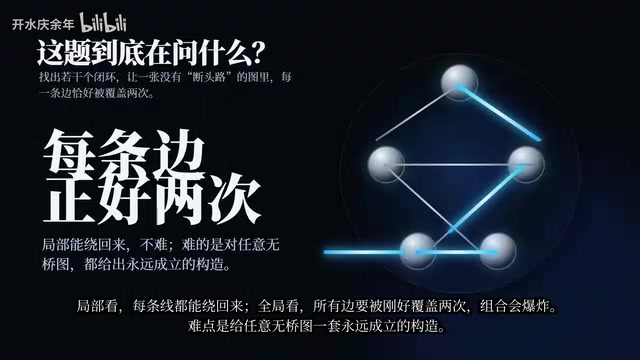
Imagine you have a network diagram with no dead ends (mathematically called a bridgeless graph). The challenge is to draw a set of closed loops on it such that every edge falls in exactly two loops — no more, no less, covered precisely twice. That is the most intuitive way to describe the Cycle Double Cover Conjecture.
Origins and Academic Significance
The Cycle Double Cover Conjecture was independently proposed by Seymour and Szekeres in 1979, and it stands as one of the most celebrated open problems in graph theory. It does not exist in isolation — the conjecture has deep connections with the Four Color Theorem, the Petersen graph, and other classical problems, and is considered one of the key tools for understanding the embedding structure of graphs.
Mathematicians have made genuine progress over the past 50 years: the conjecture has been verified for numerous special graph classes, including 4-edge-connected graphs, planar graphs, and graphs embeddable in the projective plane. But a complete proof for arbitrary bridgeless graphs remains elusive. This state of "locally solvable, globally unknown" is precisely why the conjecture attracts determined researchers — and why it is also prone to false breakthroughs.
Where the Difficulty Lies
The core difficulty is the tension between local and global structure. Locally, every edge seems capable of looping back to form a closed cycle — everything looks fine. Globally, however, ensuring that all edges are covered exactly twice causes the number of combinatorial possibilities to explode.
The place where mathematicians get stuck has never been "failing to draw a few cycles." The real challenge is providing a construction method that works for any bridgeless graph without exception. Individual cases can be resolved, but proving the statement holds for every graph satisfying the condition — that is the true chasm, and the fundamental reason the conjecture has resisted 50 years of effort.
64 Sub-Agents: A Parallel Research Pipeline
Not "A Chat Window That Suddenly Learned Math"
What genuinely deserves attention here is that the AI's workflow more closely resembles a real research team than a single model having a moment of inspiration. According to the video descriptions, the division of labor roughly breaks down as follows:
- One agent handles decomposing definitions, splitting the problem into manageable sub-tasks;
- One agent focuses exclusively on exploring construction methods;
- Other agents play the role of "challengers," specifically searching for counterexamples and logical gaps.

The Technical Principles Behind Multi-Agent Systems
The underlying logic of this architecture is worth unpacking. Each sub-agent is essentially an independent language model instance, assigned a distinct role prompt and task boundary. Sixty-four parallel branches mean the system simultaneously explores 64 different reasoning paths, using a mechanism resembling "tree search" or "ensemble verification" to filter for the best results — a design philosophy similar to AlphaGo's Monte Carlo Tree Search: replacing single-threaded deep reasoning with large-scale parallel exploration, trading computational resources for breadth of coverage.
The 64 parallel branches serve to rapidly eliminate dead-end paths and then consolidate the remaining valid arguments into one coherent draft.
What "One Hour" Actually Means
So "completed in one hour" does not mean a chat window suddenly became a mathematician. A more accurate description is: a large number of rounds of attempting, checking, and rewriting were compressed into a single parallel pipeline. This paradigm of "multi-agent collaboration + large-scale parallel verification" is the most technically significant aspect of this event — it demonstrates the possibility of AI moving from "single-point reasoning" toward "team-based problem-solving."
Keeping a Cool Head: A Blueprint Is Not a Built Bridge
This Is Only a "Proof Draft"
Here is where clear-headed thinking becomes essential. What the public materials present is a proof draft, and two critical steps have not yet been completed:
- No independent peer review has been conducted;
- No formal verification tools have checked the argument step by step.
Peer Review: Mathematics' Most Rigorous Quality Control
Peer review in mathematics is unlike that in most other scientific fields. Reviewers are expected to verify every lemma and every derivation line by line; any "intuitive leap" risks being flagged as a gap. History offers instructive precedents: after Wiles submitted his proof of Fermat's Last Theorem in 1993, a critical flaw was discovered, and it took nearly a year to repair; even the computer-assisted proof of the Four Color Theorem sparked more than a decade of debate before the mathematics community broadly accepted it. This shows that even meticulously crafted results from top mathematicians must survive this rigorous community vetting — let alone a draft generated by AI in one hour.
Formal Verification: Recalculating Every Last Bolt
Formal verification is the critical step toward making a mathematical proof "machine-trustworthy." Theorem provers such as Lean, Coq, and Isabelle require every reasoning step to be translated into strict logical notation; the system then automatically checks whether each derivation is valid, ensuring no hidden assumptions have been silently introduced. The "formalized mathematics" movement actively championed since 2023 by top mathematicians including Terence Tao aims to build a joint human-machine verification infrastructure for mathematics — elevating proofs from "legible to experts" to "verifiable step by step by machines." This process often takes longer than writing the original proof, but the certainty it provides is irreplaceable.
An Apt Analogy
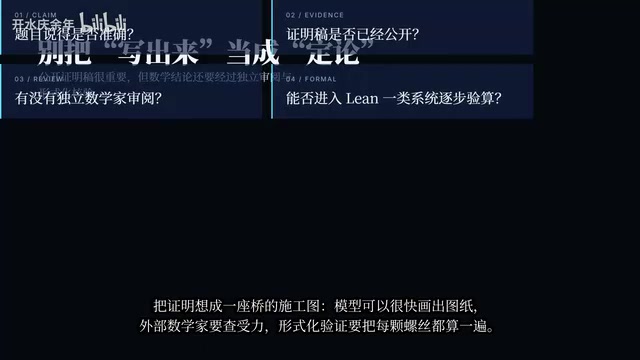
Think of a mathematical proof as the engineering blueprint for a bridge. A model can quickly produce a blueprint that looks impeccable, but external mathematicians still need to check whether the "load-bearing structure" is sound; formal verification tools then go through and recalculate every single bolt.
A beautiful blueprint does not mean the bridge is open to traffic. The rigor of mathematical proof is expressed precisely in this kind of step-by-step verification that tolerates no shortcuts.

A Four-Step Framework: How to Evaluate "AI Solves Hard Problem" Reports
To avoid being swept away by sensational headlines, the next time you encounter news about "AI cracking an unsolved problem," try applying these four questions:
- Is the problem correctly stated? — Is the problem the AI addressed actually the original conjecture?
- Is the proof publicly available? — Is the full proof draft accessible for inspection, or are only the conclusions presented?
- Has there been independent review? — Have mathematicians in the field cross-verified the result?
- Can it be formally verified? — Has it passed rigorous machine-assisted verification?
Only when all four criteria are satisfied does a result genuinely approach the standard of a textbook-worthy theorem. In the current GPT-5.6 case, it satisfies "correctly stated problem" and "proof publicly available," but remains blank on both "independent review" and "formal verification."
The Progress Is Real — But Don't Pop the Champagne Yet
Multi-agent parallel attacks on hard mathematical problems are undeniably a significant demonstration of AI's reasoning capabilities, compressing a human research team's collaborative workflow into a one-hour computational pipeline — that is genuine, substantive technical progress.
But mathematical rigor admits no compromise. An unreviewed, unverified proof draft has value as "a potentially promising approach," not as "a solved problem." Staying alert to progress while maintaining caution about conclusions may be precisely the right posture to hold as the wave of AI-driven research continues to rise.
Key Takeaways
Related articles

Cursor Can Now Control Your Computer: AI Agents Can Drive Desktop Apps for Testing
Cursor adds desktop control: AI agents can drive desktop apps like the iOS Simulator to test their own features. We analyze the impact on dev workflows, possible technical approaches, and reliability concerns.

Vibecoding a Custom Inference Engine: High Hopes, Harsh Reality
A Reddit developer shares the real experience of vibecoding a custom inference engine: running GGUF Q4 models in the browser with WebGL2 and GLSL, only to fall into tokenizer debugging hell. This article analyzes the engineering challenges of browser-side LLM inference and why cloning llama.cpp is the more rational choice.

How High Are Anthropic's Early Investor Paper Returns Ahead of IPO?
Anthropic's early investor paper returns draw attention ahead of IPO. This article analyzes sources of book gains, capital structure, pre-IPO games and risks, and implications for the AI startup ecosystem.