Muse Glimmer 30B In-Depth Review: Complete Guide to Meta's Open-Source Agent Model for Local Deployment

Meta's Muse Glimmer 30B excels at agent tasks locally while Qwen leads in coding—here's a full breakdown.
Meta's Muse Glimmer 30B is a 30-billion-parameter dense model optimized for agent tasks under the Apache 2.0 license. It outperforms peers in tool calling, multi-step planning, and self-correction, while Qwen 3.6 27B remains stronger for coding. Running on consumer GPUs with 4-bit quantization, it needs ~18GB VRAM and achieves 40 tokens/sec on an RTX 3090. Its 82% hallucination rate on GPQA V2 is a notable weakness.
Meta Returns to the Open-Source Arena: Muse Glimmer 30B Officially Launches
True to Mark Zuckerberg's earlier promises, Meta has officially returned to the open-source AI arena. Following the Llama series, this is yet another heavyweight open-source model from Meta, regarded as a core pillar of their open-source strategy. The star of the show is Muse Glimmer 30B—an open-source agent model with approximately 30 billion parameters, specifically designed to run on local devices.
You may not have noticed, but Glimmer differs from the full-weight version Muse Spark 1.2 that's set to release later. Glimmer's positioning is clearer: it's a dense model deeply optimized for agent applications, released under the Apache 2.0 permissive license, granting developers tremendous freedom. It supports a 128K (approximately 121K effective) context window, features multimodal capabilities, and runs perfectly on consumer GPUs with 24GB of VRAM.
The Dense Model Architecture Choice
Glimmer's "Dense Model" architecture stands in stark contrast to the currently popular Mixture of Experts (MoE) approach. Dense models activate all parameters during inference—every input token passes through all neural network layers. MoE architectures (like Mixtral, DeepSeekAd-V3, etc.) only activate a subset of expert networks, resulting in lower actual computation despite larger total parameter counts. The advantages of dense models include more predictable inference behavior and more uniform hardware utilization, making them particularly well-suited for GPU acceleration. The downside is higher computational overhead at equivalent parameter counts. Glimmer chose a dense architecture precisely to achieve stable and predictable inference performance on consumer GPUs.
The Strategic Significance of the Apache 2.0 License
Apache 2.0 is one of the most permissive licenses in open-source software, allowing users to freely use, modify, distribute, and even commercialize derivative works—the only requirement being retention of the original copyright notice and disclaimer. By contrast, Meta's earlier Llama series used a custom license with additional restrictions for companies exceeding 700 million monthly active users. Adopting Apache 2.0 means companies of any size can unconditionally integrate Glimmer into commercial products, which is especially important for startups and independent developers, dramatically reducing legal compliance costs.
For those who've been agonizing over "which local model is the best right now," there's no simple answer—it depends on your use case.
Glimmer vs Qwen: The Capability Divide Between Agents and Coding
Based on hands-on testing, Glimmer and Qwen 3.6 27B demonstrate a clear capability divide, each excelling in different areas.
Glimmer's Core Strength: Agent and Tool Calling
Glimmer's biggest differentiator is its agent capabilities. It's specifically optimized for Tool Calling and task decomposition, supports handling long-horizon multi-step planning, and can self-correct when execution errors occur. In MCP, deep search workflows, agent tasks, and long-range planning, Glimmer clearly outperforms other local models of similar size.
Understanding Tool Calling and the MCP Protocol
Tool calling refers to an AI model's ability to proactively invoke external tools (such as APIs, database queries, code executors, etc.) during reasoning to complete tasks. This requires the model not only to generate natural language but also to output structured function call instructions and continue reasoning based on returned results. MCP (Model Context Protocol) is an open standard protocol proposed by Anthropic in 2024, aimed at unifying communication between AI models and external data sources/tools—similar to a "USB port" for AI. Supporting MCP means Glimmer can seamlessly connect to various third-party services and local tool chains, significantly lowering the development barrier for agent applications.
Qwen's Core Strength: Coding and Logical Reasoning
In comparison, the Qwen series excels in pure coding ability, general tasks, OS-level tasks, and logical reasoning. In benchmarks like SWE-Bench and Terminal-Bench for computer operation, Qwen still holds the advantage.
It's worth explaining that SWE-Bench is a software engineering benchmark from Princeton University, containing programming problems extracted from real GitHub repositories. It requires models to understand codebase context and generate correct patches to fix bugs, and is considered the gold standard for measuring AI's practical coding ability. Terminal-Bench focuses on evaluating a model's ability to execute OS-level tasks in terminal environments, such as file management, process control, and network configuration. These two benchmarks represent the "actually doing programming" dimension rather than "answering programming questions."
The conclusion is clear: choose Qwen for coding tasks, and Glimmer for agent tasks. Combining both and running them locally unlocks even more AI application possibilities.
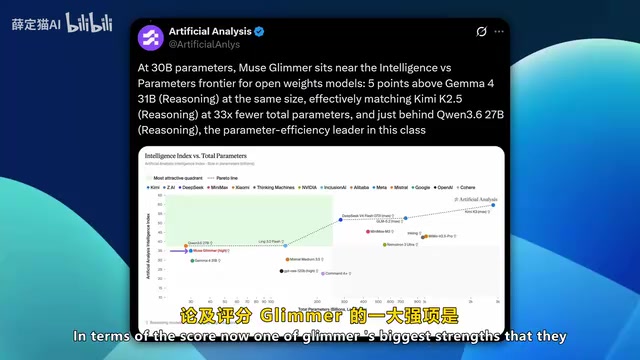
Glimmer 30B Benchmark Data Breakdown
According to independent evaluation by Artificial Analysis, Glimmer 30B achieved an intelligence index score of 35, a massive improvement over the previous Llama generation and highly competitive among models of similar size:
- Surpasses Gemma 2 27B at 30 points;
- Nearly matches Qwen 2.5 (36 points);
- While Qwen 2.5 72B still leads at 38 points, Glimmer achieves comparable performance with a much smaller parameter count.
On general agent tasks, Glimmer reportedly scored 24% according to official reports, significantly higher than Qwen's 17%. Additionally, Meta's test data shows Glimmer outperforming same-tier competitors across most benchmarks.
The Hallucination Problem: A Warning from GPQA V2
However, Glimmer has a notable weakness: knowledge processing tasks and hallucination performance. On the GPQA V2 test, its hallucination rate reached 82%—meaning extra caution is needed in scenarios requiring factual accuracy.
GPQA (Graduate-Level Google-Proof Q&A) is a challenging question-answering benchmark written by domain experts, covering graduate-level knowledge in physics, chemistry, biology, and other disciplines. It's designed so that answers are difficult to find even through Google searches. The V2 version further increases difficulty and coverage. An 82% hallucination rate means that when facing specialized questions beyond its training knowledge, the model tends to generate plausible-sounding but actually incorrect answers rather than admitting ignorance. This is a common issue across all current language models, but 82% is notably high, warning users to be extra careful in fact-checking scenarios.
The Token Efficiency Advantage
Notably, Glimmer's token efficiency is significantly higher than Qwen 3.6 and many other models in its weight class—a clear plus for local deployment costs and speed. Token efficiency refers to the number of tokens a model needs to consume to complete equivalent-quality tasks. Higher token efficiency means: during local deployment, more work gets done in the same inference time; in API call scenarios, it directly reduces costs. This is especially important for agent tasks—a multi-step planning workflow might involve generating and processing thousands to tens of thousands of tokens, and differences in token efficiency get amplified into significant time and cost gaps over long-horizon tasks.
Local Deployment Hardware Options and Cost-Effectiveness Analysis
As a dense model, Glimmer benefits significantly from dedicated GPUs. Here's a detailed hardware reference:
| Hardware | Generation Speed (approx.) | Notes |
|---|---|---|
| RTX 3090 (4-bit quantization) | 40 tokens/sec | Best value for money |
| RTX 5090 | 75 tokens/sec | Supports 4B/6B quantization |
| RTX 4090 | Slightly faster than 3090 | Higher cost |
| Apple M-series Pro | 22 tokens/sec | High memory supports higher quality quantization |
| DGX Spark | 15 tokens/sec | Limited by memory bandwidth |
4-bit Quantization Explained
Quantization is a technique that compresses model weights from high-precision floating point (e.g., 16-bit FP16) to lower-precision representations (e.g., 4-bit integers). 4-bit quantization can reduce model VRAM usage by approximately 75%, compressing a 30B parameter model from ~60GB to ~18GB, making it compatible with consumer GPUs. Common 4-bit quantization methods include GPTQ, AWQ, and Q4_K_M in GGUF format. While quantization introduces some precision loss, modern quantization algorithms—through techniques like preserving high precision for critical layers and using group quantization—can keep performance degradation within acceptable bounds.
Approximately 18GB of VRAM is sufficient to run the 4-bit quantized version with a 128K context window. With techniques like Flash Attention, speed can be boosted roughly 1.5 to 3x, especially noticeably on GPUs.
How Flash Attention Accelerates Inference
Flash Attention is an efficient attention computation algorithm proposed by Tri Dao and colleagues at Stanford University. Traditional Transformer self-attention requires O(n²) memory to store the attention matrix, but Flash Attention uses tiling and kernel fusion techniques to avoid writing the full attention matrix to GPU high-bandwidth memory (HBM), instead leveraging faster on-chip SRAM for computation. This not only reduces memory overhead from O(n²) to O(n) but also significantly improves computation speed by reducing memory read/write operations. For long-context scenarios like 128K, Flash Attention is practically an essential optimization.
A word of caution: if your system RAM is only 16GB or less, running the model is generally not recommended unless you can accept lower generation quality.
What 128K Context Window Actually Means
The context window refers to the maximum number of tokens a model can process in a single inference pass. 128K tokens is roughly equivalent to a 200,000-character Chinese novel or approximately 300 pages of English text. The "approximately 121K effective" figure accounts for tokens reserved for system prompts and output generation. For agent tasks, a long context means the model can maintain more task state, history, and tool call results within a single conversation without frequent truncation or summarization—critical for multi-step planning. However, as later tests demonstrate, complex multi-application scenarios may still hit context limits.
Coding Capability Tests: Web Development and Code Generation
The author first tested web development tasks—not Glimmer's core strength.
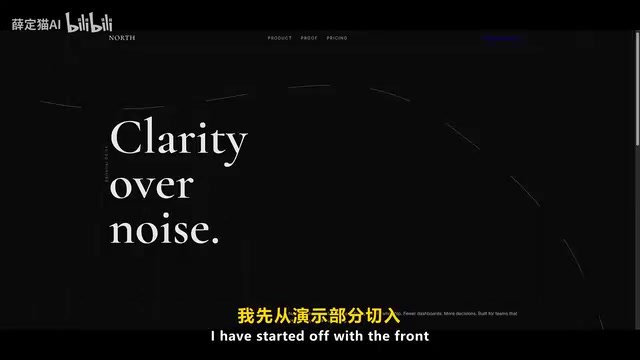
When generating a SaaS landing page, Glimmer's output was "not top-tier, but quite impressive for a local model"—it correctly added specified dependency packages and even implemented scroll-triggered effects. When generating a tower defense game, functionality was mostly working, but compared to Qwen 3.6 27B, visual quality, visual depth, and feature completeness showed noticeable gaps. This confirms the earlier assessment: for Three.js and web development tasks, Glimmer falls somewhat short.
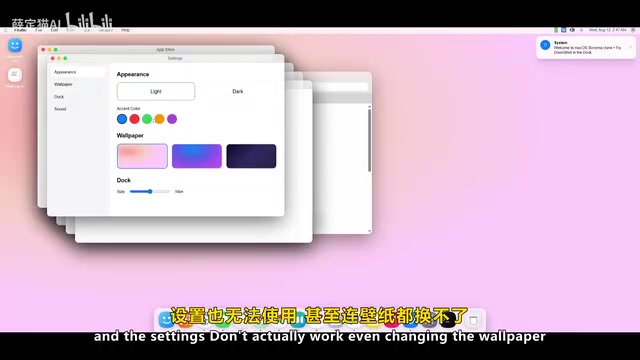
The author also tested a simulated operating system interface project. Results were mixed: notifications, spotlight search, Safari, and Photos apps were implemented properly, but the dock didn't run smoothly, and settings and wallpaper changes didn't work correctly. The author attributed this to 121K context window limitations—indeed tight for complex multi-application scenarios.
Surprisingly, Glimmer performed admirably when generating a "New York skyline" artistic piece, even perfectly capturing a butterfly's symmetrical structure with swaying antennae—remarkably lifelike. The author described its capability as "like early GPT-4, approaching 4.5 levels in some aspects."
Agent Capability Tests: Glimmer's True Power
Where Glimmer truly shines is in agent tasks. The author built a local calendar and meeting agent for testing: instead of manually directing every step, a high-level goal is given and the model decomposes it autonomously.
For example, the instruction was: "Schedule my meetings for tomorrow, avoid time conflicts, add travel time, and prepare a brief memo for the client presentation." Glimmer read local Markdown files, organized fragmented information into a complete workflow, checked schedules, analyzed conflicts, confirmed attendee availability, and even auto-generated a frontend interface.
This process showcased Glimmer's excellent planning ability, strategic tool use, and autonomous collaborative work—the core value that distinguishes it from other local models. The key difference between agent models and traditional chat models is: traditional models provide passive "question-and-answer" responses, while agent models possess proactive planning, environment awareness, error recovery, and multi-step execution capabilities. They don't just generate text—they actually "do things"—calling tools, reading and writing files, coordinating multiple subtasks, and adjusting strategies to retry when encountering obstacles.

Conclusion: Who Is Glimmer 30B For?
Overall, Muse Glimmer 30B is a remarkably versatile and practical local model. With higher computational efficiency, specialized agent capabilities, and the permissive Apache 2.0 license, it offers developers an extremely attractive local deployment option.
However, the author also noted that this release felt "slightly rushed," speculating that Meta wanted to capture market attention before Qwen's upcoming 38-billion-parameter model release, while focusing their efforts on developing the next generation of open-weight models.
Regardless of commercial motivations, for the open-source community, being able to run such a powerful agent model locally is an remarkable achievement in itself. As the author put it: "These companies have managed to deploy this level of intelligence locally." For developers focused on agent automation workflows, Glimmer 30B is worth trying; but if your focus is purely on coding, Qwen remains the safer choice.
Key Takeaways
Related articles

Bilibili's Hit Dify Tutorial: A Practical Guide to Building 20+ AI Apps from Scratch
A distilled guide to Bilibili's top-rated Dify tutorial: Windows + Docker deployment, MySQL connection, five app types, model integration strategy, and publishing.

Agent Skills Beginner's Guide: From Concepts to Multi-Agent Collaboration in Practice
A comprehensive guide to Agent Skills: core concepts, components, the importance of Description, standardization, beginner learning paths, and multi-agent collaboration.

One Neuron Detects Both Cats and Cars? We Reproduced It and Found a New Explanation
The cat-car neuron reinterpreted: researcher Cammarata argues it distinguishes pointy from round, not cats from cars. We reproduced the experiment and found the new explanation holds on most inputs—but cars are the exception. The interpretability debate continues on language models.