GPT-6.1 Sol Priced at One-Fifth of Flagship: Full Breakdown of OpenAI Developer Day Announcements

OpenAI Developer Day brings Sol's breakthrough pricing, Dots agent, Agents API, and plugin ecosystem expansion.
OpenAI's Developer Day delivered a packed set of updates. GPT-6.1 Sol offers near-flagship Astra performance at one-fifth the cost ($2 input / $10 output per million tokens). Always-on cloud agent Dots impressed conceptually but stumbled during its live demo. A new $500/month Pro500 tier and Ultra Fast inference layer launched alongside the Agents API preview, Codex Cloud, and multi-agent CLI support. ChatGPT also opened up to 16+ partner platforms and launched a plugin marketplace, backed by 1.2 billion weekly active users. On the Apple side, Shortcuts gained enhanced AI model access, while plans to replace AppleCare staff with AI agents were indefinitely shelved.
OpenAI Developer Day: GPT-6.1 Sol Leads on Price-Performance
OpenAI unleashed a flurry of product updates at its latest Developer Day, with GPT-6.1 Sol stealing the spotlight. According to Green Duck AI Daily's roundup, this model delivers performance close to the flagship Astra — at just one-fifth of the price.
Standard pricing comes in at $2 per million input tokens and $10 per million output tokens. OpenAI claims this is the best price-to-performance ratio available at this capability level. For developers and enterprises making large-scale API calls, a fivefold cost reduction translates to dramatically lower inference costs — continuing the industry-wide trend of pushing performance up while driving prices down.
Always-On Agent Dots: Impressive Capabilities, Shaky Demo
OpenAI also introduced Dots, an always-on agent built on GPT-6 Astra. Its defining feature is its own cloud-based computer — meaning Dots can continue executing tasks in the cloud even after the user steps away from their device, enabling truly unattended automation.
That said, the stability of such cutting-edge features still needs work. During its live debut, Dots went unresponsive mid-task while trying to "prepare a music app for launch," prompting the presenter to quip: "Dots is a little slow this morning." The hiccup underscored a real challenge for cloud agents in production settings — while the capability frontier keeps expanding, reliable execution of complex, long-running tasks remains an industry-wide problem.
The concept of a "cloud computer" has a specific meaning in the AI agent space: service providers allocate a persistent virtual computing environment — including a file system, browser, code runtime, and more — for each agent instance in a data center. This lets agents maintain state across sessions and continue executing tasks without relying on the user's local device staying online. It's a fundamental departure from the stateless "conversation ends, task ends" model most AI assistants have used until now. In the traditional model, closing a browser tab kills the task. With a cloud computer, an agent can run in the background for hours or even days, handling time-intensive operations like compiling, testing, and submitting pull requests. By exposing this infrastructure through the Agents API, OpenAI is giving third-party developers access to the same persistent execution environment — so they can build their own automated workflows without standing up their own cloud sandboxes.
Subscription Overhaul: $500 Pro Tier Makes Its Entrance
ChatGPT's subscription tiers are getting a serious expansion. The new Pro500 plan at $500/month offers 25× the usage of Plus and exclusive access to the fastest Astra Ultra Fast tier. The $200/month Pro plan has also been reopened to new subscribers.

On the speed front, OpenAI introduced the Ultra Fast service tier: up to 8× faster in Codex, capable of generating 300 tokens per second; up to 6× faster via API. GPT-6 Astra's Ultra Fast is now available through the API at $60 per million input tokens and $300 per million output tokens for short contexts. The premium reflects targeted supply for low-latency, high-throughput production environments.
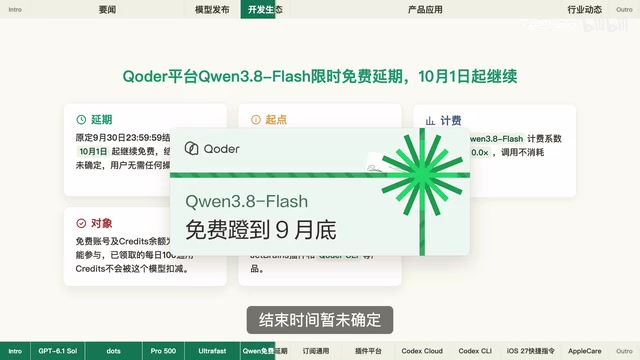
Also worth noting: Alibaba's Qwen Coder 3.8 Flash (Qwen Coder) extended its limited-time free period on the Coder platform. Originally set to end September 30, it remains free starting October 1 with no confirmed end date. Calls do not consume Credits and apply automatically to both new and existing individual users — a welcome bonus for cost-conscious developers.
One million tokens (Million Tokens) is the standard unit for pricing large language model APIs. One token roughly corresponds to 0.75 words in English, or 1 to 1.5 Chinese characters — so 1 million tokens is approximately 750,000 English words or around 660,000 Chinese characters. Compared to GPT-6.1 Sol's $2 input / $10 output pricing, GPT-6 Astra Ultra Fast's short-context rate of $60 input / $300 output is roughly 30× higher, reflecting the significantly more expensive dedicated compute required for low-latency, high-throughput inference. The "short context" qualifier is also worth noting: the longer the context a model processes, the more GPU memory and compute it requires. High-speed inference becomes even more expensive at long context lengths, which is why Ultra Fast pricing guarantees currently apply primarily to short-context workloads.
Open Ecosystem: Subscriptions Now Work Across 16+ Partners, Plugin Platform Launches
OpenAI took a significant step toward ecosystem openness. According to a post from the team, ChatGPT subscriptions can now be used directly within products from 16+ partners — including Devon, OpenCode, and Notion. No complicated rules: just consume the usage included in your subscription and log in with your ChatGPT account to get started.
Going further, OpenAI opened up a plugin platform for developers, who can now build native apps with plugin extensions and publish them directly within ChatGPT. The move is designed to position ChatGPT as an app distribution channel — not just a conversational tool.
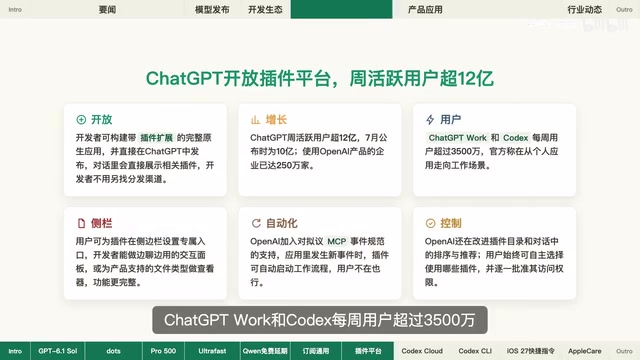
Underpinning this open strategy is a massive user base. OpenAI revealed that ChatGPT now has over 1.2 billion weekly active users, with ChatGPT Work and Codex together serving over 35 million weekly users. That kind of traffic pool provides powerful commercial foundations for the plugin and partner ecosystem.
Codex and Agents API: Developer Toolchain Gets a Full Upgrade
The developer toolchain got a comprehensive refresh. The Agents API entered preview — powering the cloud infrastructure behind Dots and all other cloud agents, with support for computer use so developers can build similar products on top of it.
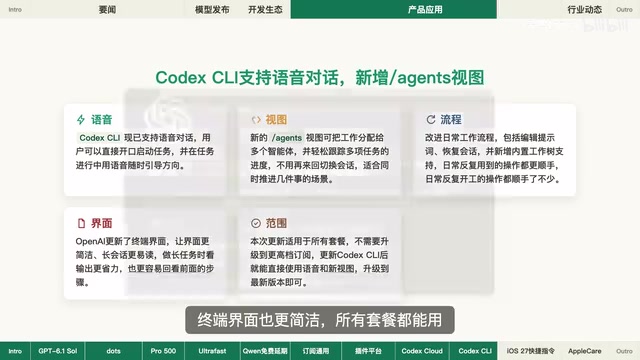
The new Codex Cloud is also live, supporting cloud environment configuration and notebook uploads — agents keep running even when your local machine is off. Codex CLI received a major upgrade: voice interaction is now built in, so you can speak tasks out loud and guide the agent mid-execution; a new Agents view lets you distribute work across multiple agents and track progress from a single interface; the terminal UI has been streamlined; and all subscription tiers get access. From single-agent to multi-agent collaboration, Codex is evolving into a more complete AI coding workflow.
The core value of the Agents API lies in providing a standardized "agent runtime" abstraction layer. Traditional AI APIs handle a single request-response cycle. The Agents API builds on that by encapsulating task state management, tool calls (such as browser control, code execution, and file I/O), and mechanisms for distributing tasks across multiple agents and aggregating their results. Developers don't need to build this infrastructure from scratch — they can call the API directly to create applications that can use computers, maintain long-term memory, and collaborate with other agents. The Agents view in the Codex CLI is the front-end expression of this system: it breaks down complex programming tasks, distributes them across multiple parallel sub-agents, and aggregates progress and results in a unified interface. Architecturally, this resembles a distributed task queue — except the workers being scheduled are AI instances with reasoning capabilities rather than plain functions.
Apple Updates: Shortcuts Gain Enhanced AI Access, AppleCare Layoff Plans Put on Hold
Apple also had news to share. Shortcuts for iOS 27, iPadOS 27, and macOS 27 are getting improvements, with 35+ new actions added. The headline feature is the "Use Model" action, which can invoke enhanced Apple Intelligence models and fetch up-to-date information from the web for anything within a shortcut — giving automation workflows real-time data capabilities.
On the personnel side, Bloomberg reporter Mark Gurman revealed that Apple had previously considered laying off approximately 5,000 AppleCare support staff and replacing parts of phone and web support with AI agents. That plan has now been shelved indefinitely. Apple is no longer pursuing it. The reversal is a reminder that deploying AI to replace human customer service agents in large enterprises still requires carefully weighing service quality against user experience.
Takeaways
This wave of updates sketches a clear picture of where the industry is heading: model prices continue to fall while speeds climb; subscription tiers are becoming more granular; OpenAI is accelerating its platform ambitions by connecting partner ecosystems and opening up a plugin marketplace; and the developer experience is being reshaped around multi-agent collaboration. At the same time, the Dots demo stumble and Apple's shelved layoff plan serve as reminders that there's still a meaningful gap between "works in a demo" and "works in production" for AI agents.
Related articles

REA: Reverse Engineer Any App with AI, No Coding Required
REA is a viral open-source AI reverse-engineering tool that lets Claude, Codex, and other AI agents analyze any app and generate functional clones—no coding required. This article covers how it works, installation, a hands-on test, and legal risks.
2026 AI Coding Tools Comparison: Claude, ChatGPT, Gemini — Which Is the Best?
A 2026 comparison of five mainstream AI coding tools — Claude Code, ChatGPT Codex, Gemini, DeepSeek, and GitHub Copilot — on real projects, pricing, and code quality, to help you decide where that $20/month should go.

ChatGPT Codex Can Clone Any Software? Testing the Risks and the Truth
YouTube shorts claim ChatGPT Codex or Claude Code can clone Adobe, Excel, and Figma for lifelong free use. We break down the feasibility, legal risks, and DM-funnel tactics—and explain what AI coding tools are truly good for.