GPT-6.1 Sol Released: Near-Flagship Intelligence at One-Fifth the Price

GPT-6.1 Sol offers near-flagship performance at one-fifth the price, targeting coding and automation at scale.
GPT-6.1 Sol is OpenAI's new cost-efficient model delivering intelligence close to its flagship Astra across coding, computer use, and professional workflows — at one-fifth the API cost. This pricing strategy reflects a broader LLM market trend: flagship models push capability limits while more affordable tiers drive commercial adoption at scale. The model selection logic for developers is shifting from "most powerful" to "most appropriate." However, public information remains limited; claims of "near-Astra" performance lack benchmark support, and real-world computer use reliability and edge-case behavior await third-party validation.
GPT-6.1 Sol: High Performance at a Lower Cost
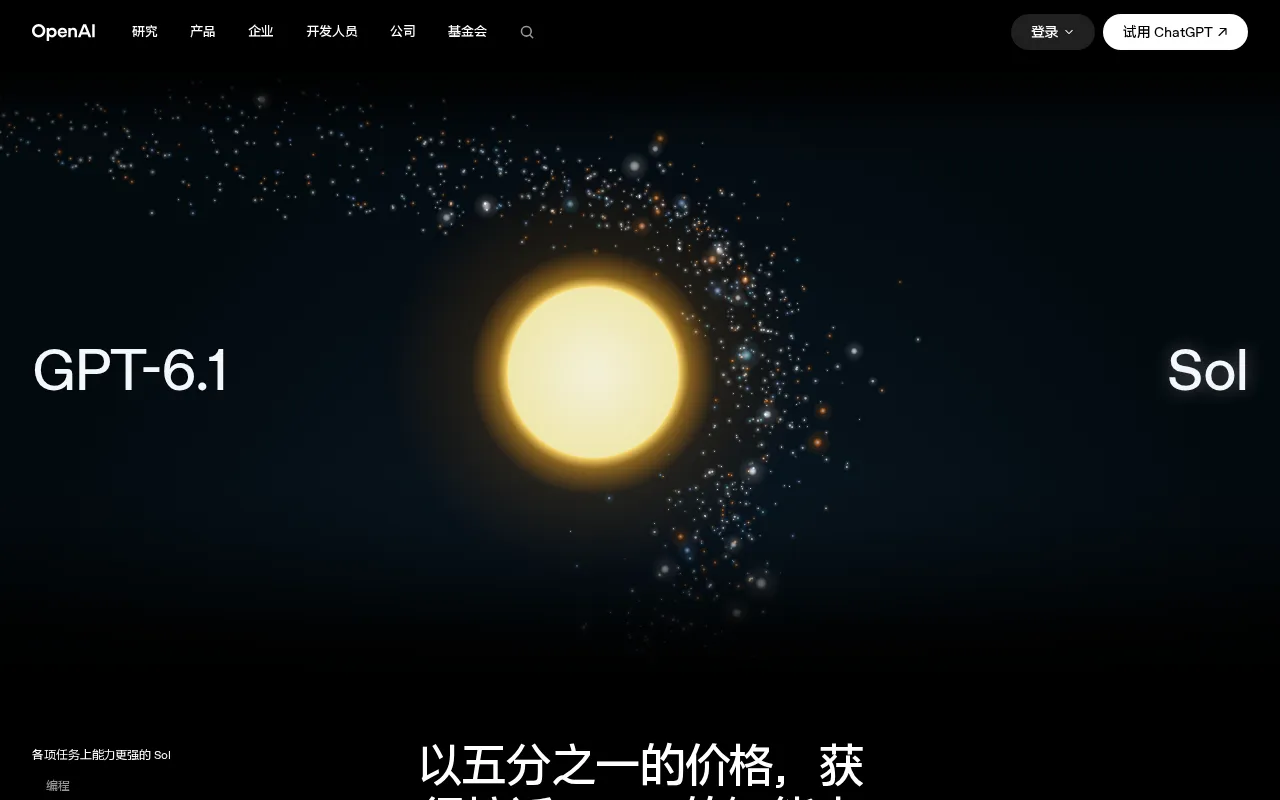
GPT-6.1 Sol has officially launched, positioning itself as a model that balances performance with affordability. According to the official announcement, it delivers intelligence close to the flagship model Astra across coding, computer use, and professional work scenarios — while charging just one-fifth of Astra's standard API input and output token prices.
This positioning sends a clear message: high-performance models are expanding into lower price points and broader application scenarios. For teams that rely heavily on LLM APIs for development and production, a five-fold reduction in cost means handling significantly more tasks within the same budget, or dramatically scaling usage without increasing spend.
Three Core Capability Areas
Based on the official description, GPT-6.1 Sol emphasizes three primary use cases.
Coding
Coding is one of the most competitive areas in today's LLM landscape. Sol is positioned as having near-Astra coding intelligence, meaning it should be capable of handling everyday development tasks like code generation, debugging, and refactoring. For developers, a model that costs less but doesn't sacrifice much capability is an ideal fit for integration into daily workflows.
Computer Use
Computer use refers to a model's ability to understand and interact with graphical interfaces and execute multi-step tasks — much like a human would. This capability is a foundational building block for Agent (AI agent) applications. Sol's emphasis on this area signals that it's designed for more automated, real-world workflows rather than simple conversational Q&A.
Computer use has become one of the most significant frontier areas in LLM development. At its core, it enables models to perceive screenshots, identify UI elements, and complete complex cross-application tasks by simulating mouse clicks, keyboard input, and similar interactions. Unlike traditional RPA (Robotic Process Automation), LLM-based computer use doesn't rely on pre-recorded scripts — it brings contextual understanding and dynamic decision-making, theoretically handling interface changes and unexpected situations. Anthropic's Claude was among the earlier movers in this space, with OpenAI gradually following suit in its flagship products. In practice, deployment still faces challenges around accuracy and reliability — model misinterpretation of images, error accumulation across multi-step tasks, and defining safety boundaries remain the primary obstacles to large-scale adoption. By listing computer use as a core scenario, OpenAI signals its intent to move this capability from experimental feature to a commercially viable production tool.
Professional Work
Beyond coding and computer use, Sol also targets broadly defined professional work scenarios. These tasks typically demand high accuracy and strong reasoning — and represent an important battleground for commercial LLM deployment.
The Strategic Value of the Price-Performance Ratio
What makes Sol stand out isn't its absolute performance ceiling, but the balance it strikes between "near-flagship capability" and "one-fifth the price." This strategy is increasingly common in the LLM market — top-tier models push the capability frontier, while slightly lower-tier models with friendlier pricing drive large-scale, real-world adoption.
For enterprises and developers, the model selection logic is shifting from "use the most powerful" to "use the most appropriate." When a model can handle the vast majority of real-world tasks at one-fifth the cost, its appeal for production environments often outweighs that of a flagship model optimized purely for peak performance.
Tiered pricing has gradually become standard practice in the LLM market. Within OpenAI's own lineup, the price ratio between GPT-4o mini and GPT-4o was roughly 1:15; Anthropic's Claude Haiku versus Opus shows a similar order-of-magnitude gap. This product tiering reflects both the objective differences in model parameter scale and inference costs, and a deliberate vendor strategy to guide customers toward "value segmentation" — routing low-latency, high-frequency, standardized tasks to cheaper models while reserving complex, deep-reasoning tasks for flagship products. For developers, this means system design increasingly requires "model routing" logic — dynamically selecting the most appropriate model based on task type to find the optimal balance between cost and quality. Sol's entry at one-fifth the price is a textbook play for exactly this market position.
Key Open Questions
Publicly available information remains limited, and several critical points still need verification:
- How close is "near-Astra intelligence" in practice? There's no public benchmark data to substantiate the claim.
- What is the reliability and success rate of the computer use capability? No real-world performance details have been shared.
- Does Sol show significant gaps compared to the flagship model in edge cases like long context windows or complex multi-step reasoning?
The answers to these questions will determine whether Sol can genuinely become the default choice for mainstream production environments. Until more detailed evaluations and user feedback emerge, any assessment must remain based on official positioning alone.
Conclusion
GPT-6.1 Sol represents a clear trend in the LLM market: delivering near-flagship capability at a significantly lower price point to enable large-scale adoption. If the performance and pricing claims hold up, it could become a highly competitive option for coding and automated workflow use cases. The real test, however, will come when real-world usage data and third-party benchmarks are available.
Related articles

Frontend to AI Agent Development: A Frontline Architect Explains Career Paths and Opportunities
A frontline AI architect explains the industry changes and practical paths for frontend developers transitioning to AI Agent development: why pure frontend jobs are disappearing, why Agent + full-stack has become mainstream in hiring, and three transformation routes—Agent development engineer, FDE, and remote contracting—along with corresponding learning strategies.

How to Choose an AI Agent Development Course: Five Pitfall-Avoidance Guidelines
A mechanical-engineering career changer's two-year pitfall-tested checklist for screening AI Agent development courses: complete delivery pipeline, resume-worthy projects, real development perspective, update frequency, and coaching feedback—with concrete judgment methods and pitfall-avoidance tips.

Coze AI Agent Building for Beginners: A Zero-Code AI Agent Development Guide
Coze, ByteDance's one-stop AI application development platform, supports zero-code drag-and-drop AI agent building. This article outlines Coze's core concepts, three advantages, differences between the domestic and international versions, and the distinction between agents and apps, helping beginners quickly get started with AI Agent development.