GPT-6.1 Sol Released: Near Top-Tier Intelligence at One-Fifth the Cost

GPT-6.1 Sol delivers near-flagship AI performance at the same price as its predecessor.
OpenAI's GPT-6.1 Sol retains GPT-6 Sol's pricing ($2 input / $10 output per million tokens) while cutting cached input from $0.20 to $0.10, delivering an "same price, better capability" value proposition. Across software engineering (DeepSWE 1.1), computer use (OSWorld 2.0), multi-step workflows (Automation Bench), and complex document Q&A, it matches or nearly matches flagship Astra at roughly one-fifth to one-third of the cost. The only notable gap is in the hardest scientific reasoning tasks, where OpenAI itself recommends Astra. The model is available now in ChatGPT work mode, Codex, and via API, but not yet in regular ChatGPT chat.
The Core Change: New Intelligence at the Old Price
OpenAI released GPT-6.1 Sol on September 29. In a single sentence, here's what this update means: it delivers near-flagship-level intelligence while keeping GPT-6 Sol's original pricing. For developers who closely track model cost-efficiency, that may matter more than any benchmark number.
Launching alongside it are Astra UltraFast — billed as "the world's fastest frontier model" — and a new $500/month Pro subscription tier. But the real story remains the rebalancing of price versus performance.
Pricing: The Real Star of This Release
Pricing is the central narrative here. GPT-6.1 Sol's standard rates are $2 per million input tokens and $10 per million output tokens — identical to GPT-6 Sol. In other words, the capability went up, but the bill didn't.
Even more notable is the cached input price, which dropped from $0.20 to $0.10 — roughly 95% cheaper than standard input. For applications that repeatedly call the same context (such as long-document Q&A or Agent loop calls), this reduction will meaningfully cut real-world costs.
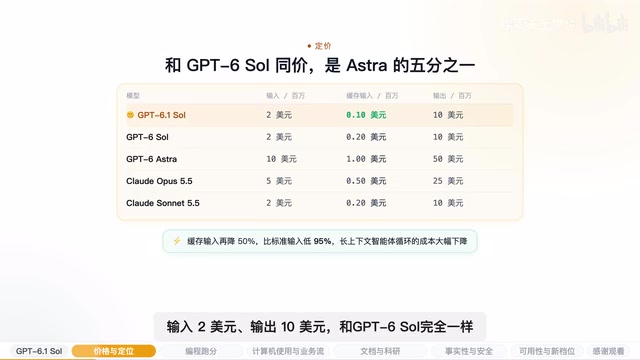
For comparison, the competing flagship Astra is priced at $10 input / $50 output / $1 cached input per million tokens. At equivalent usage volumes, GPT-6.1 Sol costs roughly one-fifth of Astra — a ratio that holds across nearly every benchmark comparison below.
What is cached input? Cached input refers to pre-storing repeated context on the model server side so subsequent requests can reuse that cache without re-transmitting or recomputing it. In LLM API calls, token costs typically split into "prompt input" and "model output." System prompts, long document backgrounds, and tool definitions tend to appear verbatim in every request. Caching lets this content be computed once, with subsequent cache-hit calls billed at a lower cached rate. This matters especially for Agent frameworks — a typical multi-turn Agent task may carry the same system prompt and context history across dozens of tool calls. The cached input price directly determines whether such applications are economically viable. Dropping from $0.20 to $0.10 means that for production-grade applications with high cache-hit rates, the overall reduction in API costs could far exceed the nominal 50% on paper.
Benchmark Breakdown: Performance Is Now Right Behind the Top
Software Engineering
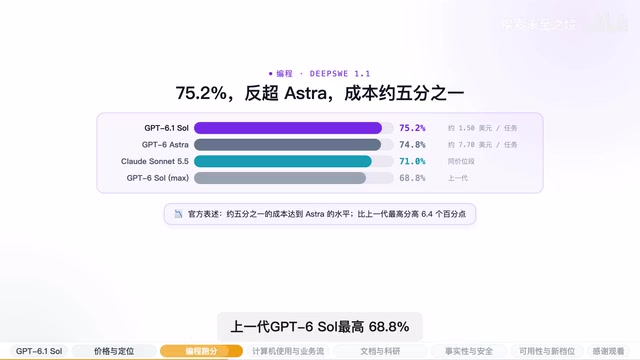
On DeepSWE 1.1, which simulates real-world code repository bug fixes, GPT-6.1 Sol scored 75.2% — edging out Astra's 74.8% — at roughly $1.50 per task versus Astra's ~$7.70. Cloud Sonnet 5.5 at the same price tier scored 71.0%, and the previous GPT-6 Sol topped out at 68.8%. OpenAI's claim of "Astra-level performance at one-fifth the cost" holds up for coding.
What is DeepSWE? DeepSWE is a benchmark that simulates real GitHub repository bug-fix scenarios. The model is given a codebase and a problem description, then asked to autonomously locate the bug and generate a patch that passes unit tests. Unlike traditional code generation problems, DeepSWE emphasizes the full "understand → locate → fix" pipeline within an existing codebase — closer to what engineers actually do. Scoring is based on whether the patch passes the test suite, leaving little room for gaming, and the benchmark is widely regarded as a reliable measure of "production-ready coding ability." Version 1.1 expands on the original SWE-bench with more repository types and introduces support for multi-file edits, pushing task difficulty closer to real engineering scenarios.
Computer Use
Computer use is measured by OSWorld 2.0. At maximum reasoning intensity, GPT-6.1 Sol scored 71.4% — up 7 percentage points from GPT-6 Sol — compared to Astra's 73.5%, a gap of 2.1 points. The gap exists, but at $1.30 per task versus Astra's $9.30, the cost-efficiency advantage is striking.
Multi-Step Business Workflows
Multi-step business workflows are tested on Automation Bench, running across 47 real SaaS tools. At medium reasoning intensity, GPT-6.1 Sol scored 35.4% — 2.2 points above Opus 5.5 — at one-third the cost. Cross-tool automation is precisely the capability dimension that Agent applications value most.
Complex Document Q&A
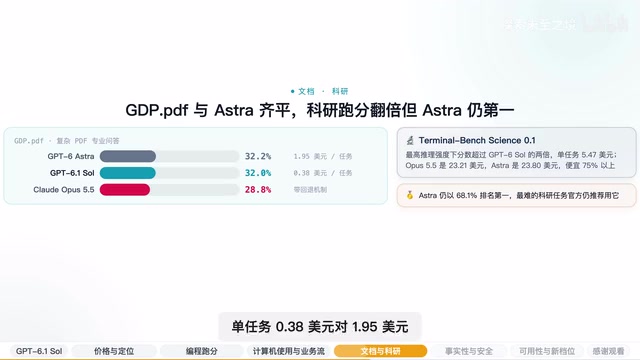
Professional Q&A on complex PDFs is evaluated with GDP PDF. GPT-6.1 Sol scored 32.0%, nearly matching Astra's 32.2%, at $0.38 per task versus $1.95. Opus 5.5 with fallback reached 28.8%.
Scientific Research Workflows
Scientific research workflows are tested on Terminal Bench Science. At maximum reasoning intensity, GPT-6.1 Sol more than doubled GPT-6 Sol's score, at $5.47 per task. Here, though, OpenAI is candid: Astra still leads at 68.1%, and for the hardest scientific tasks, the company explicitly recommends sticking with Astra. This is one of the few scenarios in this release where the new model isn't the recommended choice.
Factuality and Honesty: Incremental Improvements
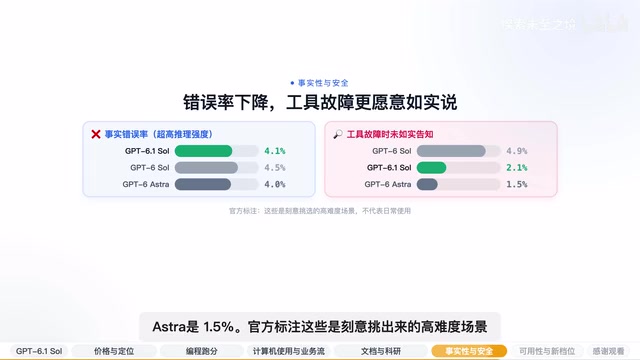
At ultra-high reasoning intensity, the model's factual error rate is 4.1%, down from 4.5% in the previous generation — approaching Astra's 4.0% — while costing about 83% less per task.
Another metric worth noting is the rate at which the model fails to honestly report tool failures, which dropped from 4.9% to 2.1% (Astra is at 1.5%). This reflects whether the model "pretends nothing is wrong" when it encounters an error — a reliability metric that's especially critical for Agent applications.
OpenAI explicitly notes that these are deliberately chosen high-difficulty scenarios and don't represent typical everyday usage. That caveat is worth keeping in mind — benchmark numbers are often produced under extreme conditions.
Why does "failing to report tool failures" matter so much in Agent systems? When a tool returns an error, timeout, or abnormal result, the model faces two choices: honestly report the failure and halt or roll back, or "rationalize" the error in its output and let downstream tasks continue. The latter may seem smoother in the short term, but it silently propagates errors into subsequent steps, ultimately causing cascading failures that are difficult to debug. This behavior is sometimes called "silent failure" in safety research — it must be evaluated separately from general factual accuracy. Dropping from 4.9% to 2.1% indicates the model is more inclined to proactively flag tool anomalies rather than conceal them.
Availability and Companion Releases
GPT-6.1 Sol is now available in ChatGPT's work mode and in Codex, and developers can access it via the API using the model name GPT-6.1 Sol. Note that OpenAI has explicitly stated it is not yet available in ChatGPT chat.
Astra UltraFast, also released at the same time, is claimed to be the world's fastest frontier model — up to 8× faster than Astra — available via API only and open to the new $500/month Pro tier. The full announcement and benchmark tables are available at openai.com.
Summary: Cost-Efficiency Is the Keyword This Time
Overall, GPT-6.1 Sol's value isn't about "topping some leaderboard." It's about compressing near-flagship capability into the previous generation's price range. Across software engineering, multi-step automation, document Q&A, and other practical dimensions, it achieves comparable or near-comparable performance to Astra at one-fifth to one-third of the cost.
The one remaining caveat is the hardest scientific research tasks — OpenAI itself acknowledges Astra still leads there. For most developers and enterprise users, if your application doesn't involve cutting-edge scientific reasoning, GPT-6.1 Sol will likely become the more cost-effective default choice.
Related articles

AI Compute Is the New Oil, But the Market Mechanism Has Yet to Take Shape
Hacker News compares AI compute to the new oil, noting the lack of price discovery, concentrated supply, and no hedging tools. The article analyzes structural issues in compute trading and explores a possible three-tier market of spot, contracts, and derivatives, plus the real impact on AI practitioners' cost management.

Running Full iOS 16.5 Firmware on Android Devices: Technical Demo or Marketing Gimmick?
A Hacker News post claims full iOS 16.5 firmware can run on Android, with 315 upvotes. This analysis argues it is more likely a web UI simulation than a true firmware port, and explores the value and risks of such projects.

Etsy Cracks Down on AI Slop: Addressing Buyer and Seller Anxieties
Etsy introduces stricter rules limiting AI-generated content in listings, addressing buyer confusion over AI products and seller fears of original work being diluted by AI slop.