GPT-6.2 Astra/Sol vs Claude Opus/Sonnet 5.5: A Head-to-Head Showdown
GPT-6.2 tested: Astra excels in aesthetics and planning; Opus is more solid in realism and writing.
GPT-6.2's Astra and Sol are benchmarked against Claude Opus 5.5 and Sonnet 5.5. Tests show Astra's unit price is still twice Opus's after the price cut, its coding score is on par with the previous generation, and Sol has even regressed slightly. In 3D snow-scene generation, Opus wins outright on physical realism, code efficiency, and 60 fps smoothness, while Astra wins on Chinese aesthetics and walk-through roaming; in the iPhone teardown task, Astra produced a highly complete GLB model in 65 minutes, while Sol completed only 8 of 20 components. In Chinese writing, Astra crashed with no main plotline, while Opus and Sonnet interweave dual emotional throughlines but are verbose. The author recommends daily use of Terra and Sol, Astra for complex engineering, and for long-term projects letting Astra build the framework first before handing refinement to Sol.
The GPT-6.2 series has officially launched, with Astra and Sol going head-to-head against Claude Opus/Sonnet 5.5. A Bilibili creator ran a comprehensive test ranging from 3D scene generation to Chinese writing, and the results were surprising: Astra wins on aesthetics and big-picture planning, but Opus is stronger on physical realism and code completeness.
Pricing and Positioning: Cheaper, But the Competitive Landscape Is Unchanged
Astra 6.2 announced a price cut on launch: 20% off both input and output, and 60% off cache reads. But even after the cut, its unit price is still twice that of Opus 5.5. Sol 6.2's price is unchanged, putting it squarely in the same bracket as Sonnet 5.5. The creator says outright that the price cut was smaller than expected, and that Anthropic (A社) — which is preparing for an IPO — can probably breathe a sigh of relief. According to the third-party Artificial Analysis composite intelligence leaderboard, Astra 6.2 ranks second behind Fable 5.2; but on the Coding Agent leaderboard, Astra 6.2 is exactly on par with the previous generation, and Sol 6.2 is even three points lower than its predecessor — so this generation may have actually regressed a bit at writing code.
3D Scene Test: The Trade-off Between Aesthetics and Physical Realism
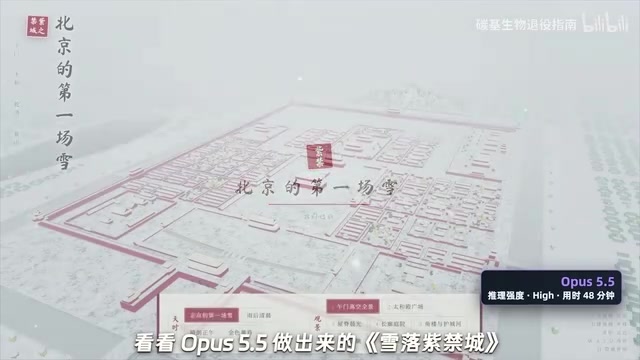
The same prompt — generate a 3D scene of Beijing's first snowfall — put all four models on the same stage.
Astra 6.2: Distinctive Chinese Aesthetics, But Rough Details
Astra took one hour and eighteen minutes, the longest of all the contenders. It used a bitmap-texture strategy, painting quite a few realistic, stylized Chinese-style bitmaps, and its Chinese aesthetic is very appealing. The 3D rendering of the Taihe Hall plaza is quite impressive, but only a small patch of the ground got a snow-texture treatment, and only about a dozen snow particles drifted sparsely in the air — the snowfall effect is mediocre. As the camera turns, the snow texture on the rooftops disappears, exposing the building itself; when the camera zooms in and the angle changes, the texture problems become even more obvious, as if the outside were wrapped in a thin layer of paper. The ground texture keeps flickering, exposing shortcomings in code capability. However, the walking/roaming feature is better done than Opus's — there's a stepping bob when going up stairs, and its physics and spatial understanding are decent. When the creator tried to walk through the railing, he was blocked but couldn't back out — a bug.
Opus 5.5: A Complete Win on Physical Realism and Code Completeness
Opus opens with a rapid push-in: the Taihe Hall is grand and imposing, snow falls slowly across the sky, and nearby snowflakes are given close-up blur. It understands very well how to choreograph different moving subjects within the same scene: some little figures on the ground stroll while others bustle about, birds in the air complement ten thousand snowflakes, their wing-spread poses aren't stiff, and this complex synchronous motion runs smoothly at 60 fps throughout. The red-wall corridor can be walked freely like in a 3D game. At the code level, Opus merged the copper-material components in the scene into just 12 large meshes, making it highly efficient to run, yet the details are frighteningly precise — the reflection of the corner tower on the ice surface shows natural mottling and distortion following the uneven ice. Apart from slightly crude tree and figure modeling, the whole scene's adherence to real-world physics is jaw-dropping.
Sol 6.2 and Sonnet 5.5: A Clear Gap for the Sub-Flagships
Sol 6.2's Chinese aesthetic is in the same lineage as Astra's, but its completeness drops by a full tier. The ground of Beijing's first snowfall is perfectly clean with not a speck of snow, and there are hardly any snowflakes in the air either. It didn't use Astra's bitmap strategy; instead it simply set the color of some models to white, giving a strong plastic feel. The roaming experience is still solid and the building quality is on par with its bigger sibling, but it feels more like a 3D game than a first-snowfall demo.
Sonnet 5.5's Forbidden City is a full half smaller than big brother Opus's; the mini snowflakes fall faster, and the birds in the sky stiffly bob up and down. The figure modeling is more simplified than Opus's, the trees are simple geometric shapes, and the bright red/green/yellow color scheme is a bit low-poly-meets-cartoon. The river surface was meant to be ice but was made into water with ripples, and the corner tower's reflection is weirdly distorted.
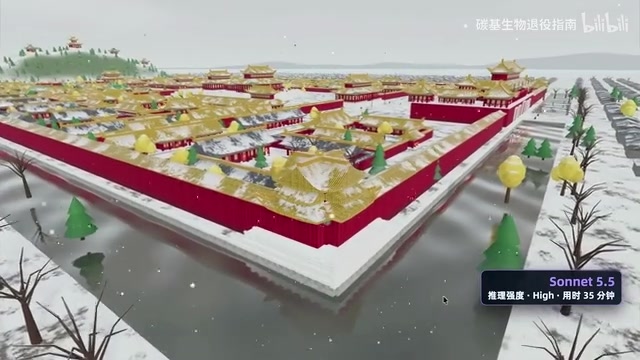
Building a snowy city purely from code tests spatial logic as well as dynamic perception and aesthetics. GPT-6.2 isn't a top-tier contender here — but what if you give it a ready-made 3D model?
GLB and Three.js
GLB is the binary container format for glTF (GL Transmission Format), defined by the Khronos Group for efficiently transmitting and loading 3D scenes at runtime. A single GLB file can pack meshes, materials, textures, animations, and the node hierarchy into one file, so the browser doesn't have to parse multiple external resources — which is why it's often used as the "delivery format" for Web 3D applications.
Three.js is the most mainstream WebGL wrapper library in the browser, responsible for translating the scene graph in a GLB into GPU instructions: the loader parses the binary and builds an Object3D tree, materials are compiled into shaders, and geometry is uploaded as vertex buffers. "Loaded in Three.js" in the article means the output isn't a rendered image but a real-time scene that is interactive and programmable — which also explains why camera choreography, snowflake particle count, and frame rate become evaluation dimensions: they all map directly to object count and rendering overhead in the Three.js scene.
3D Model Teardown: Astra's Big-Picture Thinking Is Impressive
Astra and Sol were each asked to directly modify a GLB model file and tear down an iPhone. Sol took 38 minutes to complete an iPhone 18 Pro teardown workbench, converting Apple's public 3D model to GLB and loading it in Three.js, with glossy materials and body details rendered in full detail. It built an auto-play demo showing the structure after the front and back panels open, but after the explosion there are too few parts, the camera assembly is very abstract, one set of lenses is still attached to the body, and the three ribbon cables are inaccurately positioned. From the AR model found on the official website it extracted only one color, and the internal component positions and structure came from the repair manual — the manual has 20 components, but it only produced 8. The workflow works, but completeness and accuracy are low.
Astra spent 65 minutes delivering an iPhone Duo foldable teardown, with the opening and closing fully controlled by code and extremely smooth. The explosion's separation strength, modeling completeness, and rigor of physical structure are at a level never seen before. It equipped all 3D opening/closing and teardown components with control options, set up three environment lights to show material texture, and during folding adjusted mesh vertices one by one to make the screen bend precisely. The camera module's telephoto and ultrawide multi-layer lens groups are exquisite; the body frame's support structure, various connectors, external buttons, and every screw are clearly distinct — it even independently modeled the eight dust meshes at the bottom. Astra specifically wrote an explanation: first extract the 73 meshes from the official model, find the inner-screen assembly positioning diagram and precise dimensions in the repair manual, and generate 7 GLB models for the screen. You can generate this kind of 3D model without Blender.

The creator's summary: Astra's big-picture thinking is impressive — it can efficiently handle multiple complex inputs and outputs, its logic is extremely rigorous, and its completeness is very high. Although its front-end code isn't as good as Opus 5.5's, Astra is stronger on mixed-type tasks. Sol can also fulfill requirements normally, but it does exactly what it's told and never puts in extra thought of its own. Advice for long-term projects: use Astra first to build the overall framework, then hand局部 refinement and modifications to Sol to implement.
Exploded Views and Vertex-Level Mesh Deformation
An exploded view is a standard convention in engineering and repair documentation: translating a assembly's parts apart along their assembly directions so the internal structure and assembly order are clear at a glance. Its technical difficulty isn't in "pulling apart" but in "pulling correctly" — each part must know its own assembly-constraint direction, hierarchical归属, and adjacent parts, otherwise parts will interpenetrate or float after separation.
Astra's "adjusting mesh vertices one by one to make the screen bend precisely" in the foldable task is a finer layer than exploded views: mesh deformation. The screen in the GLB is a mesh made of vertices; to make it bend smoothly at the hinge, you need to apply segmented rotations to vertices based on position, rather than rotating a rigid body as a whole. Such operations are usually done in Blender via rigging and shape keys; implementing them directly from model-generated code shows that the model has a considerable grasp of mesh data structures and spatial transformations.
Chinese Writing: New Template Unlocks Opus and Sonnet's Potential, Astra Crashes
A validated novel prompt template was used to test the flagship group and the lightweight group. Both Claude models scored noticeably higher, with tighter pacing. But Astra crashed this time — the whole story has no main plotline; the three characters are unrelated and each does their own thing, as if padding the word count, and the prose is pretentiously deep yet incomprehensible. Opus's creativity lies in interweaving two emotional throughlines: one is the protagonist mourning his grandfather and inheriting his grandfather's work, the other is soothing the wounded hearts of people after a disaster; the two threads are interwoven to complete the story, but it's a bit verbose and the pacing is flat and straightforward. Sol does decent bookending — the ending explains that the mother and daughter at the beginning confirmed each other was still alive through knocking signals and held on until rescue — but the main plot is contrived, the ghost's appearance is abrupt, and its connection to the emotion is forced. Sonnet's style is very similar to Opus's, also with two emotional throughlines, but they aren't tightly interwoven, the writing is more of a流水账, and verbosity is a common problem.

Under the new template, the potential of Opus, Sonnet, and Sol was all unlocked — yet Astra, the more detailed the constraints given, the more scattered it became; it couldn't even string three characters together with a main plotline. The path of LLM writing is still a bit far off; while everyone is strengthening coding ability, writing will be a pain point.
Prompt Templates and "The More Detailed the Constraints, the More Scattered"
A prompt template usually breaks a creative task into several slots: character setup, core conflict, emotional throughlines, pacing requirements, ending bookends, etc., narrowing the model's output space to a controllable range through structured constraints. Its effectiveness depends on the model's ability to hold multi-layer instructions — the more slots there are, the more the model needs to continuously look back and satisfy every constraint during long-form generation.
The divergence seen in the evaluation stems precisely from this: Opus, Sonnet, and Sol were actually "activated" by the more detailed template, showing they can translate constraints into structure; Astra, by contrast, showed more constraints leading to more scattered characters, i.e., the model lost the global main plotline in long text and each paragraph responded only to local instructions. This forms an interesting contrast with the strong global planning it showed in 3D tasks, suggesting that "big-picture thinking" isn't universally transferable across modalities and task types.
Daily Use and Behind the Scenes
The creator's daily drivers are GPT-6.1 Terra and 6.2 Sol, bringing out 6.2 Astra for complex engineering like 3D teardowns. Compared with GPT-6 Astra and GPT-6.1 Sol, the day-to-day feel is basically the same, just a bit faster.
Behind the scenes: ChatGPT's chat mode now lets you generate GIF stickers almost unlimited times, but after December 1 the near-unlimited quota will be canceled and merged with the work mode quota.
This entire video was edited with GPT-6.2 Sol. The creator emphasizes that he tests Chinese and 3D because LLM training is too heavily skewed toward code, Chinese expression is getting flatter and flatter, with common problems being verbosity, formulaic patterns, and trying too hard; ordinary 3D tasks can hardly test the upper limits of frontier models — only by pushing into more professional and harder scenarios can you see how far flagship models can go.
One-line Summary
GPT-6.2 tested: Astra stands out on aesthetics and big-picture thinking, Opus is more solid on physical realism and writing.
Paragraph Summary
GPT-6.2's Astra and Sol are benchmarked against Claude Opus 5.5 and Sonnet 5.5 respectively. Tests show Astra's unit price is still twice Opus's after the price cut, its coding leaderboard score is on par with the previous generation, and Sol has even regressed slightly. In 3D snow-scene generation, Opus wins outright on physical realism, code efficiency, and 60 fps smoothness, while Astra wins on Chinese aesthetics and walk-through roaming; in the iPhone teardown task, Astra produced a highly complete GLB model in 65 minutes with excellent big-picture thinking, while Sol got the workflow running but completed only 8 of 20 components. In Chinese writing, Astra crashed with no main plotline, while Opus and Sonnet interweave dual emotional throughlines but are verbose. The author recommends daily use of Terra and Sol, Astra for complex engineering, and for long-term projects letting Astra build the framework first before handing refinement to Sol.
Related articles

Jingle Jam 2026 Registration Opens: Lewis Uses Old Footage to Rally Volunteers for Fundraising
Jingle Jam 2026 fundraising registration is open. Lewis uses old footage edited into a new video, calling on viewers to create fundraising pages at jingle jam.tiltify.com to support eight charities. The event takes place in the first two weeks of December.
Gemini 4 Neon Hands-On Test: Can It Replace Claude Opus 5.5?
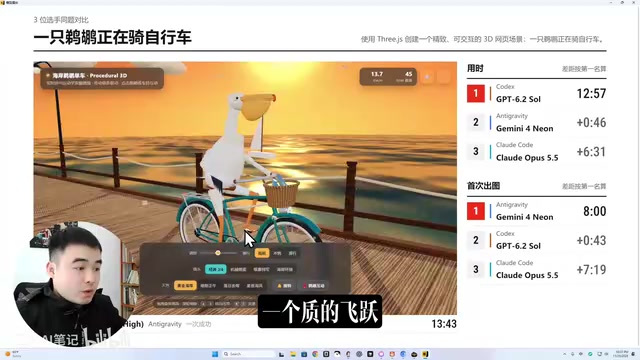
A Bilibili creator tests Gemini 4 Neon, Claude Opus 5.5, and GPT 6.2 across three coding Agent challenges—pelican animation, 3D racing, and code-generated video—to see if Gemini can replace Opus.
FBI-Warned Artex: How an AI Attack Framework With No In-House Model Pries Open Enterprise Doors
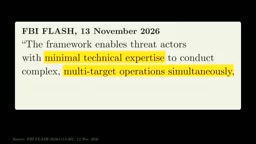
The FBI-warned open-source AI attack framework Artex has no model of its own—it plugs into Claude, GPT, and other external LLMs to drive an agent loop, turning ordinary tools like Nmap into an automated attack pipeline. This article examines three real cases—South Korean finance, ConnectWise, and Barracuda—analyzes the three drivers of speed, cost, and noise, and outlines defenses such as exposure inventory and short-lived credentials.