GPT 6.2 Unlimited Quota Tested: Can Plus Accounts Really Use It for Free?

Bilibili's "Plus accounts can use GPT 6.2 without limits" demonstration lacks evidence and carries key leakage and ban risks.
The article breaks down a video circulating on Bilibili claiming that "ChatGPT Plus accounts can use GPT 6.2 and Codex with unlimited quota." The demonstration asks users to send an address and key to an AI for automatic configuration, then execute a script in the terminal and restart Codex. The demonstrator concludes "unlimited quota" merely because the quota number remained 49 after one operation, which is clearly insufficient evidence. The article points out that an unchanged quota may come from a third-party relay, a bypassed counter, or video editing, and that the relationship between Codex and the GPT subscription system is vaguely handled. More alarmingly, giving keys to an AI assistant and executing terminal scripts of unknown origin carries risks of credential leakage and malicious instructions, and bypassing quota limits may also violate the terms of service and lead to account bans. The conclusion is that a valid demonstration does not mean a trustworthy method, and accelerated generation is different from quota not being consumed.
Recently, a claim has been circulating on Bilibili: as long as you have a ChatGPT Plus account, you can use the latest GPT 6.2 model with unlimited quota, and even make unlimited Codex calls. The video demonstrator claims that through a set of "AI configuration" steps, the quota can remain untouched indefinitely. This sounds tempting, but what is the real situation? Based on the demonstration content of that video, this article breaks it down from two perspectives: technical logic and actual results.
Demonstration Process Restored: From "Triple Like to Claim" to Terminal Configuration
The opening of the video is quite direct — "like, coin, and favorite to claim it right away" — and then it moves into the tutorial. The demonstrator first provides a "tutorial address" and asks users to send that address to an AI, which automatically completes the configuration.
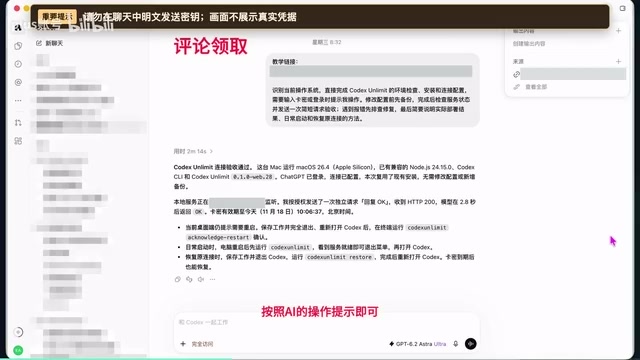
According to the operations shown in the video, users need to send the address and corresponding key to the AI, then wait for the AI to read and execute the configuration instructions. After the AI finishes, users also need to configure the terminal and restart Codex. The selling point of the whole process is that "the AI configures everything for you," lowering the barrier to manual operation.
There is a detail worth noting here: the word "key" appears repeatedly in the video. Handing a key to an AI assistant for processing itself means that credentials are circulating in a third-party environment. From a security perspective, this is a high-risk operation — once the key leaks, account access permissions may be exploited by others.
Did the Quota Really Not Change? Key Evidence in the Demonstration
The demonstrator conducted an actual test with GPT 6.2 Astra, using the highest model acceleration for generation. Before starting, the interface showed a quota of 49.
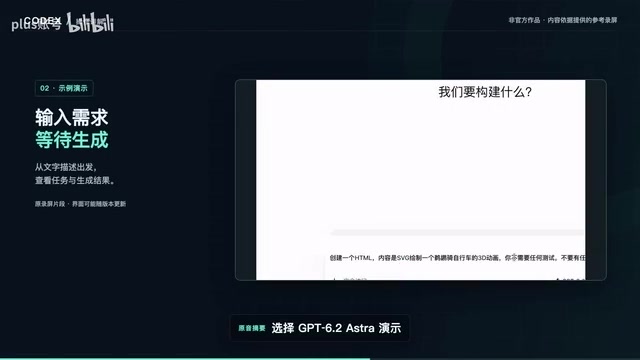
Then the demonstrator entered a prompt to generate an image and waited for completion before turning on acceleration mode, which noticeably improved generation speed. After generation finished, the quota was checked again and still showed 49.

The demonstrator's conclusion follows from this: the quota was not consumed at all, which is equivalent to a Plus account being able to use it without limits. But from the perspective of the evidence chain, there is an obvious logical leap here. The number "49" shown for the quota is not explained in the material in terms of its unit, total amount, or whether it refreshes within a specific time window. A value remaining unchanged after a single operation cannot directly lead to the conclusion of "unlimited quota" — it could mean that this call went through some cache or proxy channel, or that the quota display itself has a delay.
The video repeatedly uses "this proves that unlimited quota was successfully used" to make judgments, but the only support for this judgment is one number that did not change. For technical content, this level of verification is weak.
Technical Doubts Behind "Unlimited Quota"
From the normal logic of model calls, the equation "Plus account = unlimited quota" is itself very questionable. OpenAI has always imposed usage limits on model access for Plus accounts, especially since calls to the highest-tier models are costly, and the official side has no reason to open unlimited quotas to a single subscription account.
So where might the "quota not consumed" in the demonstration come from? There are several common explanations: first, the demonstrator connected to some third-party relay or proxy service, so the quota number does not correspond to the actual backend being called; second, the quota counter in the demonstration environment itself was bypassed or not correctly reported; third, the video was edited and only shows the segment where the quota was not consumed. The material does not provide actual call logs on the Codex side, nor does it show quota changes after multiple rounds of continuous calls, which makes the claim of "unlimited" lack reproducible verification.
In addition, the claim of "unlimited Codex quota" itself confuses concepts. Codex is a tool oriented toward code generation, and its relationship with the GPT model subscription system is not clarified in the material; the video only mentions it vaguely. This kind of vague statement easily leads viewers to misunderstand.
Third-party relay and proxy services are the key background for understanding this phenomenon of "quota not consumed." Such services are usually set up by individuals or small teams, inserting a relay layer between users and the official API. The interface users see, the quota numbers, and even the call logs may all be forged or rewritten by the relay layer. Relay service providers often charge users by number of calls or token volume, but they themselves may use shared keys, stolen credentials, or vulnerable accounts to call official interfaces, so both cost and stability are uncontrollable. More seriously, the relay layer can fully record users' prompts, returned content, and even account credentials, creating risks of data leakage and resale. The process in the video of "sending the address and key to the AI" is essentially asking users to actively connect their credentials to a relay environment of unknown origin, which is completely different from an official direct call chain.
Security and Compliance Risks Cannot Be Ignored
More important than "whether it can be used" is "whether it can be used safely." The video process requires users to send keys to the AI and execute configuration scripts in the terminal. Both steps fall outside the boundaries of conventional security advice.
Giving an API key or account credential to a third-party AI assistant is equivalent to partially handing over control of the account. If the configuration script comes from an untrusted source, there is also the possibility of malicious instructions being implanted. At the step of executing terminal configuration and restarting Codex, ordinary users can hardly determine what the script actually does.
From the perspective of platform rules, operations that bypass official quota limits usually violate the terms of service, and the account risks being banned. The video does not mention any risk warnings at all. Instead, it uses phrases like "like, coin, and favorite to claim" to push viewers to participate, and this orientation itself is worth being wary of.
The security boundary of API keys deserves separate explanation. An API key or access token is equivalent to an account's "password." Once leaked, the holder can call interfaces, consume quota, and even modify account settings without triggering secondary verification. Standard security practice requires keys to be stored only in controlled environments (such as local environment variables or key management services), and never to be transmitted through chat windows, screenshots, or plaintext configuration files. In the video, asking users to send keys to an AI assistant means letting the keys pass through the servers of a third-party model provider, whose retention policies, log auditing, and employee access permissions are all outside the user's control. Even if the demonstrator claims it is "just for configuration," the key has already left the user's security boundary during transmission and storage, and whether it will later be recorded, reused, or resold cannot be verified.
Conclusion: A Valid Demonstration Does Not Mean a Trustworthy Method
Overall, this video shows a phenomenon in which the quota number did not change, but it does not provide enough evidence to prove that "Plus accounts can use GPT 6.2 without limits" is true. The demonstration process relies on third-party configuration and key circulation, and there are obvious problems in both security and compliance.
For users who want to improve efficiency, a more reliable path is to pay attention to officially announced usage policies and model capability updates, rather than relying on "unlimited quota" configurations of unknown origin. The improvement in image generation speed demonstrated in the material is a genuinely perceptible part, but that is different from "unlimited quota" — accelerated generation is a product feature, while quota not being consumed is an account benefit, and the two should not be conflated.
If you see similar "unlimited quota" tutorials on social platforms, it is advisable to ask three questions first: What is the source of the quota counter? To whom was the key given? Does the quota remain unchanged after multiple consecutive rounds of calls? The demonstration video answers none of these three questions.
One-line Summary
Bilibili's "Plus accounts can use GPT 6.2 without limits" demonstration lacks sufficient evidence and carries risks of key leakage and account bans.
Paragraph Summary
The article breaks down a video circulating on Bilibili claiming that "ChatGPT Plus accounts can use GPT 6.2 and Codex with unlimited quota." The demonstration process asks users to send an address and key to an AI for automatic configuration, then execute a script in the terminal and restart Codex. The demonstrator concludes "unlimited quota" merely because the quota number remained 49 after one operation, which is clearly insufficient evidence. The article points out that an unchanged quota may come from a third-party relay, a bypassed counter, or video editing, and that the relationship between Codex and the GPT subscription system is vaguely handled. More alarmingly, giving keys to an AI assistant and executing terminal scripts of unknown origin carries risks of credential leakage and malicious instructions, and bypassing quota limits may also violate the terms of service and lead to account bans. The conclusion is that a valid demonstration does not mean a trustworthy method, and accelerated generation is different from quota not being consumed.
Related articles

Pure-Code Video Generation Tested: Which AI Model Actually Follows Instructions?
A Bilibili creator tested three AI models' pure-code video generation with unified prompts and three revisions each: Xiaonaomao has a high ceiling but lacks stability, GPT 6.2 Extra models well but only follows half the instructions, and OPAS 5.5 remains the benchmark.

GPT-6 Six-Tier Hands-On Test: Astra Ultra Dominates but Bills Double
GPT-6 six-tier test: Astra Ultra sweeps 3:0 in 3D tasks thanks to sub-agents and runs 14% faster, but hidden backend bills make its real cost 2.6x single-threaded.

GPT-6.2 Astra vs Fable 5.2: Huge Cost-Efficiency Gap Across 12 Real-World Tests
Bilibili creator tests GPT-6.2 Astra vs Fable 5.2 across 12 real tasks: Fable wins 7-5 but costs 7.2x more and takes nearly 5x longer. Token efficiency emerges as the key selection metric.