GPT-6.2 Astra vs Sol Hands-On Test: 6x Stronger at 6x the Cost — Which to Use as Your Daily Driver
Astra is stronger but ~6x pricier; use Sol daily and Astra for hard tasks.
OpenAI's GPT-6.2 Astra and Sol diverge sharply in positioning: Astra chases the capability ceiling, Sol focuses on cost. A Bilibili hands-on test shows a median ~6x cost gap (4–7x per task), with Sol ultra-fast mode still cheaper than Astra standard. Astra leads on 3D detail, depth of field, data viz, and explainers; Sol wins on dynamic scenes, camera work, and regular UI, while Astra suffers mode collapse. The takeaway: use Sol as the daily driver and switch to Astra for hard tasks.
OpenAI released two models at the same time — GPT-6.2 Astra and GPT-6.2 Sol — and they clearly diverge in positioning: Astra chases the upper bound of capability, while Sol focuses on cost control. A Chinese-language hands-on test by a Bilibili creator reached a counterintuitive conclusion: Astra really is stronger, but for most people the daily driver should actually be the several-times-cheaper Sol.
Price Gap: Median Around 6x
The most direct dimension in the test is cost. With the same prompt for Sagrada Família, Astra costs in the $10 range while Sol needs just over $1; another set of waterscape prompts came out around $13 vs $2. After tallying multiple runs, the creator's median estimate is a cost gap of about 6x, with actual multiples fluctuating between 4x and 7x depending on the task.
That gap directly determines usage strategy. In the Codex scenario, Sol in ultra-fast mode burns through quota at roughly 3x the rate of standard mode — yet even so, it's still cheaper than switching to Astra standard. In other words, for performance-sensitive tasks, Sol in ultra-fast mode still beats Astra standard on value.
Astra's Strengths: Detail, Depth of Field, and Information Density
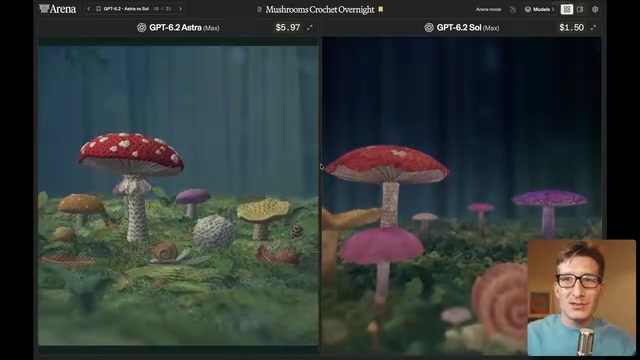
In 3D scenes and multi-element compositions, Astra's lead is fairly consistent. The creator repeatedly cites a few key phrases: detail layering, sense of depth, deeper understanding of elements. Given the same prompt, Astra's output includes boat shadows, more swimmers, and birds in flight, while Sol produces only a few boats with too much empty space.
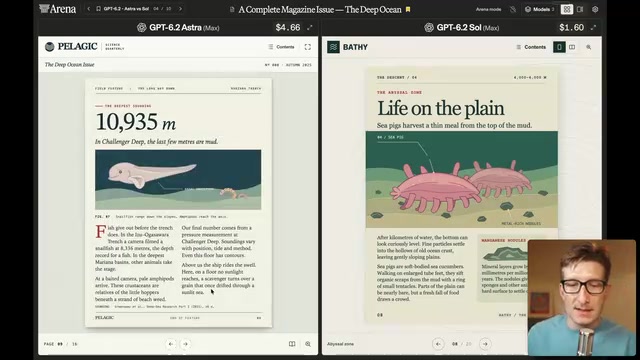
The gap is even more obvious on white-collar tasks. Asked to create a visualized explainer of "the history of AI," Astra can fill in details the prompt didn't specify and organize them into a clear narrative image; Sol's result is solid but lacks that layer of reasoning. It's the same with data visualization — Astra takes care to place asteroids around the Earth, while Sol's approach is closer to a conventional model.
Where Sol Pulls Ahead: Dynamism, Camera Work, and UI Layout
There are several places where Sol is actually better, and they're not isolated cases.
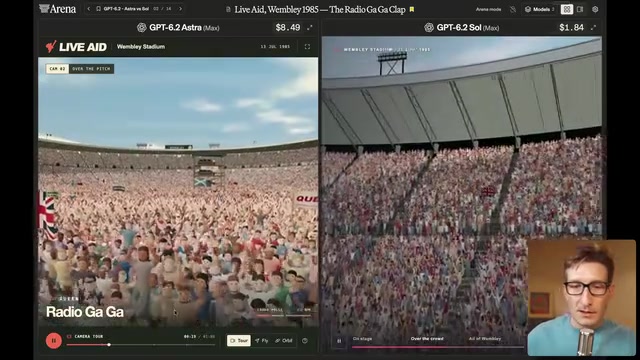
Dynamism and camera work is the first. In prompts requiring strong motion, like "cheese rolling downhill," Sol's characters are running, the direction is clear, and there's impact, while Astra's image feels static. In a Freddie Mercury concert scene, Sol's crowd rendering and camera movement even surprised the creator — "I've only seen this kind of camera work on Opus before."
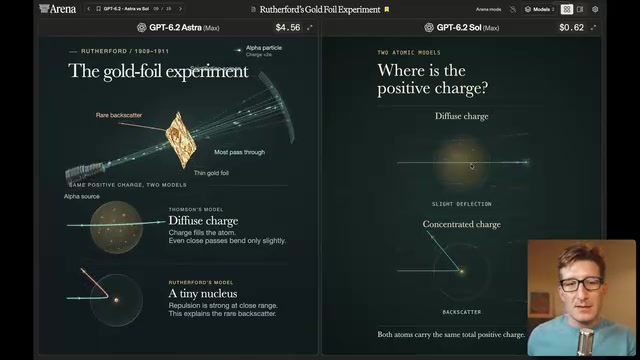
UI generation is the second, and the more practical one. One explicit criticism the creator makes of Astra is mode collapse: it favors green palettes and a fixed "brand name + title + subtitle" layout, so almost every output looks the same. Sol has its own patterns too, but adapts direction better to the prompt, and the overall page looks more natural. For ordinary websites and landing pages, Sol's output is "totally fine, sometimes better."
The exception comes with complex UI elements — application interfaces requiring multi-layered layouts, keyboard components, and the like, where Astra's structural organization is clearly stronger. So the creator draws a dividing line: use Sol for regular UI, Astra for complex interactive components and data visualization.
Mode collapse, in the context of generative models, refers to a model repeatedly outputting highly similar results for the same type of prompt, covering only a small region of the output space rather than genuinely responding to the prompt's content with diversity. In image/UI generation, it often manifests as fixed color schemes, a fixed layout skeleton, and a fixed number of elements. Astra's preference for green palettes and its fixed "brand name + title + subtitle" structure in UI tasks, as described in the article, is a typical collapse pattern — the model treats the most frequent design pattern in its training data as the default answer. Collapse is usually caused by imbalanced training distributions and overfitting to a single aesthetic or reward signal during reinforcement learning. For users, collapse means lower prompt adherence, requiring stronger wording or multiple resamples to compensate.
Games and 3D Assets: Trade-offs by Scenario
In game generation, Astra and Fable are the two earliest models able to produce decent game mechanics, but Astra's output suffers from the same convergence problem. Sol's fighting game characters are more structurally coherent, the kick hit detection works, and the game mechanics are "actually pretty good." The creator's stance: try Sol first for games — at a 4–5x cost difference, the gap between the two isn't large.
3D asset generation is clearly Astra's home turf. The creator uses an Alpine scene as an example — Astra outputs a green website that doesn't match the ice-and-snow theme; Sol's palette fits the theme better but the materials are rough. Overall, Astra's finesse on 3D assets is worth paying extra for.
Playability assessment is a commonly used standard when evaluating "AI-generated games": it looks not just at visuals but at whether the generated code contains a working core mechanism — collision detection, input response, win/lose conditions, and whether the character state machine is self-consistent. When the article says Sol's fighting game has "working kick hit detection" and "pretty good mechanics," it means this kind of judgment logic actually runs, rather than being just a visual shell. For generative models, mechanical correctness is harder than visual polish, because it requires the model to understand the causal structure of the game loop and turn it into executable code. The usual process for judging whether a generated game passes: first actually press keys in the browser to see whether attacks land, whether characters get stuck in terrain, and whether rounds end properly, then evaluate the art.
Cross-Comparison in the Low-Price Tier
The creator also made a horizontal judgment on low-cost models: Sol's one-dollar-level output at extremely low cost is something "no open-source model comes close to." DeepSeekAd Flash is clearly cheaper but doesn't reach this quality level; Google's models are also competitive at this price point but still lag. The creator's assessment is that Sol is the best choice for tasks like making games, anywhere along the entire parameter curve.
Also worth noting is model convergence. The creator found that the gap between top-tier and second-tier models on UI tasks isn't obvious, and open-source models also perform decently on UI — "this area may already be somewhat saturated."
Conclusion: Sol for Daily Use, Astra for Hard Problems
The creator's actual usage strategy has already shifted back to Sol as the daily driver, with occasional switches to Astra. Sol covers the vast majority of tasks and has ultra-fast mode to stretch subscription quota; when a hard task that Sol can't push through comes up, hand it to Astra and spend the extra money. In his words, Astra is the stronger model with broader, deeper, and more precise coverage, but in daily use, paying one-sixth to one-quarter of the price gets you results that are "absurdly good."
For budget-sensitive teams that still want to preserve the upper bound of capability, one viable combination is: Astra for large worlds and complex visualization, Sol for mechanics and routine output.
One-line Summary
Astra is stronger but about 6x more expensive — use Sol as your daily driver and bring in Astra for hard problems.
Paragraph Summary
OpenAI's simultaneously released GPT-6.2 Astra and GPT-6.2 Sol have clearly divergent positioning: Astra chases the capability ceiling, Sol focuses on cost. A Chinese-language hands-on test by a Bilibili creator shows a median cost gap of about 6x, with per-task multiples between 4x and 7x, and Sol in ultra-fast mode still cheaper than Astra standard. Astra consistently leads on 3D detail, depth of field, data visualization, and information explainers, filling in layers the prompt didn't specify; Sol pulls ahead on dynamic scenes, camera movement, and regular UI layouts, while Astra shows obvious mode collapse. The final strategy: use Sol daily for most tasks, switch to Astra for hard problems, forming a combined workflow.
Related articles

How the European Commission Rolled Out Matrix to 40,000 Employees
The European Commission rolled out Matrix to over 40,000 employees. Element's blog reviews the phased strategy, digital sovereignty, and open-source adoption lessons.
Why AI Is Going Local: A Deep Dive wit…
Why AI Is Going Local: A Deep Dive with Moonshine Voice Creator Pete Warden
Moonshine Voice creator Pete Warden explores the trend toward local AI, analyzing the four drivers of latency, privacy, cost, and reliability, and what local-first design means for developers and product teams.

ChatGPT Launches Live Dictation: Transcribe as You Speak, Available on All Platforms
ChatGPT launches Live Dictation, a real-time transcription feature that transcribes as you speak, now available to all plan users globally on web, desktop, iOS, and Android.