How the European Commission Rolled Out Matrix to 40,000 Employees
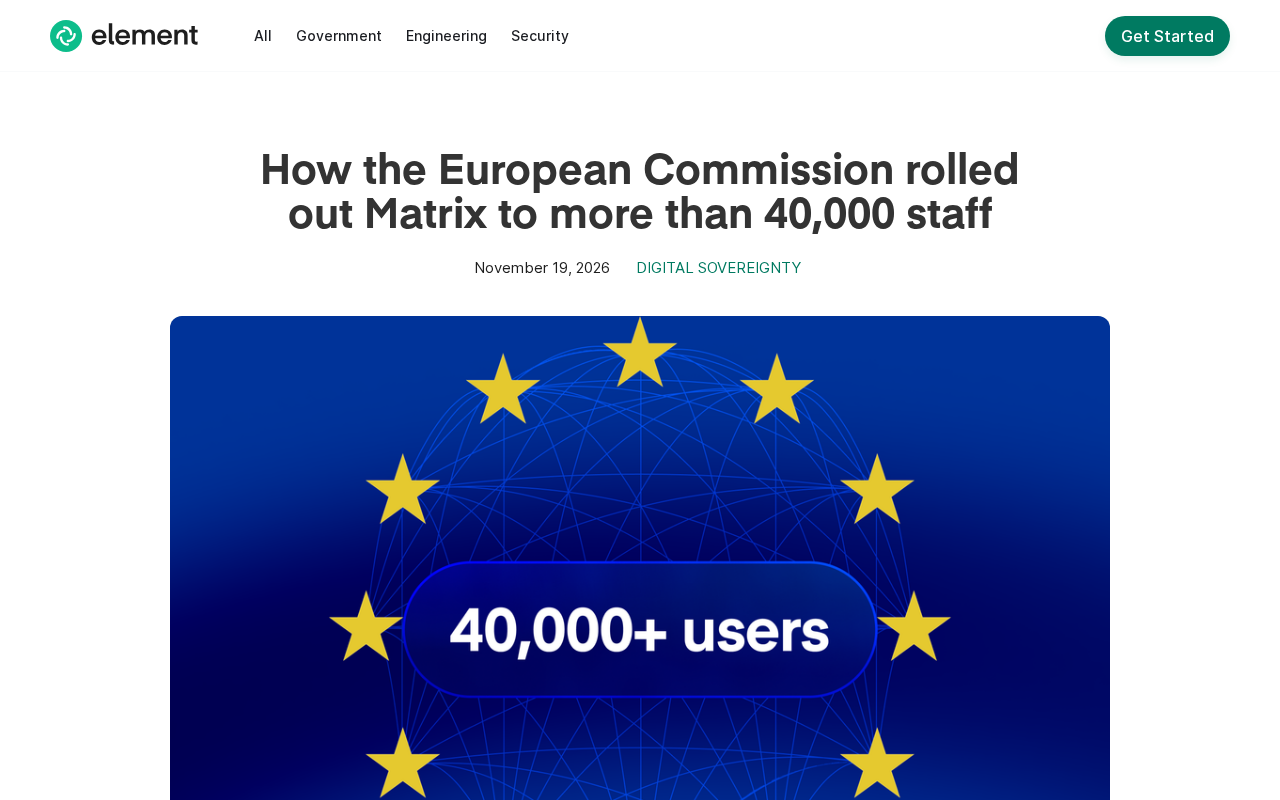
The European Commission rolled out Matrix to over 40,000 employees, showing a path for open-source comms in the public sector.
The European Commission has rolled out a self-hosted Matrix-based communications solution to over 40,000 employees, per Element's retrospective. The phased approach—piloting first, then expanding—relied on internal communication, user training, and IT governance alignment. Matrix's federation preserves data control while enabling cross-department collaboration, aligning with Europe's digital sovereignty agenda. Hacker News welcomed the case's demonstration effect but questioned long-term costs and UX versus commercial products.
From Pilot to a 40,000-User Communications Migration
The European Commission made a sizable attempt at choosing its internal communications tool. According to a disclosure on the official Element blog, the institution has rolled out the Matrix protocol to more than 40,000 employees—a figure drawn from Element's retrospective on the project's implementation. For any large organization, replacing instant messaging infrastructure is no small matter, and the complexity facing the European Commission is compounded by its multinational structure, multilingual environment, and strict compliance requirements.
Matrix is an open, decentralized communications protocol that lets organizations run their own servers and federate with other Matrix instances. Element is the client and commercial service provider built on Matrix. The key point of this deployment isn't "what tool was used," but how a public-sector body can find a balance among security, sovereignty, and usability.
The core design of the Matrix protocol is "federation": each organization can run its own homeserver, user accounts are identified in the form @username:server-domain, and different servers synchronize messages and state through a standardized Server-Server API. This works similarly to email—you can set up a mail server under your own domain while communicating with the outside world. For the public sector, this means data doesn't have to be stored centrally on third-party clouds but can remain in infrastructure the organization controls. Matrix also defines end-to-end encryption (using the Olm/Megolm algorithms by default), room state events, bridging, and other mechanisms, making it usable both as a standalone IM and as a way to connect with existing systems like Slack and Teams. Element, founded by the core developers of the Matrix protocol, provides Element Web/Desktop/Mobile clients and support services for on-premises enterprise deployments, making it the most commercialized player in the Matrix ecosystem.
A Phased Rollout Strategy
Element's blog retrospective shows that the European Commission's rollout was not an all-at-once switch but a phased approach. It first validated functionality and operational processes with a small group of users, then gradually expanded coverage. This approach is fairly common in communications migrations at large organizations: early users take on the role of discovering problems, while the operations team uses the opportunity to refine support processes and documentation.
According to Element's summary, success factors included clear internal communication, investment in user training, and alignment with the institution's internal IT governance processes. Matrix's federated architecture shows its advantage here—organizations can retain control over their data without sacrificing cross-department collaboration.
Communications migrations at large organizations typically face a "network effect" challenge: the value of an instant messaging tool rises with the number of users, but in the early stages of migration there are few users and the experience is incomplete, which easily leads to reversion. Phased rollout (pilot → expansion → full deployment) is precisely designed to first prove out the tech stack, permission model, compliance auditing, and help-desk processes on a small scale, then use feedback from early users to reduce the risk of a large-scale switch. This model is especially common in public-sector IT projects, because procurement cycles are long, change management is strict, and integration with existing identity authentication (such as LDAP/Active Directory), archiving and retention, and e-discovery requirements is needed. The "internal communication" and "training investment" emphasized in Element's retrospective are essentially about handling organizational inertia during migration—technical availability is only a prerequisite; user habits and the support system are what ultimately determine retention.
Digital Sovereignty and Compliance Considerations
When public-sector bodies choose self-hosted communications solutions, it is often directly related to data sovereignty. The European Commission's adoption of Matrix means communications data can be deployed on controlled infrastructure rather than relying entirely on external SaaS vendors. This aligns with the direction of the digital sovereignty agenda that Europe has emphasized in recent years.
In the Hacker News discussion (the post received 390 points and 191 comments), many commenters focused on the demonstration effect this case has for governments and other large organizations. Some also raised questions: can the operational costs and user experience of self-hosted solutions match mature commercial products over the long term? These disagreements reflect the real tension open-source communications tools face in the enterprise market—the trade-off between control and convenience.
In the European policy context, "digital sovereignty" generally refers to the ability of a state or organization to maintain control over its own data, infrastructure, and technology stack, reducing dependence on non-EU vendors. In recent years, the EU has strengthened this agenda through a series of laws including GDPR, the Data Governance Act, and the Digital Markets Act, and public-sector IT procurement increasingly incorporates "portability," "self-hosting options," and "open-source licensing" into evaluations. For an institution like the European Commission, communications tools involve a large volume of internal discussions and sensitive information; if it relied entirely on external SaaS, the actual location of data storage, the legal applicability of cross-border transfers, and vendor lock-in would all become focal points of compliance review. Self-hosted Matrix servers put the physical location of data and access policies in the institution's own hands, while the federated architecture still allows interoperability with external partners—offering a compromise between "closed security" and "open collaboration."
A Reference Case for Open-Source Collaboration Tools
From a broader perspective, the European Commission's deployment offers a sample of the feasibility of open-source communications tools in very large organizations. Matrix's decentralized design makes it naturally suited to scenarios requiring cross-institution interconnection, while Element's productization efforts at the client level determine the actual experience of ordinary employees.
The value of this case lies in showing a path: large public institutions can modernize their communications infrastructure without fully giving up control. For those interested in open-source tools in enterprise adoption, digital sovereignty practices, and secure communications solutions, Element's retrospective is worth reading closely. According to feedback in the Hacker News discussion, the community's interest in this kind of real-world implementation experience is clearly higher than in mere product launches.
One-line Summary
The European Commission rolled out Matrix to over 40,000 employees, demonstrating a path for open-source communications tools in the public sector.
Paragraph Summary
The European Commission has rolled out a self-hosted communications solution based on the Matrix protocol to more than 40,000 employees, and Element's official blog reviewed the deployment process. The rollout used a phased strategy—first validating functionality and operational processes on a small scale, then gradually expanding coverage—with success factors including internal communication, user training, and alignment with IT governance processes. Matrix's federated architecture lets the institution retain data control without sacrificing cross-department collaboration, in line with Europe's digital sovereignty agenda. In the Hacker News discussion, the community affirmed its demonstration effect but also questioned whether the long-term operational costs and user experience of self-hosted solutions can match mature commercial products. The case provides a reference for the feasibility of open-source communications tools in very large organizations.
Related articles

GPT-6.2 Astra vs Sol Hands-On Test: 6x Stronger at 6x the Cost — Which to Use as Your Daily Driver
GPT-6.2 Astra vs Sol hands-on test: Astra wins on detail, depth of field, and data viz but costs ~6x more; Sol beats it on dynamism, camera work, and regular UI. Here's which to use as your daily driver, by scenario.
Why AI Is Going Local: A Deep Dive wit…
Why AI Is Going Local: A Deep Dive with Moonshine Voice Creator Pete Warden
Moonshine Voice creator Pete Warden explores the trend toward local AI, analyzing the four drivers of latency, privacy, cost, and reliability, and what local-first design means for developers and product teams.

ChatGPT Launches Live Dictation: Transcribe as You Speak, Available on All Platforms
ChatGPT launches Live Dictation, a real-time transcription feature that transcribes as you speak, now available to all plan users globally on web, desktop, iOS, and Android.