GPT-6.2 Astra vs Sol Hands-On: Why Is a 20% Price Cut Actually More Expensive and Slower?

GPT-6.2 price cut but same-task tests cost more — the key trade-off is task difficulty vs reasoning level.
The article examines OpenAI's GPT-6.2 price adjustment: Astra's API price fell about 20%, yet the same task at Max level rose from 63 to 89 cents. Astra is positioned for complex multi-step tasks and Sol for everyday ones, with upgrades limited to GPT-Work, Codex, and the API. Testing four models across valuation tables, mecha cities, a lily teaching model, and code regression, the old Astra delivered in 8 minutes at ~200K tokens, the new version used ~400K, and 6.2 Sol's re-run hit ~2.05M tokens. The takeaway: set a "good enough" bar first, then choose the reasoning level; OpenAI and Anthropic are now pricing around wait time, creating "pay for speed" vs "trade time for a discount" models.
OpenAI has adjusted pricing for the GPT-6.2 series, cutting both API input and output costs for Astra by roughly 20%. But a price cut doesn't necessarily mean savings — one user ran the same prompt at the same Max reasoning level and found that the old Astra cost 63 cents, while the new 6.2 Astra cost 89 cents. This video starts from an interpretation of the official docs and combines hands-on tests of four models on the same task to answer one question: what kinds of tasks are actually worth switching to GPT-6.2 for?
Official Positioning: Astra for Hard Work, Sol for Everyday
This upgrade only applies to GPT-Work, Codex, and the API — users of the regular chat interface will barely notice a difference. The official positioning of the two models is clear: Astra handles complex, multi-step hard tasks, while Sol is the everyday model. The capability areas the official materials highlight are file processing, computer operation, building interactive experiences, and making multi-step tasks less laborious.
One official example is telling: both generations of Astra are given the same data to build a valuation table. The old version puts each business line's revenue on a separate tab, with the valuation algorithm and per-share results below the table; the new version puts the revenue breakdown, valuation derivation, and assumption changes all on the same page. When someone in a meeting asks "which business is propping up the company's valuation," you can trace it on that same page. The output is closer to real decision-making scenarios — that's the core upgrade logic of 6.2 Astra.
But a question follows: do ordinary people really need such complex valuation tables? In our hands-on test we used a public Excel exercise that explicitly specified where the data was, what line to draw, and the Y-axis range. Both generations of Astra and both generations of Sol all found the correct 41-day data point and all delivered editable charts. This shows that on tasks close to everyday work intensity, every tier of model can do a good job: if the task isn't complex enough, the new model brings limited benefit while costs don't drop noticeably, so there's little point in switching.
Creative 3D Capability: Ball Runs and Mecha Cities
Another highlight in the official docs is creativity and 3D aesthetics. In OpenAI's public ball-run chain demonstration, the process starts with tracks and dominoes, then moves on to mechanisms, camera work, sound, and playback fixes. This example shows that 6.2 Astra can push a prototype forward round after round, giving it an edge in 3D interactive scenarios.
A user's test is even more直观 (more intuitive): give both 6.2 models the same prompt — make a city in New York State rise up off the map and turn into a mecha that walks across several New York boroughs. The Astra version shows a yellow mecha crouching then standing upright on a glowing map; the Sol version shows a gray mecha with a few buildings still visible on its shoulders. Both mechas stand up, but the detail handling isn't quite there — following the map, it's hard to tell which block became a hand and which patch of ground became a foot.
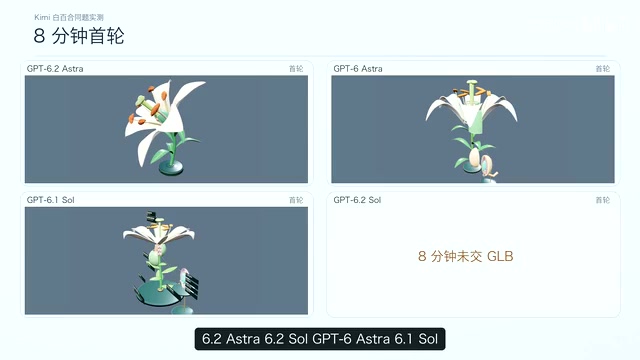
GLB is the file extension for the glTF binary format, part of the glTF (GL Transmission Format) 3D scene interchange standard developed by the Khronos Group. It packs a model's geometry, materials, textures, animations, and scene hierarchy into a single .glb file, which is easier to distribute than a .gltf plus external textures combo and can be loaded directly by browsers and most 3D viewers. For model-generation tasks, GLB is both a deliverable format and a verifiable intermediate artifact: whether a valid GLB can be exported, whether the hierarchy is reasonable, and whether textures are correctly embedded often reveal generation quality better than a rendered screenshot.
Four Models on the Same Task: A Lily Teaching Model
I tested four models on a prompt closer to a teaching scenario: 6.2 Astra, 6.2 Sol, 6.1 Astra, and 6.1 Sol. The task was to make a lily with six petals and six stamens, able to be taken apart to show the internal ovules, plus a demonstration of the pollen tube growing inward. Each of the four was drawn independently, all at the high reasoning level, delivering a GLB file that could be rotated on open, with a first-round time limit of 8 minutes.
The results diverged clearly. 6.2 Sol didn't finish writing its script within 8 minutes; 6.2 Astra delivered a finished piece with the flower head facing the viewer, curved petals, and paired ovules visible when taken apart; the old Astra scaled up a single ovule and placed it off to the side; 6.1 Sol added labels and hatching. If a teacher wanted to point at a specific part on screen, the old Astra's version would actually be the handiest. 6.2 Sol, when re-run later with a different export method, took an extra 11+ minutes to deliver the file. In the re-run version, the petals block the view at low angles; tilt slightly downward and you can see the ovary opening layer by layer, with all three pollination paths traceable from the top of the flower along the coral-colored one to the ovule entrance.
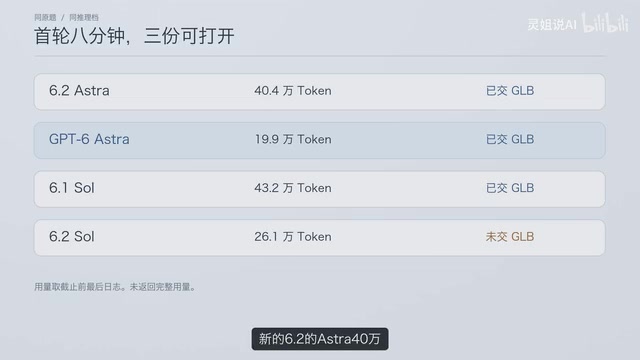
Usage data makes the picture clearer. The old Astra used the least, delivering a finished piece within the 8-minute limit at about 200K tokens; the new 6.2 Astra used about 400K; 6.1 Sol used about 430K; 6.2 Sol ran 260K tokens within the limit without delivering, and its re-run used about 2.05M tokens, of which 1.88M were cached input and about 23K were output. If the goal is just a take-apart teaching model, the old Astra is sufficient; if you want the audience to see exactly where the pollen tube finally enters, the re-run 6.2 Sol group is clearer.
Cached input refers to the portion of the prompt identical to the previous call that the server caches and bills at a lower rate. In multi-round re-runs or long-context tasks, unchanged content such as the system prompt, task description, and existing code hits the cache, so the bill shows separate "cached input" and "regular input" lines. Caching can significantly lower unit costs, but it also means total token consumption and actual spend can't be equated directly: one re-run consumed 2.05M tokens, most of it low-price cached input, and it's the output tokens and new input that really drive up cost and latency.
Code and Web Regression: On Par, With Some Regressions
Beyond artifact generation, I also ran regression tests with small tools: cut a segment from a video, shift the following subtitles earlier, and the old command should still work. The latter three models all passed the corresponding checks. The new Astra's capability is basically on par with the old version; the new Sol missed information on the repository question and appears to have regressed slightly. Whether old projects can be used stably still needs to be judged with your own regression cases.
The mobile web page task is similar: 6.1 Sol's page got stretched too wide, while 6.2 Sol fits at the same width, with better detail and responsive optimization, and external browser checks all passed. Another study compared models annotating their own data centers: 6.2 Astra improved over the old version, but on campus annotation 6.2 marked only one building while humans marked six, and Faber 5.2 was closer to the level of external researchers on this task.
Cost vs. Benefit: Set the "Good Enough" Bar First, Then Decide How Big to Go
The new Max level renders the lake-test bird's throat-pouch feathers and trampling pose in great detail, at the cost of more output tokens. With the same prompt at high reasoning, the new version actually dropped from 18 cents to 12 cents, and the trampling pose is still fairly clear — if you only need one image, the high level is enough to call it done.

Sol itself didn't get a unit price cut, but the tests show that 6.2 Sol can match or approach the old Astra's total score in some cases — from that angle, it can be seen as a kind of price cut: work that used to require the flagship model can now be done by the everyday one.
More noteworthy is the shift in pricing logic. OpenAI and Anthropic are competing head-on, and both are putting a price on "how long you're willing to wait." OpenAI sets some backend API tasks so that waiting longer costs less, giving a discount for queue time; Anthropic does the opposite, charging more on Fable to run faster. For users, it comes down to two sentences: how hard the task is determines which model to use — don't chase the highest reasoning level reflexively; how urgent you are determines whether to pay for speed. In the future, wealth may be measured by token freedom — the rich buy time with money, the poor trade less money for more time; the rich will buy tokens with money, and the poor will spend more time to save tokens.
Reasoning effort is a common adjustable parameter in current reasoning models, usually offered at levels like low / medium / high, controlling the token budget the model spends on internal thinking before answering. Higher levels mean more tokens spent on self-checking, breaking down steps, and trial and error; complex tasks often succeed more, but latency and cost rise accordingly. The "Max" level mentioned in the article can be understood as the highest tier, suited to one-off hard problems; for tasks that only need one image or a short piece of code, dropping to high or lower is often more cost-effective.
One-line Summary
GPT-6.2 is cheaper on paper, but the same task costs more in practice — the key is trading off task difficulty against reasoning level.
Paragraph Summary
The article starts from OpenAI's price adjustment for the GPT-6.2 series, noting that while Astra's API unit price dropped by about 20%, the same task run at Max level actually went from 63 cents to 89 cents. Officially, Astra handles complex multi-step hard tasks and Sol handles everyday scenarios, with the upgrade covering only GPT-Work, Codex, and the API. The author compares the four models across four test types — valuation tables, mecha cities, a lily teaching model, and code regression — and finds that the old Astra delivered the teaching model in 8 minutes at about 200K tokens, the new version used about 400K, and 6.2 Sol's re-run reached about 2.05M tokens. The conclusion: set the "good enough" bar to gauge task difficulty first, then decide the reasoning level; meanwhile, OpenAI and Anthropic are pricing around waiting time, forming two models of "pay for speed" and "trade time for a discount."
Related articles

Jingle Jam 2026 Registration Opens: Lewis Uses Old Footage to Rally Volunteers for Fundraising
Jingle Jam 2026 fundraising registration is open. Lewis uses old footage edited into a new video, calling on viewers to create fundraising pages at jingle jam.tiltify.com to support eight charities. The event takes place in the first two weeks of December.

Gemini 4 Neon Hands-On Test: Can It Replace Claude Opus 5.5?
A Bilibili creator tests Gemini 4 Neon, Claude Opus 5.5, and GPT 6.2 across three coding Agent challenges—pelican animation, 3D racing, and code-generated video—to see if Gemini can replace Opus.
FBI-Warned Artex: How an AI Attack Framework With No In-House Model Pries Open Enterprise Doors
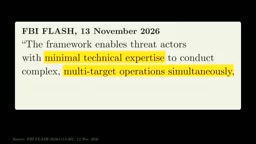
The FBI-warned open-source AI attack framework Artex has no model of its own—it plugs into Claude, GPT, and other external LLMs to drive an agent loop, turning ordinary tools like Nmap into an automated attack pipeline. This article examines three real cases—South Korean finance, ConnectWise, and Barracuda—analyzes the three drivers of speed, cost, and noise, and outlines defenses such as exposure inventory and short-lived credentials.