GPT-6.2 Dual-Model Launch, Qwen4-Max Goes GA, and Multiple API Updates
OpenAI, Alibaba Cloud, Anthropic, DeepSeek, and Google released concentrated updates to models, billing, and platform capabilities.
This article reviews a concentrated round of product updates across multiple vendors. OpenAI released GPT-6.2 Astra and Sol on the same day, targeting professional research and everyday coding and agent workflows, with Astra priced 20% lower than the previous generation and the Responses API background completion beta launched. Alibaba Cloud's Qwen4-Max moved from preview to GA API, using MoE architecture with 2.4 trillion total parameters and 71 billion activated per token, and the preview plan will go offline on November 25. Anthropic introduced the Code Platform linked billing beta, where customers can link an existing organization for billing, though security policies don't automatically apply. DeepSeek opened search, file, voice, and security capabilities to the API, with server-side search now billed only by tokens. Google made Gemini Tasks free in six countries and launched a robotics-related plugin. The article reminds developers to check offline deadlines and call restrictions.
OpenAI released two new models at once, Alibaba Cloud's Qwen4-Max moved from preview to general availability (GA) API, and Anthropic, DeepSeek, and Google updated their product capabilities in the same period. This is a broad, concentrated round of updates spanning models, billing methods, and platform integrations. Here's a breakdown, item by item.
OpenAI: GPT-6.2 Astra and Sol Released Together
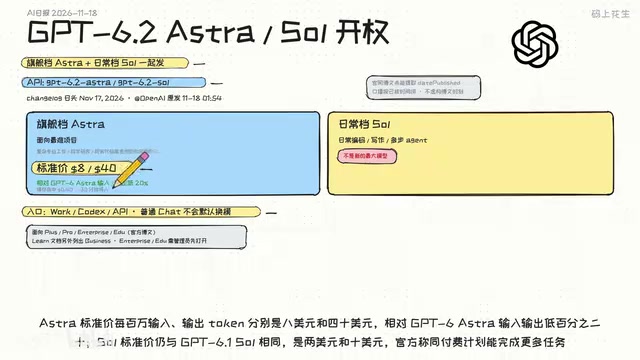
According to Bilibili creator "马上花生" (Mashang Huasheng), at around midnight Beijing time on November 18, OpenAI's official account announced the launch of GPT-6.2 Astra and GPT-6.2 Sol, with API model IDs GPT-6.2 Astra and GPT-6.2 Sol, and a Change Log date of November 17.
The two models have clear positioning: Astra targets complex professional work, scientific research, and implementation and testing within existing codebases; Sol targets everyday coding, writing, and multi-step agent workflows. Access covers Chat, GPT-Work, Codex, and the API, but regular Chat will not switch to these two models by default.
On pricing, Astra's standard price is $8 and $40 per million input and output tokens respectively, 20% lower than GPT-6 Astra on input and output; Sol's standard input price remains the same as GPT-6.1 Sol at $2 and $10. The company says the same paid plan can complete more tasks. A few usage limits are worth noting: tool calls must use the Responses API; when input exceeds 272K tokens, the diagnostic request input and cached price double, and output is 1.5× that of short context. The official benchmarks are re-tests, and the company says it will work to bring GPT-6.2 into Daybreak, though Daybreak has not yet switched by default.
On the same day, the Responses API launched public beta for 2-hour and 8-hour background completion, with model token rates at 70% and 60% of standard price respectively.
The Responses API mentioned in the article is the interface form OpenAI introduced for agent scenarios, standing alongside the traditional Chat Completions API. Its key difference is that it expands "a conversation" into a "response" object that can include multiple rounds of tool calls, state retention, and background tasks: after the caller submits input, the server can continuously execute tools, retrieval, or long-running computation, and support streaming event callbacks. This is precisely why OpenAI restricts some GPT-6.2 capabilities (such as tool calls) to the Responses API only. The 2-hour and 8-hour background completion modes in the article are implemented on this interface: tasks execute asynchronously in the background, billed at 70% and 60% of standard price, suitable for batch, non-real-time workloads. When migrating, developers should note that request structures, event types, and error handling all differ from Chat Completions.
Alibaba Cloud: Qwen4-Max Moves to GA API
Alibaba Cloud Model Studio (Bailian) listed the GA version of Qwen4-Max on November 16, with call model ID Qwen4-Max. The preview version had been open previously; this time it moves to GA API and also offers a Token PlanAd, with the preview page still available and supporting only the Token Plan.
On specs, the press release states total parameters of 2.4 trillion, 71 billion activated per token, and a context of 1 million tokens. The company says open-source small-size weights will soon be opened to developers, but they are not yet available. Note that the official benchmarks and stability figures are claims not independently re-tested.
One timing point: at 24:00 Beijing time on November 25, the preview plan ends and goes offline; calls that depend on the preview model ID need to migrate in advance.
"Total parameters" and "activated parameters per token" are two commonly used metrics for Mixture-of-Experts (MoE) architecture models. Total parameters refer to the scale of all expert weights in the model, determining storage and deployment costs; activated parameters refer to the number of parameters actually involved in computation in a single forward pass, directly tied to inference compute overhead. Qwen4-Max's stated 2.4 trillion total parameters and 71 billion activated per token mean the model has large capacity, but each token only schedules about 3% of the weights to participate in computation, balancing effectiveness and inference cost. This is also why MoE is widely adopted in current large models. Understanding the difference between these two numbers helps judge the model's memory requirements, throughput performance, and pricing reasonableness, and avoids mistaking "total parameters" for the computation amount of a single inference.
Anthropic: Code Platform Linked Billing Beta
In its November 17 product update, Anthropic introduced the Code Platform linked billing beta. Third-party platforms can let customers link their existing Code organization so usage is recorded to that organization, rather than asking customers for an API Key.
Customers can set read limits, and requests run within the platform's organization. Note that the customer's IP allowlist, encryption keys, and data retention policies do not automatically apply; this part needs to be confirmed by the platform side itself.
"Linked billing" is a common settlement model between cloud platforms and model vendors: end customers do not directly hold the model vendor's API Key; instead, they authorize their organization at the model vendor to a third-party platform, the platform initiates requests on their behalf, and usage is ultimately recorded to the customer's own organization account. The benefit is that customers don't need to distribute keys to every platform, reducing key exposure, while billing is unified and cost allocation is easier. The cost is a change in responsibility boundaries: calls actually occur on the platform side, and the customer's existing security configurations such as IP allowlists, bring-your-own encryption keys, and data retention policies typically do not take effect. Therefore, before adopting such a model, you need to clarify with the platform who is responsible for data flows, log retention, and access control.
DeepSeek: Search, Files, and Other Capabilities Opened to API
On November 13, DeepSeekAd opened the search, file linking, voice, and security capabilities from its app to the API, built on the existing DeepSeek Flash. Starting at 12:00 Beijing time on November 18, server-side search and web scraping triggered within model calls are no longer billed separately as tool fees, only by model tokens.
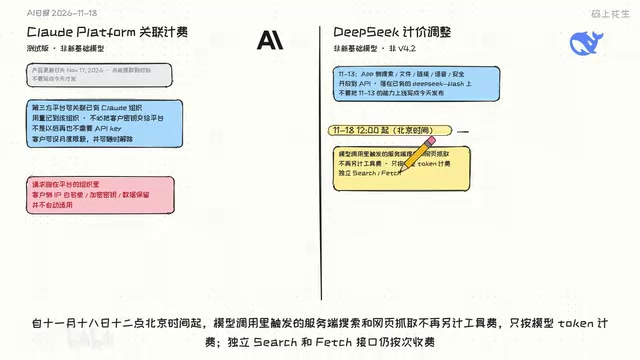
Standalone search and Face interfaces are still billed per call. This adjustment effectively lowers the overall cost of search-type calls, with an obvious impact on applications that need frequent web data retrieval.
"Server-side search" means that during answer generation, the server automatically determines whether web retrieval is needed and directly fetches web content as context, rather than the developer calling a separate search interface and splicing the results into the prompt. This mode merges retrieval and generation into a single model call, simplifying the engineering pipeline, but billing can be ambiguous: previously it was usually billed extra per search or per scrape, and now it is billed only by model tokens, meaning retrieved web content is counted as input tokens on the bill. For applications with frequent web access, the cost structure shifts from "per call" to "per volume," requiring re-estimation of token consumption per request, especially since input tokens can rise significantly when scraping long web pages.
Google and the Robotics Plugin for Unreal Engine
Google published an official blog post at around midnight Beijing time on November 18: Tasks in the Gemini app are free for eligible users in the United States, Japan, South Korea, Canada, Australia, and India, running on already-released Gemini models; at the same time, higher-tier capabilities such as proxy payment are rolling out starting in the United States. This is a dual change in product capability and price threshold.
Another official announcement at around midnight Beijing time on November 18 was the launch of a Robotics plugin for Under Gravity, packaging hardware integration, simulation, and real-machine control into one set of skills. The developer blog is dated November 17, and you can try GPT-X in Work, Codex, and the API that day, while keeping an eye on the November 25 offline window.
Summary
This round of updates centers on three lines: model capabilities, API billing rules, and platform integration. For developers, the most direct actions are to check the two offline deadlines on November 25 (the Qwen4-Max preview plan and the related preview window) and confirm whether the Responses API call restrictions affect existing workflows.
One-line Summary
OpenAI, Alibaba Cloud, Anthropic, DeepSeek, and Google released concentrated updates to models, billing, and platform capabilities in the same period.
Paragraph Summary
This article reviews a concentrated round of product updates covering multiple vendors. OpenAI released two models on the same day, GPT-6.2 Astra and Sol, targeting professional research and everyday coding and agent workflows respectively; Astra is priced 20% lower than the previous generation, and the Responses API background completion beta launched. Alibaba Cloud's Qwen4-Max moved from preview to GA API, using MoE architecture with 2.4 trillion total parameters and 71 billion activated per token, and the preview plan will go offline on November 25. Anthropic introduced the Code Platform linked billing beta, where customers can link their existing organization for billing, but security policies do not automatically apply. DeepSeek opened search, file, voice, and security capabilities to the API, with server-side search now billed only by tokens. Google made Gemini Tasks free in six countries and launched a robotics-related plugin. The article reminds developers to check the offline deadlines and call restrictions.
Related articles

Why the A321XLR Accepts Higher Takeoff Weights on Ultra-Short Routes
Analyzing why airlines accept the Airbus A321XLR's higher takeoff weight even on ultra-short routes under an hour, from the perspectives of fleet commonality, RCT tank structure, and route network revenue.
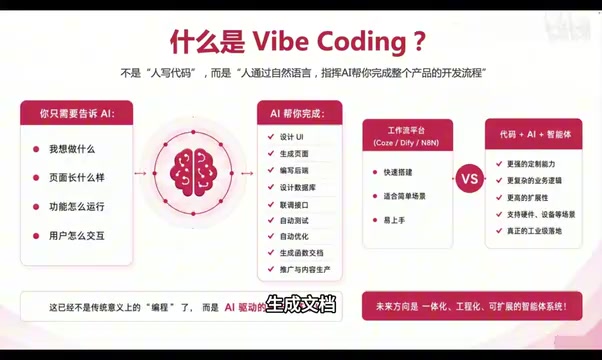
Vibe Coding Full-Stack in Practice: How One Person Builds a Commercial-Grade Product with AI
An analysis of the Bilibili course Vibe Coding Full-Stack in Practice: how one person uses AI to complete requirements analysis, frontend/backend development, MySQL databases, cloud deployment, multi-platform Mini Program execution, and AI-driven operations promotion—mastering one-person-company AI engineering product development.
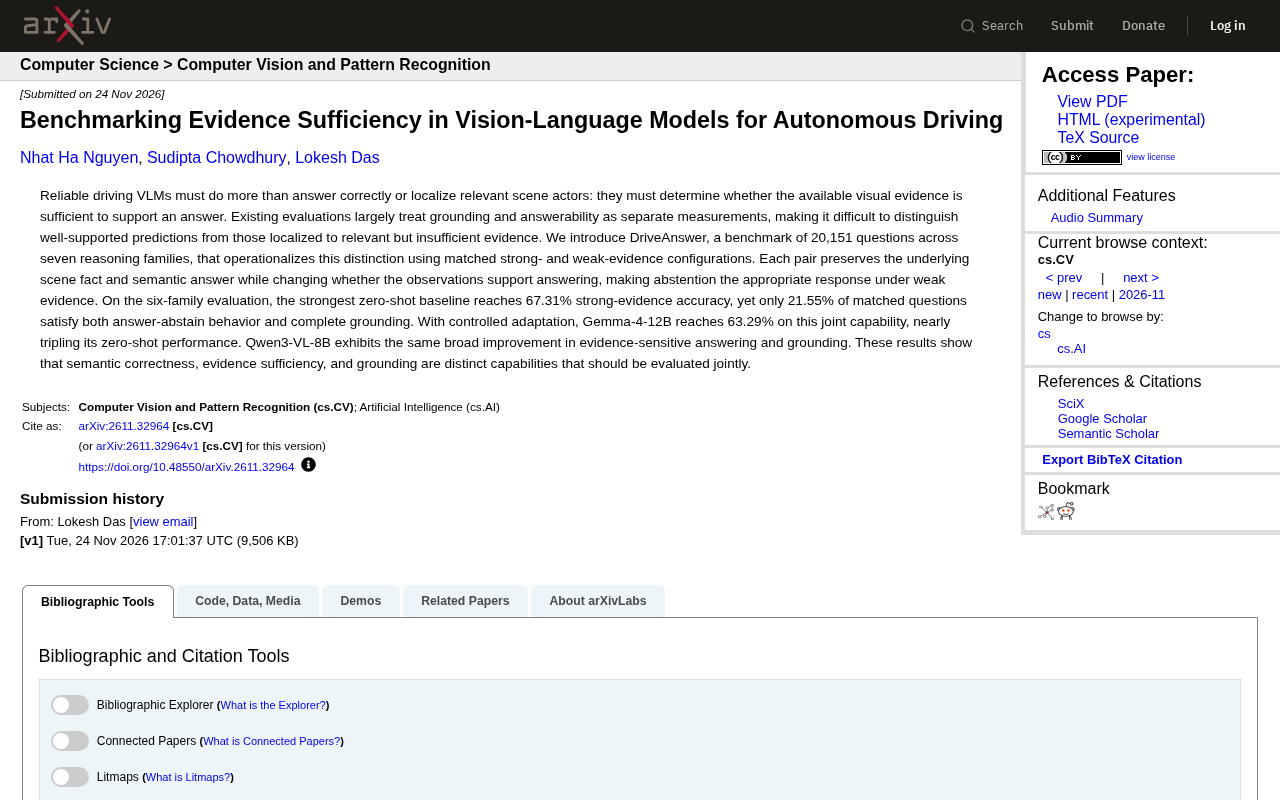
DriveAnswer Benchmark: Evaluating Evidence Sufficiency in Autonomous Driving VLMs
DriveAnswer benchmark with 20,151 questions uses strong/weak evidence pairing to jointly evaluate answer correctness, evidence sufficiency, and visual grounding in autonomous driving VLMs, revealing zero-shot joint capability of only 21.55%.