Why the A321XLR Accepts Higher Takeoff Weights on Ultra-Short Routes

Airlines accepting the A321XLR's high takeoff weight on ultra-short routes is a rational choice prioritizing fleet commonality over per-flight weight reduction.
The A321XLR enables narrowbody aircraft to fly long transatlantic routes, but airlines also accept its higher takeoff weight on ultra-short routes under an hour. This apparent contradiction stems from fleet scheduling logic: a unified performance envelope lets the A321XLR deploy freely on any segment, avoiding divergence in load planning and crew training, with scheduling flexibility worth more than per-flight weight savings. The structural weight from the permanent rear center tank (RCT) cannot be removed; airlines have already paid for long-haul capability, and short-haul routes merely amortize fixed costs. Ultra-short segments mainly serve network connectivity, with revenue from network contribution rather than per-flight profit, so sensitivity to weight and fuel is lower. The Hacker News discussion remains divided, and actual deployment patterns deserve continued attention.
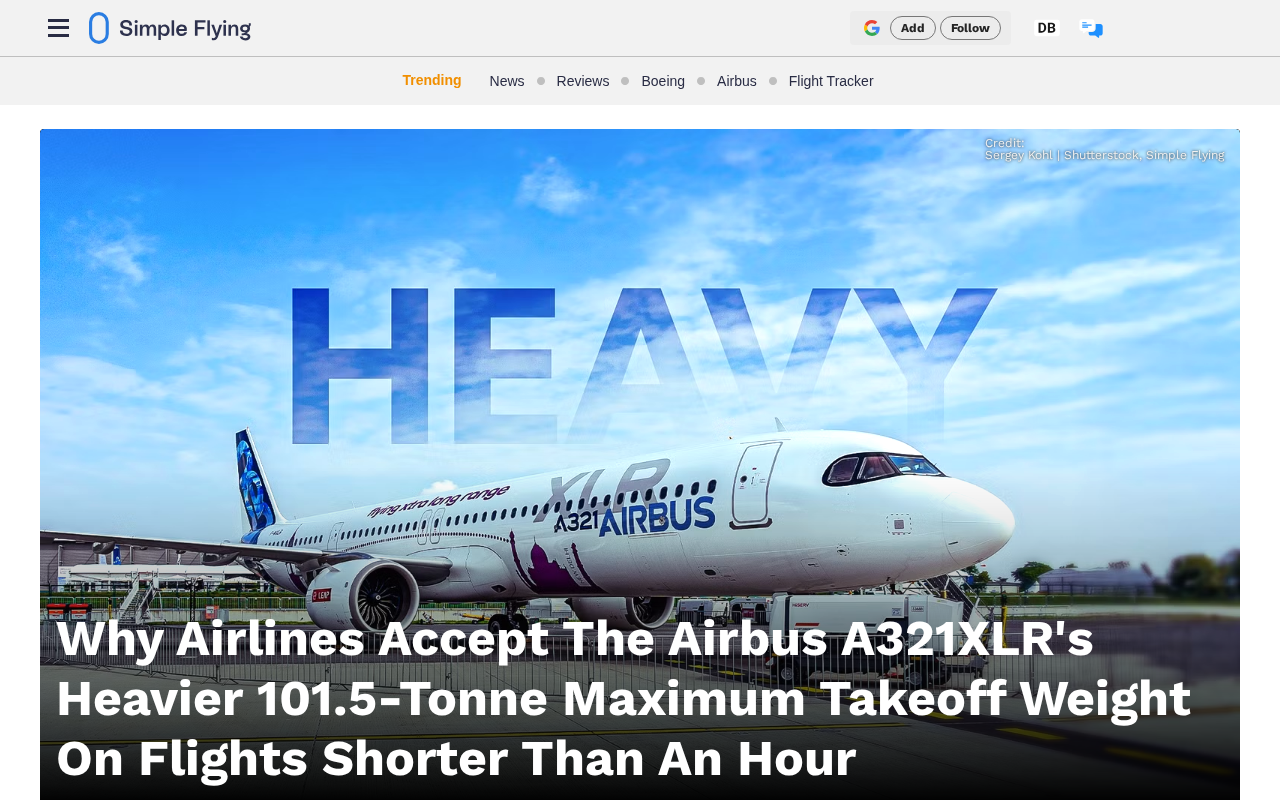
The introduction of the Airbus A321XLR has enabled airlines to operate long transatlantic routes with narrowbody aircraft, but a seemingly contradictory phenomenon is emerging: on ultra-short routes of less than an hour, airlines are equally willing to accept the A321XLR's higher takeoff weight. This involves multiple trade-offs spanning aircraft design, operational economics, and route network strategy.
The Weight Paradox on Ultra-Short Routes
To achieve greater range, the A321XLR added a permanent rear center tank (RCT) within the fuselage and increased its maximum takeoff weight. Intuitively, short-haul flights should minimize weight to reduce fuel consumption and takeoff/landing costs. Yet on segments of less than an hour, airlines have been observed accepting this higher takeoff weight limit.
This phenomenon drew attention in a Hacker News discussion, with the core question being: given the extremely short flight time, why not reduce load to obtain lower takeoff/landing fees or more flexible airport compatibility? The answer must be found in aircraft commonality and fleet scheduling logic.
Maximum Takeoff Weight (MTOW) is the maximum total weight an aircraft is permitted at the start of its takeoff roll, jointly determined by structural strength, landing gear load-bearing capacity, engine thrust, and performance limits such as airport runway length and obstacle clearance. Increasing MTOW typically means structural reinforcement of the fuselage, landing gear, and brake systems, thereby increasing the aircraft's empty weight. For airlines, MTOW is not merely a technical parameter but is directly tied to takeoff/landing fees, en-route charges, and airport compatibility: a higher weight class often means higher charges and longer runway requirements. Therefore, accepting a higher MTOW on ultra-short routes is effectively trading higher direct operating costs for fleet scheduling uniformity.
Weight reduction in aviation operations typically refers to lowering the actual takeoff weight by reducing payload (passengers, baggage, or cargo) or fuel to meet performance limits such as runway length, climb gradient, or landing distance. Weight reduction directly erodes flight revenue and requires additional load planning calculations and performance evaluation processes. For ultra-short segments, weight could theoretically be reduced by carrying less fuel, but the A321XLR's permanent structural weight cannot be eliminated through fueling strategy, which limits the economic significance of weight reduction.
Fleet Commonality Takes Priority Over Per-Flight Weight Reduction
For airlines, the value of the A321XLR lies not in optimizing a single route to the extreme but in covering a continuous spectrum from ultra-short to long-haul with the same aircraft type. If weight were specially reduced for short-haul flights, additional load planning processes, performance calculations, and crew training divergence would be required, actually driving up systemic costs.
Accepting a higher takeoff weight means airlines can freely deploy the A321XLR on any segment without changing operating standards. This "one aircraft, multiple uses" scheduling flexibility is often more valuable than the fuel or takeoff/landing fees saved on a single flight. Especially in hub airports with tight slots and frequent last-minute aircraft swaps, the significance of a unified performance envelope far exceeds the numbers on paper.
The Structural Trade-off of the RCT Tank
The A321XLR's rear center tank is a permanent structure that cannot be removed on demand like optional auxiliary tanks. This means that even on ultra-short routes, the aircraft carries structural weight prepared for long-haul flights. Airlines accepting a higher takeoff weight are, to some extent, passively adapting to this established design.
From an engineering perspective, increasing maximum takeoff weight requires stronger landing gear and structural reinforcement, and these changes also increase empty weight. Airlines have already paid for long-haul capability at the time of purchase; short-haul routes merely amortize this fixed cost rather than prompting a fresh economic calculation.
Rear Center Tank (RCT) is the key design that distinguishes the A321XLR from the previous A321neo series. Traditionally, the A321's additional fuel capacity relied on optional forward or rear auxiliary center tanks (ACT), which are installed in the cargo hold and can be removed according to route requirements. The RCT, by contrast, is a permanent structural tank integrated below the floor in the rear fuselage, designed as one with the fuselage skin and frames, and is non-removable. Its advantage is a substantial increase in fuel capacity without occupying cargo hold volume, giving the A321XLR a maximum range of approximately 8,700 kilometers. The cost is a permanent increase in structural weight that does not vary with route length. For short-haul flights, this weight is "dead weight," but airlines have already treated it as a fixed cost of long-haul capability at the time of purchase.
The Route Network and Revenue Management Perspective
Ultra-short segments often serve a connecting function within an airline's network—funneling regional passengers into hubs or providing slot coverage in high-frequency business markets. The revenue from such flights comes from network contribution rather than per-flight profit, so their sensitivity to weight and fuel consumption is lower than that of pure point-to-point routes.
Operating the A321XLR on such segments also frees up other aircraft types to perform more suitable missions. Airlines are really comparing the marginal revenue of the entire fleet, not the takeoff weight of a single flight.
Divergences and Open Questions in the Discussion
The Hacker News discussion was small in scale, and no consensus has yet formed. One view holds that this is a reasonable use of the aircraft's performance envelope; another questions whether the A321XLR is really needed on ultra-short routes rather than the lighter A320 family.
As the original discussion contains limited information, specific airline cases and operational data have not yet been fully developed. This topic deserves continued attention, especially regarding the A321XLR's actual deployment patterns in high-frequency regional markets.
One-line Summary
Airlines accepting the A321XLR's high takeoff weight on ultra-short routes is a rational choice prioritizing fleet commonality over per-flight weight reduction.
Paragraph Summary
The A321XLR enables narrowbody aircraft to operate long transatlantic routes, but airlines also accept its higher takeoff weight on ultra-short routes of less than an hour. This seemingly contradictory phenomenon stems from fleet scheduling logic: a unified performance envelope allows the A321XLR to be freely deployed on any segment, avoiding divergence in load planning processes and crew training, and its scheduling flexibility is worth more than the weight savings on a single flight. The structural weight brought by the permanent rear center tank (RCT) cannot be removed; airlines have already paid for long-haul capability at purchase, and short-haul routes merely amortize the fixed cost. Ultra-short segments mostly serve a network connecting function, with revenue coming from network contribution rather than per-flight profit, so sensitivity to weight and fuel consumption is lower. The Hacker News discussion remains divided on this, and actual deployment patterns deserve continued attention.
Related articles

GPT-6.2 Dual-Model Launch, Qwen4-Max Goes GA, and Multiple API Updates
OpenAI launches GPT-6.2 Astra and Sol dual models, Alibaba Cloud's Qwen4-Max goes GA API, Anthropic tests linked billing, DeepSeek opens search API, plus Nov 25 offline reminders.

Vibe Coding Full-Stack in Practice: How One Person Builds a Commercial-Grade Product with AI
An analysis of the Bilibili course Vibe Coding Full-Stack in Practice: how one person uses AI to complete requirements analysis, frontend/backend development, MySQL databases, cloud deployment, multi-platform Mini Program execution, and AI-driven operations promotion—mastering one-person-company AI engineering product development.

DriveAnswer Benchmark: Evaluating Evidence Sufficiency in Autonomous Driving VLMs
DriveAnswer benchmark with 20,151 questions uses strong/weak evidence pairing to jointly evaluate answer correctness, evidence sufficiency, and visual grounding in autonomous driving VLMs, revealing zero-shot joint capability of only 21.55%.