GPT-6.2 Dual Models Astra vs. Soul: Benchmark, Cost, and Selection Guide
OpenAI's GPT-6.2 Astra and Soul compared on benchmarks, cost, and use cases, plus AI news roundup.
OpenAI released GPT-6.2 variants Astra (complex delivery) and Soul (daily iteration). Same-task tests show Astra is stronger on complex and long tasks but costs more, while Soul scores less than half on coding tests at about one-fifth the cost. API pricing: Astra $8/$40, Soul $2/$10 per million tokens. Tests also reveal aggregation methodology can change conclusions, so same-task comparisons need methodology checks. The article rounds up security incidents, quota updates, Gemini Tasks, Microsoft Ignite coding tools, and Kling Image 4.0, advising Soul for daily iteration and Astra for complex delivery.
OpenAI has released GPT-6.2, introducing two variants at once: Astra, aimed at complex deliverables, and Soul, better suited for everyday iteration. Give the same task to both models and the results differ more than you might expect—this isn't just about benchmark scores, but a divergence in delivery logic, cost structure, and use cases.
Same Task, Two Delivery Approaches
In the official demo, Astra places mountain-road visuals, suspension motion, and tire loads into a single driving simulation, showcasing complex multi-element coordination. Third parties have also run comparisons on the same task. Simon Willison used Codex's Ultradown to turn cities on a map into mecha; both Astra and Soul could produce motion, but the author felt the transformation effect was less natural than Fable and Gemini Carbon—suggesting that on creative tasks, the gap between the two isn't as large as the price gap.
DataCamp's test is more telling: when the old and new Astra were asked to build a dashboard from the same employment data, the new version cost $1.79 versus $2.93 for the old—the new one is cheaper. But their aggregation methodologies differed: the new version aggregated by median per major, while the old version weighted by graduate count, causing the health category ranking to shift from fourth to tenth. Same data, same question, yet methodological differences directly change the conclusion—which is exactly why cross-validation is essential when evaluating model outputs.
Benchmarks and Cost: Where the Gap Lies
According to multi-party evaluations compiled by the Bilibili AI Daily, in the AA three-way blind evaluation, Astra scored 1318 on 55 offline interactive questions, versus 1259 for Soul; on another comprehensive index with a different question set at the same top reasoning tier, the two scored 62 and 57 respectively. On long tasks, Astra has a cost advantage: in OpenAI's Agent's Last Exam comparison, the new Astra costs about $2.89 per question, versus nearly $9 for the old Astra.
But on Cognition's coding test, Soul reportedly scores less than half of Astra while costing only about one-fifth per question. On standard API pricing per million tokens, Astra is $8 input / $40 output, while Soul is $2 input / $10 output.
This data points to a clear selection logic: for routine code changes, start with Soul; for complex deliverables, test Astra against your own tasks. The Pro 200 fast tier this round goes to Soul first, reinforcing the strategy of prioritizing lightweight models for everyday scenarios.
AA Blind Evaluation and Composite Index
The AA blind evaluation mentioned in the article (possibly referring to Artificial Analysis or a similar evaluator) is a method where models answer the same set of questions without knowing their own identity, reducing bias from brand preference. The composite index weights and aggregates scores from multiple benchmarks into a single number for easy horizontal comparison. The gap between 1318 and 1259 is about 4.7%, a moderate difference, but combined with the cost gap, cost-effectiveness must be weighed when selecting.
Agent's Last Exam and Long-Task Cost
Agent's Last Exam is a benchmark targeting agent long-task execution, requiring models to complete complex goals through multi-step interaction. The new Astra costs about $2.89 per question versus nearly $9 for the old Astra, showing that model iteration significantly reduces inference overhead while maintaining or improving capability. This cost reduction is especially important for teams that need to run long tasks in batches.
Security Incident and Quota Adjustments
Wiz confirmed that npm versions 1.26.1 and 1.26.2 carried credential-stealing payloads and were taken down around 5:30 AM. Teams using Microsoft Agent Framework should check dependencies first today—search files, pipelines, and images; environments that ran affected versions should be isolated and potentially exposed credentials rotated.
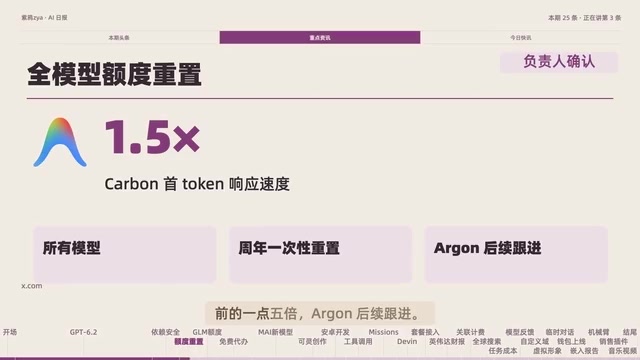
On quotas, the Anti-Gravity lead confirmed a one-year anniversary quota reset for all models; Carbon's first-token response speed increased to 1.5x, with Argon following up. The most direct effect is faster response starts. OpenCode's GLM campaign has entered phase two: $10 corresponds to $200 worth of GLM 5.3 usage, double the first phase—existing subscribers can check whether their quota page has updated.
Tool Ecosystem: From Task Agents to Development Environments
Gemini Tasks is now free in the US, Japan, South Korea, Canada, Australia, and India—you can have it contact repair shops and put available appointments into your calendar, with SMS and forwarded-email entry points starting in the US. For shopping, you can set spending limits, and key purchase steps will request confirmation or pre-authorization. Over 60 apps are officially integrated.
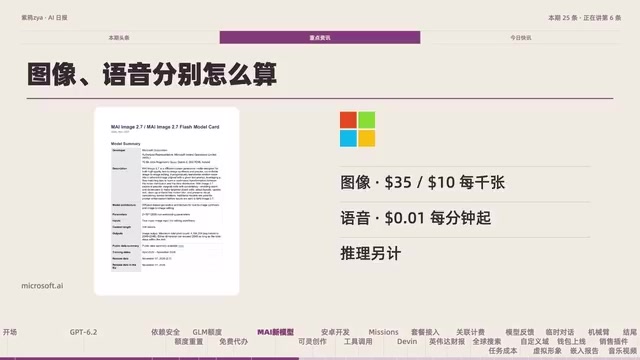
At Microsoft Ignite this round, coding comes first: MacCode R and Flash are now in GitHub Copilot—the former excels at cross-file edits, and Flash enters the free tier. MaiImage 2.7 and Flash are in public preview on Foundry, with official sample pricing around $35 and $10 per thousand images. RealTime 1 voice starts at 1 cent per minute base price, with inference billed separately.
Kling Image 4.0's official samples highlight three things: native 8K leaves room for cropping, up to 2,000 yuan per image; a single prompt can generate up to ten coherent images in a series. Actual API resolution should be verified against the channel you use. Google AI Studio updated Android development—the browser emulator supports HD and audio, Firerace can handle login and cross-device data sync, and in the US you can publish apps to your personal Play library and install them on your phone.
Cloud Code's Code Mode is an experimental preview that lets you write a script to chain multiple tool calls, and you can continue the conversation while long commands run. It requires native version 2.1.323+ and an interactive terminal; desktop and VS Code panels aren't supported this round.

Replete Missions writes target spending caps and actions requiring approval together, then lets agents work in parallel. In the official case, a self-hosted monitoring tool called DataCat was built and open-sourced within two days and a $3,000 budget; it stops at the budget cap, and tasks are still judged by acceptance criteria. DevinBot targets continuous engineering goals—one bot runs tests and finds issues, another picks up to fix code, and teams can follow along in Slack. Both are worth watching, but actual value depends on how teams define permissions and acceptance.
Code Mode and Tool-Call Orchestration
Code Mode is an experimental feature that allows users to write scripts chaining multiple tool calls into reusable workflows. Compared with traditional one-by-one calls, it reduces interaction rounds, improves long-command execution efficiency, and supports continuing the conversation while commands run. It currently requires native version 2.1.323+ and must be enabled in an interactive terminal; desktop and VS Code panels aren't supported yet.
Other Quick Updates
OpenCloud announced that ChatGPT login has ended testing—you can connect using an existing ChatGPT plan, officially confirmed to include Business and both GPT-6.2 models. NVIDIA reported Q3 FY2027 revenue of $115.8 billion, up 103% year-over-year, with data center revenue of $107.6 billion (about 93% of total); summer guidance is around $130 billion ±3%, including an extra week and excluding China data-center compute revenue. Cloud-linked billing has entered beta—when using integrations like Factory or Linear, you can authorize payment by your own Cloud organization without handing over API keys; app spending can be capped and authorization revoked.
Google confirmed Hydrogen is now live globally in Search, with demos showing finer search decomposition, links, and visual results. Perplexity Search and Computer have also integrated the two new models; in their own WNDR evaluation, Astra costs about 12.5 yuan per question versus 2.65 for Sol, while retaining actual scores for both. The lead confirmed Altman will prioritize improving the new models' collaboration experience—a response worth comparing against the same-task demos above, including whether the models clearly articulate key difficulties.

Google AI Studio's Build can connect custom domains, suitable for users who need to turn prototypes into official websites; check the publishing panel for binding and pricing conditions. GoogleViz offers free personal avatars for personal accounts—generate a virtual character from a selfie and voice sample, then input narration. Google Search's AI Mode adds temporary conversations, accessible from the top right; temporary generations don't use history or personalize with old preferences. US iOS users can now manage tickets and purchase records with Google Wallet. Google has published the technical report for Embedding Gemma 2, explaining how to map text, images, audio, and video into the same space and how the model was made more compact. DeepMind demonstrated the Anti-Gravity robotic arm plugin, which works with Hydrogen—first rehearsing in Mujoco, then handing tasks to compatible physical robotic arms. ChatGPT posted today showcasing the Ceos plugin, which connects CRM, meeting notes, and follow-up tools. Zuno released Visuals examples today: entering Create Visual from a song can produce 5–15 second clips, generated using separate visual credits.
Multimodal Embeddings in Embedding Gemma 2
Embedding Gemma 2 is Google's embedding model that maps text, images, audio, and video into the same vector space, enabling cross-modal retrieval and similarity computation. The technical report focuses on how the model maintains compactness for edge devices and on training strategies for multimodal alignment. This is valuable for building unified search, recommendation, or multimodal RAG systems.
Selection Recommendations
The core difference between the two models isn't whether they can do the job, but the cost and delivery certainty of doing it. For everyday iteration, quick code changes, and batch tasks, prioritize Soul; for complex deliverables, multi-element coordination, and long tasks, use Astra. Third-party tests have already exposed a key reminder: when comparing on the same task, always check aggregation methodologies and evaluation conditions—otherwise score differences may be amplified by methodological noise. The truly reliable way to judge is to run your own real tasks on each and compare delivery quality against per-run cost.
One-line Summary
OpenAI releases GPT-6.2 variants Astra and Soul; same-task tests reveal differences in delivery logic and cost structure, plus a roundup of security incidents and tool ecosystem updates.
Paragraph Summary
OpenAI launched two variants of GPT-6.2: Astra (for complex deliverables) and Soul (for everyday iteration). Third-party same-task tests show Astra is stronger on complex and long tasks but costs more, while Soul scores less than half of Astra on coding tests at about one-fifth the cost. API pricing: Astra $8 input / $40 output per million tokens; Soul $2 input / $10 output. DataCamp's test also found that different aggregation methodologies lead to different conclusions, reminding that same-task comparisons require checking methodology. The article also covers the npm security incident, quota adjustments, free Gemini Tasks, Microsoft Ignite coding tool updates, Kling Image 4.0, and more, with selection advice: use Soul for everyday iteration, Astra for complex deliverables.
Related articles

Daybreak Red Deployment Guide: A Reference Architecture for Supervised Security Investigation
A breakdown of the Daybreak Red reference architecture: security control design, deployment configuration process, and runtime monitoring for supervised security investigation.

Gemini 4 Neon Tops the Models Engineering Index
Gemini 4 Neon tops the Models Engineering Index, sparking Hacker News debate over ranking credibility and evaluation methods. Here's what it means for developers.

Apple's Self-Developed AI Agent: An Agent That Can Operate Your Mac Is Coming
Apple is reportedly developing an AI agent that can operate a Mac, targeting Meta Muse, Claude, OpenAI Dots, and others. This article analyzes Apple's system-level advantages, the competitive landscape, and likely rollout paths in the agent race.