GPT-6.2 Dual Release: Microsoft's Coding Models and Speech AI Gain Momentum
Model competition shifts to deployment: GPT-6.2 splits, Microsoft launches three lines, engineering details matter more than parameters.
OpenAI splits GPT-6.2 into Astra and Sol product lines, targeting professional work and everyday coding/agent tasks respectively; Microsoft simultaneously launches MAI Code 2, Flash, MAI Image 2.7, and its first speech-to-speech model MAI Realme. The article notes that the common signal of this round of updates is the competitive focus shifting from parameter scale to deployment capability. Frontier Harness 1.1's comparison shows that the same model with a different runtime framework changes both pass rate and cost, so migration requires checking interfaces, tool calls, and billing rules. SenseTime's Sense Nova Loop uses recurrent architecture to control parameter scale, while Garlic LLM runs a 9-billion-parameter model on a PS4 GPU, exploring new paths in architectural reuse and hardware utilization.
OpenAI's GPT-6.2 splits into two product lines, Astra and Sol, while Microsoft simultaneously rolls out MAI Code 2, MAI Image 2.7, and the speech model MAI Realme. This round of updates may look like routine model iteration, but it actually pushes the question of "how to use models" to the forefront—interfaces, runtime frameworks, billing methods; if any link is misaligned, switching models can turn into a pitfall.
GPT-6.2 Split into Two Usage Modes
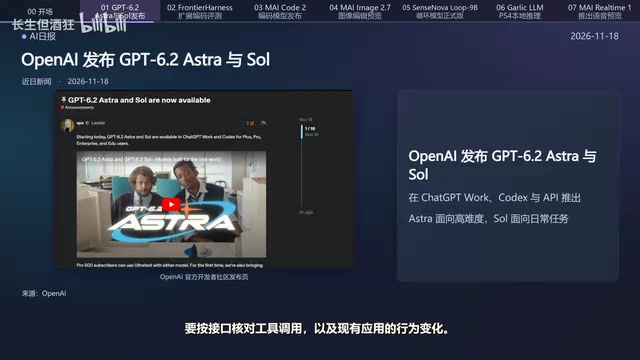
The positioning of Astra and Sol is clear. According to Bilibili AI Daily's breakdown, Astra targets harder professional work, while Sol focuses on everyday coding and agent tasks. Both models simultaneously enter ChatGPT, Work, Codex, and the API, covering multiple entry points from conversation to programming.
For developers, what truly needs preparation ahead of time isn't model capability but the migration process. The daily report reminds that during migration, tool calls should be checked against the interface, as well as behavioral changes in existing applications. The same model connected to different product forms doesn't have entirely consistent invocation methods; directly replacing the model name often causes problems in the tool-calling phase.
Before Switching Models, Check the Runtime Framework
Frontier Harness version 1.1 does something easily overlooked: it compares 22 runtime frameworks alongside 5 models. The results show that the same model with a different tool environment changes both pass rate and cost.
The practical significance of this conclusion is that when developers evaluate models by looking only at the model's own benchmark scores, they can easily underestimate or overestimate actual performance. The daily report also notes that the results in the image correspond only to specific tasks, versions, and evaluation settings, and cannot be directly applied to one's own scenarios. Checking the runtime framework alongside model switching is becoming a necessary step.
Runtime Framework (Harness) refers to the entire set of tool invocation, prompt orchestration, memory management, and execution environment wrapped around the model. It determines which tools the model can call, how returned results are parsed, whether retries occur after failure, and how multi-turn tasks are organized. The same underlying model connected to different Harnesses can perform significantly differently, because model outputs need to be correctly parsed and executed by the framework—any change in parsing rules or tool descriptions affects the final pass rate. The value of horizontal comparisons like Frontier Harness is that it separates "model capability" from "engineering implementation," reminding developers: when switching models, if you keep the old framework, you may misjudge model quality due to mismatched tool-calling formats. Therefore, during evaluation, tasks and evaluation settings should be fixed, and framework versions recorded, to obtain reproducible conclusions.
Microsoft's Three Product Lines
Microsoft this time launches two coding models, MAI Code 2 and Flash, with equally clear division of labor: MAI Code 2 targets multi-file implementation and debugging, while Flash targets high-frequency tasks such as explaining code and targeted modifications.
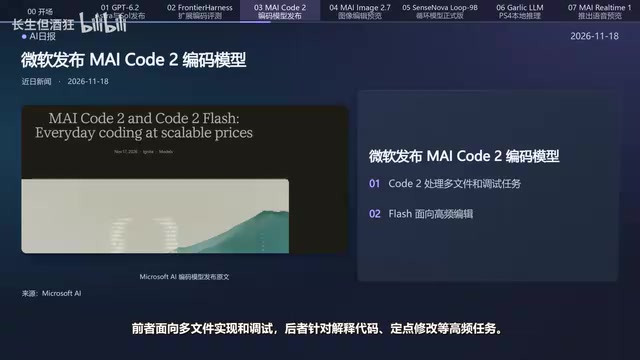
Microsoft focuses on enterprise everyday coding; the price and performance figures come from specific evaluation teams, and the daily report's recommendation is to validate on your own codebase. This reminder has practical significance—multi-file refactoring and single-point modifications test models completely differently, and evaluation team samples may not equal the complexity of real enterprise codebases.
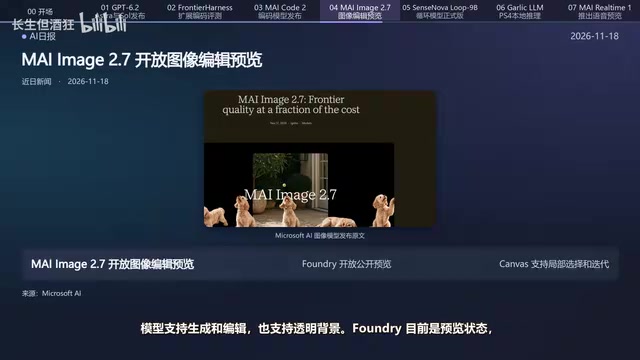
On the image side, MAI Image 2.7 and Flash enter public preview, alongside the launch of Canvas, letting users select image regions in the same space to continue modifying and iterating. The model supports both generation and editing, as well as transparent backgrounds. Foundry remains in preview status; usage costs should be checked against image specifications and actual billing.
On the speech side, MAI Realme is Microsoft's first direct speech-to-speech model, also entering preview. It can handle interruptions and connect to enterprise tools to complete tasks. Base speech starts at one per minute, with in-depth reasoning billed separately; access requires registration for limited preview. In speech interaction, "being interruptible" may seem like a small feature, but it actually determines whether conversations can flow naturally.

Speech-to-Speech models differ from traditional cascaded approaches of "speech recognition → text model → speech synthesis" by directly using audio as input and output, reducing latency and information loss from intermediate text conversion. This architecture is naturally suited to handling interruptions: when users interject mid-conversation, the model can adjust its response in real time without waiting for the entire speech segment to be transcribed. However, direct speech models have higher requirements for training data and inference compute; enterprises typically adopt limited previews when integrating, and are billed separately by base speech duration and in-depth reasoning. Microsoft MAI Realme's pricing model reflects this trend—separating real-time conversation and complex reasoning into distinct billing categories.
SenseTime and Garlic LLM: Two Explorations in Architecture and Hardware
SenseTime releases the official version of the Sense Nova Loop 9-billion-parameter model, with the idea of increasing computational depth by repeatedly executing some layers while controlling the scale of stored parameters. The official version retains the recurrent architecture and reports improvements on coding and agent tasks; the public model card is readable, and downloading weights requires meeting the repository's access conditions.
Another path comes from this week's Garlic LLM project: running a 9-billion-parameter model on the PS4's GPU, capable of offline chatting and connecting to some speech tasks. The project requires a compatible modified console environment; the author has not yet verified PS4 Pro running speed, and actual performance is affected by version and settings. These two projects point in the same direction—not relying on stacking parameters, but finding space through architectural reuse and hardware utilization.
Recurrent Architecture refers to models repeatedly executing some layers during inference, passing the same parameters through the same set of network layers multiple times to increase computational depth, rather than increasing parameter count to boost capability. This approach is like unfolding computation along the time dimension, gaining deeper representational capability under constrained parameter counts, but it also increases single-inference latency and memory usage. SenseTime's Sense Nova Loop applies this idea to a 9-billion-parameter model, aiming to improve coding and agent task performance while controlling stored parameter scale. For developers, recurrent models' weight loading and inference frameworks require specialized adaptation and cannot simply reuse standard Transformer deployment processes.
The Common Signal of This Round of Updates
Looking at these pieces of news together, the competitive focus of model vendors is shifting from "how many parameters" to "how to land in practice." Astra and Sol divide by task, Microsoft's three models position by scenario, SenseTime uses recurrent architecture to control scale, and Garlic LLM runs local inference on existing hardware. For users, engineering details beyond model selection—interface verification, runtime frameworks, billing rules—are becoming as important as model capability itself.
Related articles
Perplexity Launches Orchestrator API: Unified Multi-Model Access with Failover
Perplexity releases the Orchestrator API, enabling single-endpoint access to OpenAI, Anthropic, Google, xAI, and open-weight models with same-model provider failover, unified billing, and a preview perplexity/auto auto-routing option.
13 Best Agent Gateways in 2026: MCP, A2A, and LLM Traffic Governance
MarkTechPost ranks the 13 best Agent gateways in 2026 by model traffic, MCP tool traffic, and A2A traffic governance, covering Kong, Bifrost, AgentCore, Arcade, with verified pricing and deployment options, revealing trade-offs omitted from vendor marketing.
Google Gemini Comes to Mac: AI Agent Now Operates Your Computer for You
Google's latest Gemini update brings AI agent capabilities to Mac, letting it organize files, fill forms, and handle multi-step workflows—moving AI from conversation to operating your computer.