GPT-6 Astra: AI Competition Shifts from Best Answers to Workflow Ownership
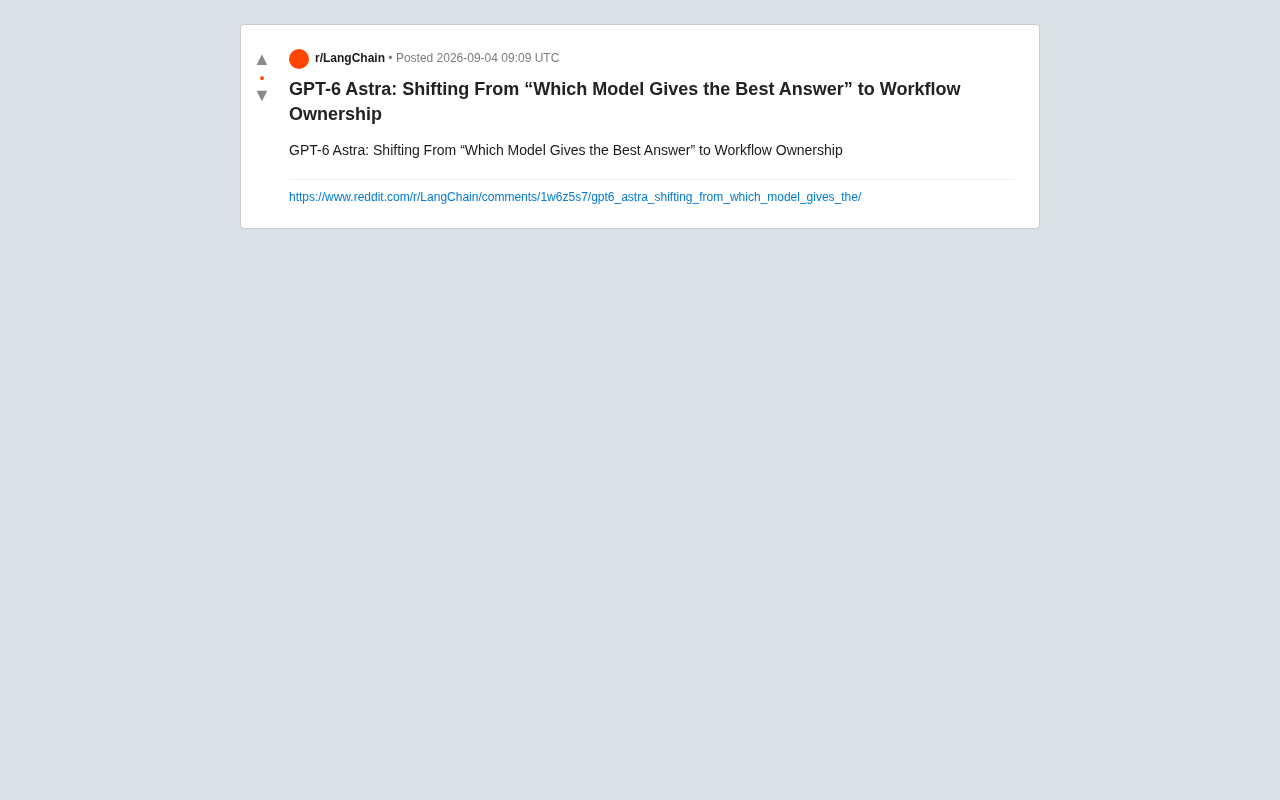
AI competition is shifting from best answers to owning and executing entire workflows.
The AI model race is undergoing a paradigm shift—from competing on single-answer quality to battling for workflow ownership. Discussions around GPT-6 Astra highlight how next-gen AI aims to decompose tasks, orchestrate tools, and close execution loops autonomously. This transforms AI from a passive Q&A tool into an active workflow agent, reshaping how users, developers, and enterprises interact with and build on AI systems, while raising critical challenges around reliability, controllability, and explainability.
From "Q&A Tool" to "Workflow Owner"
For the past two years, the competitive focus among large AI models has centered almost entirely on one question: "Which model gives the best answer?" Whether it's GPT-4, Claude, or Gemini, the criteria users and developers use to judge them have typically revolved around single-conversation response quality, reasoning depth, and factual accuracy.
However, discussions surrounding the rumored next-generation model "GPT-6 Astra" are revealing a deeper paradigm shift—the core of competition is moving from "answer quality" to "Workflow Ownership."
This shift means AI is no longer just a passive machine waiting to be asked questions. Instead, it is gradually evolving into a "workflow agent" capable of proactively understanding the full scope of a task, planning execution steps, invoking tools, and continuously following up on results. In other words, a model's value is no longer just about what it "says," but about what it "can accomplish for you."
Why the "Best Answer" Alone Is No Longer a Moat
As foundational model capabilities have broadly improved, the gap in answer quality among mainstream large models for most common tasks is rapidly narrowing. Between 2023 and 2025, the large model space experienced what's known as "capability convergence." As key technical approaches—Transformer architectures, RLHF (Reinforcement Learning from Human Feedback), MoE (Mixture of Experts)—were widely adopted across major vendors, and as high-quality training data sources increasingly overlapped, the score gaps among mainstream models on standard benchmarks like MMLU and HumanEval shrank from initial double-digit percentages to single digits or even within the margin of error. For ordinary knowledge Q&A, text generation, and code snippet writing, the performance across models has become largely homogenized. Under these circumstances, the strategy of purely competing on "who has the better answer" is gradually losing its differentiation value in both business and technical terms.
The real pain point is emerging: what users need is often not an isolated perfect answer, but a coherent end-to-end task execution capability.
For example, a marketer doesn't just want "write me some copy." They want "analyze my product data, generate multiple copy versions, provide A/B testing recommendations, and integrate everything into my existing publishing workflow." This kind of demand spans multiple steps, multiple tools, and multiple contexts—something a single Q&A exchange simply cannot accommodate.
Three Layers of Workflow Ownership
From the ongoing discourse, we can distill several key layers of "Workflow Ownership." The concept itself originates from the "System of Record" paradigm in enterprise software. In traditional SaaS competition, whoever controls the data and processes of a company's core workflows commands the deepest customer stickiness—this is why platform companies like Salesforce and SAP are valued far higher than point-solution tools. Applying this logic to the AI domain means a model's commercial value no longer depends on the quality of a single inference, but on whether it can embed itself in and dominate the user's core business processes, becoming an irreplaceable "execution hub."
Task Decomposition: Can the model automatically break down a vague high-level goal into executable subtasks? The technical implementation of this capability relies on a combination of cutting-edge methods—Chain-of-Thought prompting techniques have taught models to decompose complex problems into reasoning steps, while more advanced Plan-and-Execute architectures introduce hierarchical planning mechanisms where models first generate high-level task graphs, then progressively refine them into atomic executable operations. Stanford University's Generative Agents research demonstrated that when models possess Reflection and Planning capabilities, their task completion rates can improve several-fold. This direction also echoes classical AI concepts like STRIPS planners and Hierarchical Task Networks (HTN), signaling an ongoing convergence between deep learning and symbolic AI planning methodologies.
Tool and Context Orchestration: Can the model proactively invoke external tools, access historical context, and maintain state consistency throughout the task? The development of tool-calling capabilities has followed a clear technical evolution—from the earliest ChatGPT Plugins, to OpenAI's Function Calling mechanism, to Anthropic's MCP (Model Context Protocol)—the industry is moving from a paradigm of "models occasionally using tools" to "models as tool orchestration centers." MCP is particularly noteworthy, as it attempts to establish a standardized connection layer between AI models and external data sources and APIs, similar to how the USB protocol provides a unified interface for hardware devices. Context orchestration, meanwhile, involves the coordinated operation of RAG (Retrieval-Augmented Generation), long context windows (such as Gemini's million-token window), and external memory storage to ensure the model doesn't "forget" prior information during multi-step tasks.
Closed-Loop Follow-Through: Can the model verify results after execution, detect deviations, and autonomously correct course, rather than going "silent" after a one-time delivery? Closed-loop follow-through is the critical dividing line between an "advanced chatbot" and a "true AI Agent." Technically, this involves mechanisms like Self-Evaluation, Error Detection, and Autonomous Retry. Typical implementation frameworks include AutoGPT, BabyAGI, and the more mature LangGraph, which introduce an "observe-think-act-feedback" loop structure that allows models to review outputs after execution, compare them against expected goals, identify deviations, and adjust strategies. This is essentially the application of the Negative Feedback Loop concept from control theory to the execution framework of large language models.
Together, these three layers constitute the capability leap from "answer provider" to "workflow owner."
The Technical Direction GPT-6 Astra Represents
The codename "Astra" itself carries a metaphor of "celestial navigation"—suggesting the model will serve as a navigator for users in the ocean of complex tasks, rather than merely a map consulted during the voyage. The core of the discussion around it isn't about some new benchmark score, but whether it can truly "hold" and drive a complete workflow.
This means the model needs stronger long-term memory, more reliable multi-step reasoning, and deeper integration with external systems. Compared to pursuing answer precision on a single difficult problem, the far more formidable and valuable challenge is how to keep AI stable, controllable, and trustworthy across tasks spanning dozens of steps over hours or even days.
What This Means for Users and Developers
For end users, this shift means their interaction with AI will fundamentally change—from high-frequency micro-management of "constantly asking questions and repeatedly correcting," to a higher-level management mode of "setting goals, delegating execution, and reviewing results." The user's role becomes more like that of a "principal," while AI serves as an "agent" capable of assuming responsibility.
For developers and enterprises, this also redefines the approach to product building. The era of building applications around single API calls may be passing, replaced by Agent systems that can support complete business processes with persistent state and autonomous action capabilities. In fact, the Agent concept has rapidly moved from academic discussion to industrialization. OpenAI's Operator product launched in early 2025, Anthropic's Computer Use feature, Google DeepMind's Project Mariner, and Microsoft's strategy of deeply embedding Copilot across the entire Microsoft 365 suite are all concrete manifestations of the battle for workflow ownership. In the enterprise market, products like Salesforce's Agentforce and ServiceNow's AI Agents indicate that traditional SaaS giants are also actively integrating AI Agent capabilities into existing business processes. According to McKinsey estimates, the proportion of knowledge worker tasks that AI Agents could automate may reach 60%-70%—this potential is the core economic driver pushing the entire industry toward this shift.
Challenges and Concerns
While workflow ownership is an enticing prospect, it also introduces new problems. As AI gains increasing execution authority, reliability, controllability, and explainability become critically important. A model that merely "answers a question wrong" has limited impact, but one that "incorrectly executes an entire workflow" can cause real business losses.
When AI upgrades from "advisor" to "executor," the risk level of its failure modes escalates accordingly. On the reliability front, current models still suffer from "hallucination"—confidently generating content that appears plausible but is actually incorrect. In multi-step tasks, small errors in individual steps accumulate progressively, creating a so-called "error snowball effect" that ultimately drives the entire workflow off course. On the controllability front, the industry is exploring "Human-in-the-Loop" mechanisms—setting up human approval checkpoints at critical decision nodes to preserve AI's execution efficiency while ensuring human final control over major decisions. On the explainability front, regulators like the EU AI Act have explicitly required that high-risk AI systems must be auditable, posing a serious challenge to "black box" end-to-end Agent systems.
Therefore, how to establish effective oversight, auditing, and intervention mechanisms while granting AI greater autonomy will be a defining issue for the next phase. Finding the balance between autonomy and controllability has become the thorniest design trade-off in engineering implementation. Building trust no longer depends on the correctness of a single answer, but on the transparency and reliability of the entire execution process.
Conclusion
From "which model gives the best answer" to "who can own your workflow"—this is not merely a shift in competitive dimensions, but a profound evolution in AI product philosophy. Whether the discussions around GPT-6 Astra ultimately materialize or not, they clearly outline the direction the industry is heading: AI's value is moving from "demonstrating intelligence" to "assuming responsibility."
The true winners of the future may not be the models with the most impressive answers, but the systems you feel most confident handing an entire job over to.
Related articles

M&M's Spent Millions Replacing Artificial Blue Dye — Why Is It So Hard?
Mars spent millions trying to replace artificial blue dye in M&M's with spirulina, but thick material clogs pipes and residue risks mold, forcing a full production-line rebuild. Here's the engineering behind the reformulation.
Teammate Wanted for Meta Global AI Developer Hackathon: Computer Vision & Medical AI
A Reddit developer seeks teammates for the Meta Global AI Developer Hackathon, focusing on computer vision and medical AI. This article analyzes the track logic, skills-complementarity needs, and topic selection strategy behind this teaming signal.
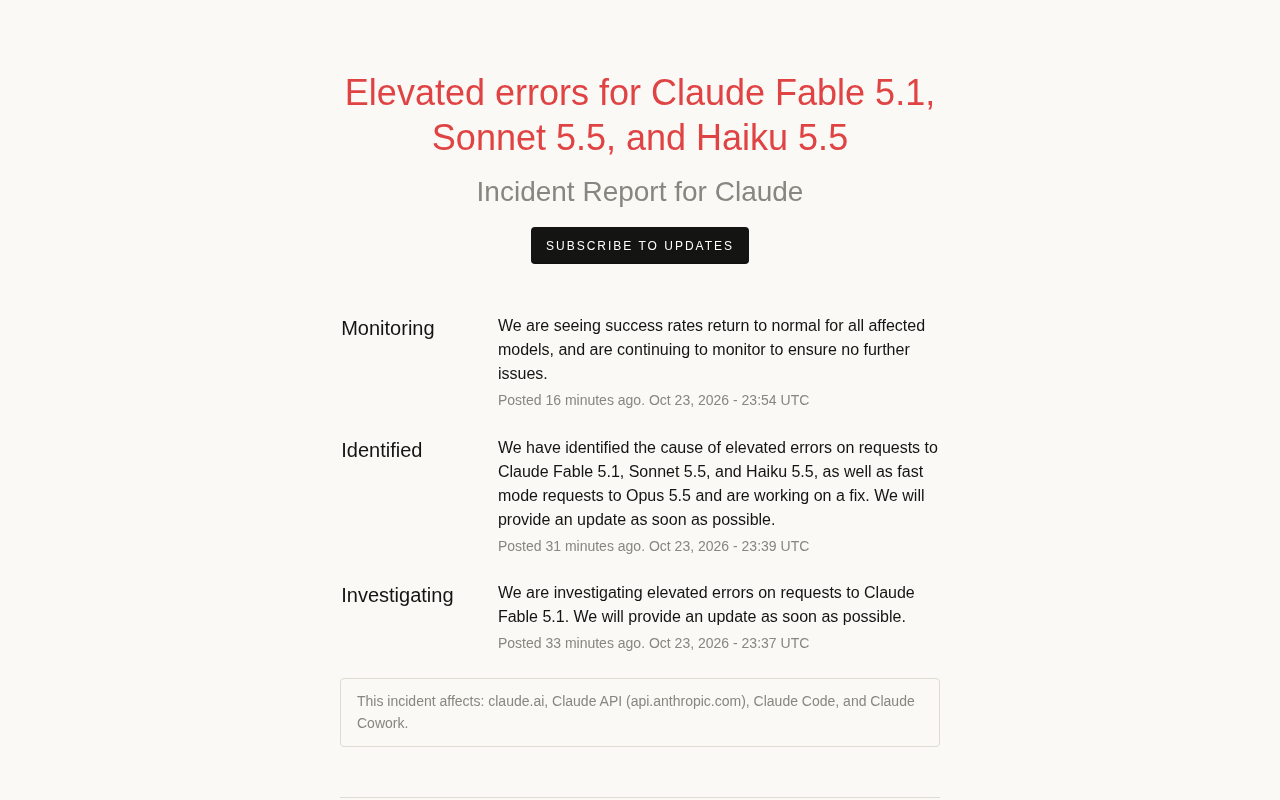
Multiple Claude Models Hit by Errors: A Postmortem of Fable 5.1, Sonnet 5.5, and Haiku 5.5
Claude Fable 5.1, Sonnet 5.5, Haiku 5.5, and Opus 5.5 fast mode saw elevated errors; Anthropic identified and resolved the issue in 17 minutes. This postmortem covers the timeline, the technical reasons for the multi-model cascading failure, and practical lessons for retry and degradation strategies.