GPT-6 Astra Builds a Full E-commerce Site from One Prompt: A Complete Workflow Breakdown

GPT-6 Astra + Codex + Higgsfield CLI turns one prompt into a complete e-commerce site with AI visuals and video.
Developers Digest demonstrated how GPT-6 Astra generates a full yoga apparel e-commerce site from a single prompt — with AI product photography, click-through product pages, and an AI video Hero — using Codex for page logic and Higgsfield CLI for media assets. Genjutsu's video re-versioning capability further enables one creative video to be adapted into multiple localized market versions at scale. The workflow signals AI's shift from coding assistance to end-to-end digital product delivery, though real-world gaps around licensing, performance, and maintainability remain.
From One Sentence to a Complete E-commerce Website
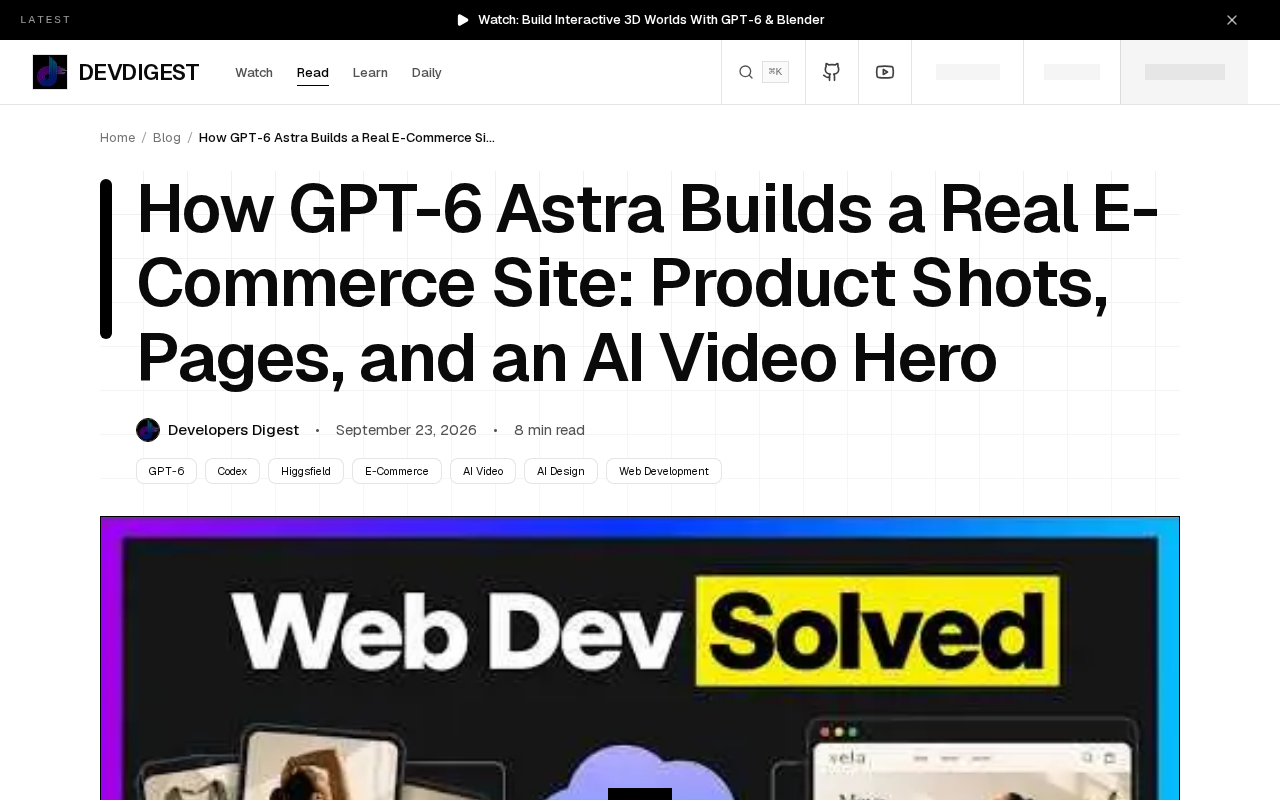
The latest episode from Developers Digest demos an impressive scenario: feed a single prompt to GPT-6 Astra, and get a fully functional yoga apparel e-commerce website in return. This isn't just a landing page template — it's a complete package that includes AI-generated product photography, click-through product detail pages, and a custom AI video as the above-the-fold Hero.
The entire pipeline is orchestrated through Codex and Higgsfield CLI, compressing what would typically take designers, photographers, and frontend engineers several days into a single conversational generation session. It's a telling signal that AI is moving beyond "coding assistance" into genuine end-to-end product delivery.
Workflow Breakdown: Three Key Deliverables
Based on the verified workflow from the video and accompanying documentation, the Astra-generated storefront consists of three main components — each replacing a type of work that previously required dedicated human effort.
Product Photography: AI-Generated, Not Shot
In traditional e-commerce launches, product imagery is typically one of the biggest cost and time sinks. In this workflow, product photography is entirely AI-generated, outputting ready-to-use visuals for product listings. For a category like yoga apparel — where texture, fit, and wear aesthetics all matter — whether AI-generated images can meet the quality bar needed to drive conversions is one of the central questions this workflow raises.
Product Detail Pages: Real, Clickable Pages
Astra doesn't produce static mockups — it generates actual click-through product detail pages. That means the output already has basic site structure and interaction logic baked in. Users can navigate from the homepage into individual product pages, completing a full browsing path rather than looking at an isolated visual concept.
AI Video Hero: A Dynamic Above-the-Fold Experience
The site's homepage features a custom AI-generated video as its Hero content. Compared to a static banner, a video Hero does far more to convey brand atmosphere. This video is also AI-generated and integrated into the overall build pipeline via Higgsfield CLI.
Codex and Higgsfield CLI: Turning Isolated Capabilities into a Pipeline
Point solutions for AI generation — writing code, generating images, generating video — aren't new. The real value lies in chaining them into a reusable pipeline. In this case, Codex handles code generation and page logic, while Higgsfield CLI manages the generation and integration of media assets (images and video).
This kind of command-line toolchain makes the entire site-building process feel more like the engineering workflows developers already know — scriptable, reproducible, and iterable — rather than a one-shot black-box output. For developers, that has far more practical production value than pure conversational generation.
Codex is OpenAI's code generation model, capable of interpreting natural language instructions and producing runnable code snippets or complete project structures. Its core strength lies in translating developer intent into HTML/CSS/JavaScript and even backend logic — without requiring line-by-line authoring. Higgsfield is a company focused on AI video and image generation; its CLI (command-line interface) tool lets developers invoke media generation APIs through scripts, bringing image and video asset production into automated build pipelines. The key advantage of a CLI over a GUI is programmability — developers can embed media generation steps directly into a Makefile or CI/CD pipeline, automatically regenerating assets whenever changes are made. The real significance of combining these two tools is that code generation and media generation are no longer two isolated manual steps — they can be triggered together through a single script, enabling truly end-to-end automated site building.
Genjutsu: Re-versioning One Video for Every Market
The video also highlights a Genjutsu capability: "re-versioning" a single video to produce market-specific variants. For teams running cross-border e-commerce or multi-region operations, this directly addresses the challenge of scaling localized creative assets — the same hero video can be rapidly adapted into multiple versions tailored to different languages and regional preferences, without any reshooting or re-editing.
If this capability holds up in practice, it means marketing asset production can shift from "one video at a time" to "one video, many versions at once" — significantly reducing content costs for multi-market campaigns.
Video "re-versioning" is an emerging direction in AI video tooling. The technical foundation involves preserving the original video's camera movement, scene composition, and visual style while swapping out subtitle text, voiceover language, on-screen text elements (like price tags or product names), and even adjusting color grading or talent faces to match specific market preferences. Compared to traditional localization workflows (re-recording voiceovers, manual post-production), AI re-versioning delivers its cost advantage most clearly at scale — the marginal cost of adapting a single video trends toward zero. For e-commerce sellers needing to cover multiple language markets simultaneously, this means spinning a primary video into dozens of localized variants for parallel testing, dramatically compressing the timeline from creative concept to live campaign.
Realistic Limitations Worth Noting
It's worth keeping perspective here: demo videos tend to showcase the best-case path under ideal conditions. There's still a meaningful gap between "generating a decent-looking site" and "generating a store that can reliably operate, pass payment and compliance requirements, and handle real traffic." Commercial licensing for AI-generated product images, Hero video load performance, and the maintainability of generated pages are all unavoidable questions when moving from demo to production.
That said, the direction this workflow points toward is clear: AI is rapidly lowering the barrier to building complete digital products. For independent developers and small teams, starting from a single prompt and then iteratively taking ownership of the details may well become the new normal.
Related articles

Free Unlimited Claude Code Solution: Agnes AI + CC Switch Setup Guide
No paid subscription needed — pair the free AI platform Agnes AI with the open-source tool CC Switch to provide a backend for Claude Code, enabling unlimited free calls to text, image, and video models. This guide covers the full setup, test results, and usage boundaries.

A Complete Zero-Cost Guide to Getting Started with Claude Code for Beginners in China
A beginner's guide to Claude Code for users in China: two installation methods (command line and IDE plugin), full configuration steps for replacing the official API with the free domestic LongCat model, and a hands-on demo of building a small tool with natural language, plus tips.

When the NSA Gets Involved: The AI Supply Chain Crisis Behind Open-Source CVEs and API Key Hijacking
Multiple open-source projects disclosed severe CVEs in one day, PHP flaws alarmed the FBI, and Railway and OpenCode were breached with API keys stolen. This article breaks down the vulnerability window, AI-accelerated exploitation, and the AI supply chain crisis behind the API key black market, with a developer defense checklist.