GPT-6 Astra Tested: Exploring the Limits of 40-Minute Automated 3D Modeling

GPT-6 Astra autonomously completes complex architectural modeling in 40 minutes with accurate layers and error correction.
Bilibili creator Elstra tested GPT-6 Astra on a complex architectural modeling case, completing it in ~40 minutes at "schematic design depth." The AI automatically organized components into correct layers and corrected structural errors in the reference images. Elstra concluded the model's ceiling still hasn't been reached and plans harder tests. A notable postscript: the previous episode's impressive results were partly due to the AI silently invoking a pre-saved skill in the background — a reminder that structured methodology encapsulation remains a key quality variable even as AI capabilities rapidly advance.
A Complex Case for Automated Modeling
Bilibili creator Elstra recently ran a series of tests on GPT-6 Astra's automated 3D modeling capabilities. Following an initial validation the day before, he chose a larger-scale architectural case with more intricate structural details, aiming to probe the model's true limits in 3D modeling.
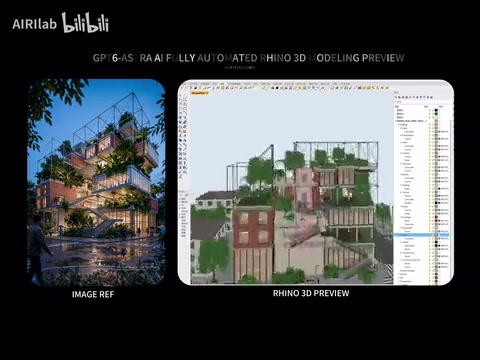
The entire modeling process took roughly 40 minutes, and the final output was described by Elstra as "an exceptionally complete result." For an architectural model autonomously generated by AI, this level of finish is remarkably impressive — reaching what he called "schematic design depth" — something he never explicitly requested in his prompts.
Automated Handling of Layers and Structural Relationships
One of the most noteworthy details in this test was the model's ability to organize layer and structural information. Elstra pointed out that the AI proactively categorized different object types into the correct layers throughout the modeling process, with the structure-related layer relationships being "entirely correct." This means that any subsequent manual editing would flow smoothly, rather than having to untangle a chaotic pile of overlapping geometry.
For anyone familiar with architectural 3D modeling, layer management is often the most easily overlooked aspect — yet it directly impacts collaboration efficiency. The AI's ability to handle this step automatically suggests its understanding of architectural logic goes well beyond simple geometry generation.
Self-Correction of Incomplete or Inaccurate Reference Information
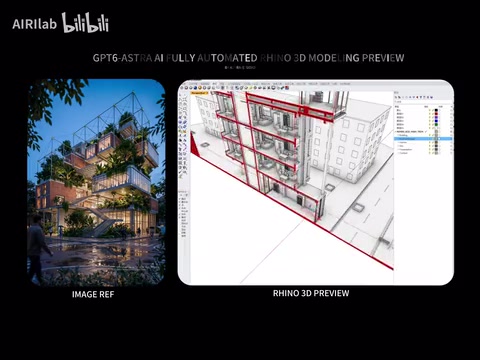
Even more interesting was the issue with the reference images themselves. Elstra candidly admitted that some of the structural relationships in the reference images he provided were inaccurate. This raised the bar considerably: the AI couldn't simply replicate the errors — it needed to exercise judgment based on sound architectural logic, proactively correct the mistakes, and generate the proper construction.
The results showed that the model did exactly that. The structural relationships within the building interior were also handled well, with vertical surface layering clearly visible through section cuts. This ability to "error-correct while modeling" is a key indicator of whether an AI truly understands architectural logic, rather than mechanically assembling shapes.
In mainstream architectural 3D modeling software (such as Rhino, Revit, and SketchUp), layers are the fundamental unit for organizing geometric objects. Professional workflows typically require placing walls, floor slabs, structural columns, curtain walls, interior partitions, and other components on separate layers, identified by agreed-upon naming conventions. When layer relationships are disorganized, downstream tasks — such as construction drawing output, render layer separation, and structural coordination — all generate significant rework. Traditionally, sensible layer assignment relies on the modeler's understanding of architectural professional logic and years of accumulated experience. An AI that can automatically handle this step without explicit instruction has internalized a kind of "architectural common sense," rather than simply executing geometric transformation commands.
The Capability Ceiling Has Yet to Be Reached
The original intent of this test was to find the model's ceiling through a more complex project. But Elstra's conclusion was that the current case "still isn't complex enough to hit that ceiling." In other words, the model's actual capabilities may far exceed what this test was able to reveal.
He mentioned that the next test will use an even more complex, larger-scale case to keep pushing the boundaries of what Astra can do. This incremental stress-testing approach also makes the series more valuable as a reference — rather than a one-off showcase, it's a sustained effort to approach the model's true upper limit.

A Background-Invoked Skill Reveals the Value of Methodology
At the end of the video, Elstra added a telling correction. He revealed that the project generated in the previous episode wasn't actually completed with a single prompt alone. He had originally intended to test the model's "bare" modeling capability without invoking any skill — but only discovered afterward that the AI had quietly called up a skill he had previously saved in the background, which is what made the results look so impressive.
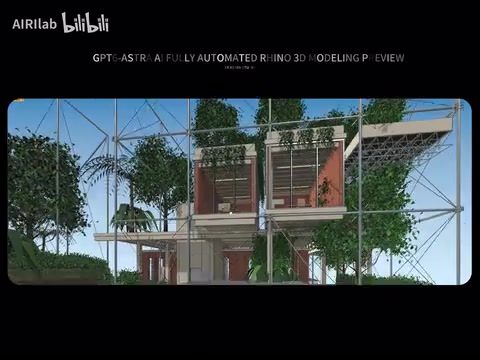
This "accidental" discovery actually delivers an important insight: even as AI models grow increasingly powerful, the accumulation of methodology-level skills remains critically important. A tool's raw capability cannot replace the encapsulation of process and experience — reusable methodologies remain a key variable determining output quality.
The "skill" here refers to a pre-saved, encapsulated instruction set or operation template within an AI workflow — similar to a macro or prompt preset, containing parameters for a specific modeling style, layer naming conventions, component breakdown logic, and other experiential settings. Users can lock in a workflow that has been refined through multiple iterations into a skill and reuse it directly in future tasks. The core value of this mechanism is that it allows the methodology accumulated by an individual or team to continuously deliver results in a reproducible way, rather than resetting with every new conversation. Whether or not a skill is invoked can cause a significant difference in output quality — which is exactly why this "accidental invocation" made the previous episode's results look so exceptional.
Conclusion
Based on this test, GPT-6 Astra demonstrates a comprehensive understanding of layer organization, structural logic, and even information error-correction in automated 3D modeling — and its performance ceiling has yet to be reached. Meanwhile, the behind-the-scenes skill invocation incident reminds us that even as AI capabilities evolve at a rapid pace, human accumulation and reuse of methodological knowledge remains an irreplaceable part of the equation. The results of the next, more ambitious test are well worth watching.
Related articles

Cursor AI Programming in Practice: Build a Student Management System from Scratch in 30 Minutes
A Bilibili creator demonstrates Cursor AI programming: generating a student management system in 30 minutes with natural language. Details on Agent mode, Claude selection, prompt techniques, and thresholds.

Top 20 AI Coding Tools Ranking: From Rock-Solid to Lackluster, a Scored Matrix
Bilibili creator releases top 20 AI coding tools ranking, tiered T0–T4 from rock-solid to lackluster, with Claude Code and Codex tied at T0. This article details the scoring dimensions (capability, reliability, robustness, durability, cost, domestic availability) and tool performances to help developers choose the right AI coding assistant.

Vibe Coding Systematic Tutorial: Master AI-Assisted Programming from Zero
A three-month Vibe Coding tutorial from a Bilibili creator covering Codex, ClaudeCode, and Cursor, from core logic to commercial project practice for beginners.