GPT-6 Goes Free for 1.2 Billion Users — The Rules of the AI Race Have Changed

OpenAI makes GPT-6 free for all, signaling AI competition has shifted from model power to user scale.
OpenAI has opened its flagship GPT-6 model to regular users for free, with paying users accessing GPT-6 SO and free users getting the lightweight GPT-6 LUNA. The new version supports chart generation, interactive forms, and mini apps directly in the chat interface, with streaming output for faster response. The strategy closely mirrors China's Doubao — free first, monetize later. The core thesis: the global AI race has shifted from a parameter arms race to a battle over who can become users' indispensable daily tool at the lowest cost. Note: some product names are unconfirmed.
OpenAI's Free Strategy: Flagship Model Reaches Everyday Users
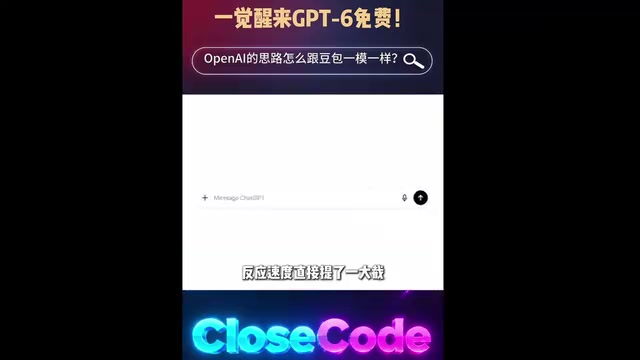
According to a report by a Bilibili content creator, OpenAI recently made a striking decision — opening its latest flagship model, GPT-6, to a massive user base at no cost. Previously, GPT-6 had been exclusive to paying subscribers, with virtually no access path for regular users. Under the new arrangement, OpenAI has launched two product tiers: paying users get the full-featured GPT-6 SO, while free users can access the lightweight GPT-6 LUNA.
This kind of tiered strategy isn't new, but pushing flagship-level capabilities down to the free tier represents a clear shift in how OpenAI is positioning its products. The free version may be lightweight, but it's more than sufficient for most everyday use cases. The signal here is clear: OpenAI is no longer treating model capability as the sole paywall. Instead, it's prioritizing scale and usage frequency.

Beyond Chat: Charts, Interactive Forms, and Mini Apps
This upgrade isn't just an incremental improvement to text capabilities. According to the source material, the new GPT-6 can handle significantly more complex tasks directly within the chat interface — generating charts, processing data, building interactive forms, and even producing simple mini applications. The chat window is evolving from a plain-text interface into a lightweight productivity workspace.
From a user experience perspective, these capabilities matter because they shorten the path from idea to finished output. Previously, users had to copy AI-generated content into other tools for further processing. Now, many lightweight tasks can be completed end-to-end within the same interface. For everyday users, this lowers the barrier to entry; for OpenAI, it deepens product stickiness.

Faster Response Times
Another improvement that's easy to overlook but has a strong impact on perceived experience is how responses are delivered. The source material notes that answers are now streamed progressively as they're generated, rather than making users wait for the full response to load. Streaming output paired with faster inference directly shapes users' gut feeling of whether a product is "good" — and that often matters more than raw parameter counts when it comes to retention.
Streaming Output refers to a delivery method where the server pushes generated content to the client incrementally as it's produced, rather than waiting for the full computation to complete before returning a response. For large language models, since inference is inherently token-by-token, streaming adds virtually no extra computational overhead while dramatically improving perceived latency. Psychological research shows that users are far more sensitive to "Time to First Token" than to total completion time — seeing content begin to appear makes users subjectively feel the system is fast, even if the total time hasn't changed. This is why streaming output has become a standard feature in mainstream AI chat products, not an optional one.
Mirroring Doubao: Scale First, Monetize Later
The most telling aspect of this shift isn't the technology itself — it's OpenAI's business playbook. The content creator observed that OpenAI's approach closely mirrors that of China's Doubao: use free access to push user scale to its ceiling, then figure out monetization.
At the height of competition, Chinese AI companies burned cash aggressively to capture distribution. Doubao was first to crack 100 million daily active users. Now OpenAI, after taking a very different path, has arrived at the same strategy. This convergence is worth reflecting on: as the technology gap narrows, the logic of user acquisition becomes remarkably similar. Going free isn't generosity — it's a carefully calculated battle for the entry point.

Doubao is ByteDance's AI assistant product, launched in the second half of 2023. It grew rapidly by leveraging ByteDance's existing traffic ecosystem — including Douyin and Toutiao — and maintained a completely free policy for individual users. According to third-party data, Doubao surpassed 100 million daily active users in 2024, making it one of the fastest-growing AI applications in China. ByteDance's logic: use a zero-marginal-cost free strategy to capture user mindshare, accumulate behavioral data at scale, and then monetize through advertising, enterprise services, or premium subscriptions. This playbook mirrors the early growth trajectories of WeChat and Douyin — Chinese internet companies have refined "scale first, monetize later" into a mature competitive template. OpenAI's pivot is, in essence, an attempt to transplant this methodology into the global AI market.
The Underlying Logic of the AI Race Is Shifting
The core argument in the source material is this: the fundamental logic of the global AI race has changed. "The biggest model no longer wins automatically" — the era of simply stacking parameters and topping leaderboards is fading. The real moat is now about who can make AI an indispensable part of users' daily lives at the lowest possible cost.
This argument holds up. Once multiple players' models reach a "good enough" threshold, users won't pay for marginal performance differences. They'll gravitate toward lower-cost access, smoother experiences, and richer application scenarios. In other words, the competitive axis is shifting from "how powerful is the model" to "how usable is the product and how wide is its distribution."
From this perspective, making GPT-6 free isn't just a product decision by OpenAI — it's a snapshot of a broader strategic turn across the industry: from a technological arms race toward a competition for user scale and ecosystem distribution. Whoever first occupies the "something I use every day" slot in users' minds holds the initiative in the next phase.
Closing: The Long Game Behind "Free"
It's worth noting that the content above draws primarily from a single source, and some details — including the specific product names GPT-6 SO and GPT-6 LUNA — have yet to be confirmed by official announcements. But setting aside the specifics, the trend this episode reveals is clear: the center of gravity in AI competition is moving from model capability toward user scale and cost efficiency.
Free access is never the end goal — it's the opening move. Once 1.2 billion users are brought into the free tier, the real question becomes: how do you monetize without losing them? That's the long-term challenge that will truly test OpenAI and every other AI company in the field.
Related articles

GitHub Daily · October 23: Agent Runtimes and Skill Libraries Surge on the Same Day
NVIDIA open-sources OpenShell, a Rust security runtime for autonomous agents; Claude-Red turns security methodology into SKILL.md skills; VoxCPM2 drops the tokenizer.

Build an AI Super Employee System at Zero Cost: A Full Breakdown of Automated Agent Workflows
A deep breakdown of the AI super employee system demoed on Bilibili: agent orchestration, digital human voiceovers, map and enterprise lead generation, 24/7 customer service, and legal modules. We analyze the business logic and compliance risks behind zero-cost signup to help entrepreneurs judge the real ROI of this AI digital employee system.

The Essential Difference Between Chatbots and AI Agents: Crossing from Conversation to Execution
What's the difference between a chatbot and an AI agent? Based on the MCP series on the Learn Tech channel, this article uses examples like booking flights and summarizing notes to explain: a chatbot only gives answers, while an agent actually completes tasks through a think-act-observe loop. It breaks down the four core components—model, tools, memory, and goal—as well as MCP's role as a bridge, and discusses agents' applicable boundaries and permission risks.